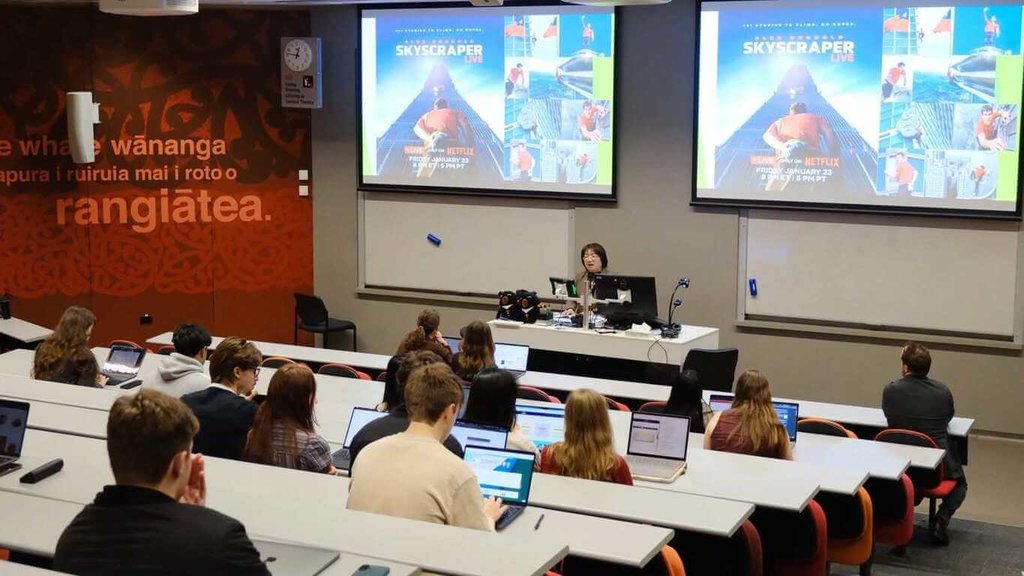
Chen Yung-shao, Director-General of the Taipei Economic and Cultural Office in Auckland, was invited to deliver a speech yesterday at the University of Auckland. She explained Taiwan's importance to the Indo-Pacific region and the international community from the perspectives of strategic security, global supply chains, and democratic development, and exchanged views with students on issues such as cross-strait relations and US-China relations.
In a press release issued by the office, Chen pointed out that Taiwan is located at the core of the First Island Chain, at the junction of Northeast and Southeast Asia, and is one of the world's most important maritime shipping lanes, with over half of all global container shipping passing through the waters around Taiwan. She quoted US General Douglas MacArthur, who once described Taiwan as an "unsinkable aircraft carrier," to illustrate Taiwan's significant strategic position in maintaining Indo-Pacific security and the regional balance of power.
Chen mentioned that Taiwan is also a critical hub in the global technology supply chain, currently producing 92% of the world's advanced chips and about 70% of AI servers, holding a leading position in the semiconductor, ICT, and high-tech industries.
She noted that as countries around the world are actively reducing their dependence on China and reorganizing global supply chains, Taiwan has become an important partner for democratic nations in promoting supply chain resilience and the layout of non-red supply chains.
Chen emphasized that Taiwan's importance to the international community is due to its position at the core of the First Island Chain, its control over key global technology supply chains, and its role as a model of a democratic society. "Even after facing long-term authoritarian pressure, Taiwan has remained free and prosperous, and continues to deepen its democratic politics."
Chen mentioned that Taiwan completed its democratic transition after a period of authoritarian rule and has since undergone multiple peaceful transfers of power between political parties. It is the only mature and fully functioning democracy in the Mandarin-speaking world, proving that a democratic system can successfully take root and develop stably in a Chinese society.
She warned that in recent years, China has continued to exert pressure on Taiwan through military, diplomatic, economic, cyber, and legal warfare. China also misinterprets UN Resolution 2758, conflating its "One China Principle" with the "One China Policies" of various countries, in an attempt to isolate Taiwan by distorting facts and thereby change the status quo in the Taiwan Strait. She stressed that the People's Republic of China has never ruled Taiwan, Resolution 2758 does not mention Taiwan, nor does it authorize China to represent Taiwan internationally.
Chen stated that in the face of Chinese pressure, Taiwan has always remained calm, pragmatic, and resilient, continuing to strengthen its national defense and social resilience, diversify its markets to reduce economic dependence on China, and deepen cooperation with like-minded countries.
Chen also said that Taiwan has always been a defender of the peaceful and stable status quo in the Taiwan Strait. Conversely, China's frequent military exercises in recent years, its denial of the Taiwan Strait median line, and its claims that the Taiwan Strait is not international waters are the true sources of regional instability and attempts to change the status quo. "Peace and stability in the Taiwan Strait are not just in Taiwan's interest, but are also crucial for Indo-Pacific security, international shipping, and the normal functioning of the global technology supply chain. It should never be sacrificed or traded."
After the speech, students asked about the future direction of cross-strait policy under a potential Trump presidency, whether Taiwan is worried about being isolated by the international community, and how it would respond if China further escalates military and economic pressure. Chen responded that maintaining the status quo in the Taiwan Strait aligns with the core interests of the United States and the international community, and has long received bipartisan support in the US. She added that the G7 and many other countries have issued joint statements continuously emphasizing the importance of maintaining peace and stability in the Taiwan Strait, showing that this has become a strong international consensus.
FACT BOX
- Source: CNA (Central News Agency)
- Category: 國際
- Organizations: University of Auckland