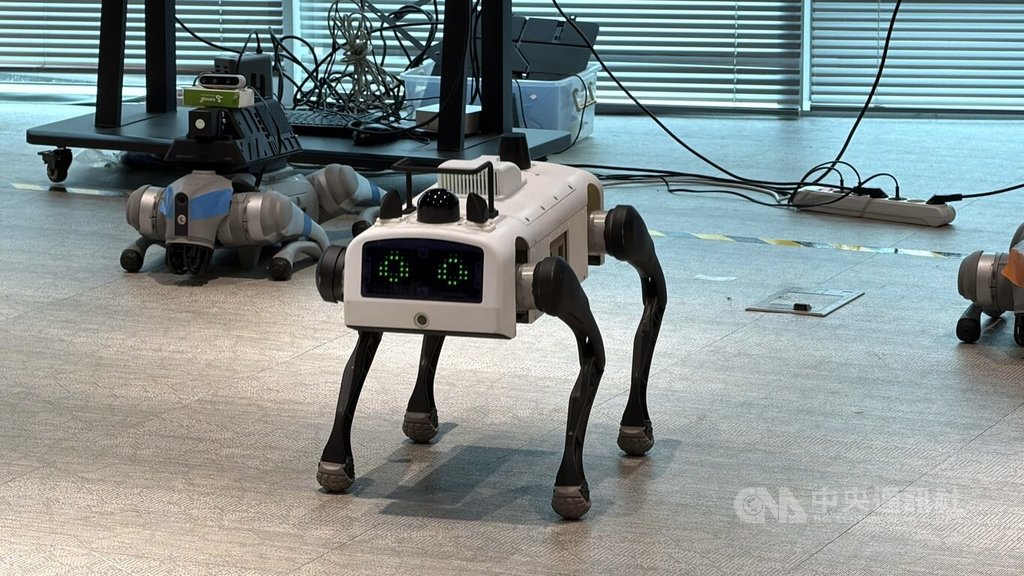
(CNA, Seoul, 21st) South Korea is committed to developing its AI industry, with notable projects including the quadruped robot Jindo Bot developed by startup Maum AI for patrol and equipment inspection functions. Additionally, the Central Veterans Hospital is developing advanced medical equipment integrated with AI. South Korea's Ministry of Science and ICT and Ministry of Patriots and Veterans Affairs today introduced the development of Physical AI technology to foreign media. This included the Korean-produced quadruped robot Jindo Bot, developed by Physical AI startup Maum AI, and the use of wearable medical devices at the Central Veterans Hospital (similar to Taiwan's Veterans General Hospitals). Jindo Bot comes in four versions for different functions, with weights of 15kg, 35kg, 64.1kg, and 13kg. It can be used for internal facility patrols, long-distance outdoor patrols, intrusion detection, logistics support, and equipment inspection. It can also be applied in disaster sites and the defense sector, with a market launch being planned. Maum AI bluntly stated, "These challenging real-world sites are the next AI battlefield." Maum AI CEO Ryu Tae-joon said, "The definition of Physical AI is often unclear right now, and many people think that any moving robot is Physical AI." He pointed out that automated robots are already used in factories, but they can be moved simply by inputting coordinates. Regarding Physical AI, Ryu noted that after an AI model is built, it can continuously collect data. "Just as a human infant cannot grasp things on its own but learns to do so through repeated practice, Physical AI is like a person; it involves training a robot that initially knows nothing." Separately, the Central Veterans Hospital is promoting more efficient medical services based on AI and digital technologies, including AI endoscopy and a cardiovascular disease diagnostic support system. The hospital's rehabilitation center uses a 3D motion analysis system and rehabilitation robots to analyze patients' movements and provide customized treatment based on their individual conditions. Seo Seok-in, Head of the Planning and Coordination Office at the Veterans Hospital, stated that it will still take some time for the medical field to fully adopt Physical AI, as it currently serves mostly as a tool to assist physicians' diagnoses. However, the hospital has introduced various advanced devices, including a walking robot in the rehabilitation center that can support patients unable to walk independently, allowing them to practice.
FACT BOX
- Source: CNA (Central News Agency)
- Category: 產業
- Organizations: Maum AI
- Products / services: Jindo Bot