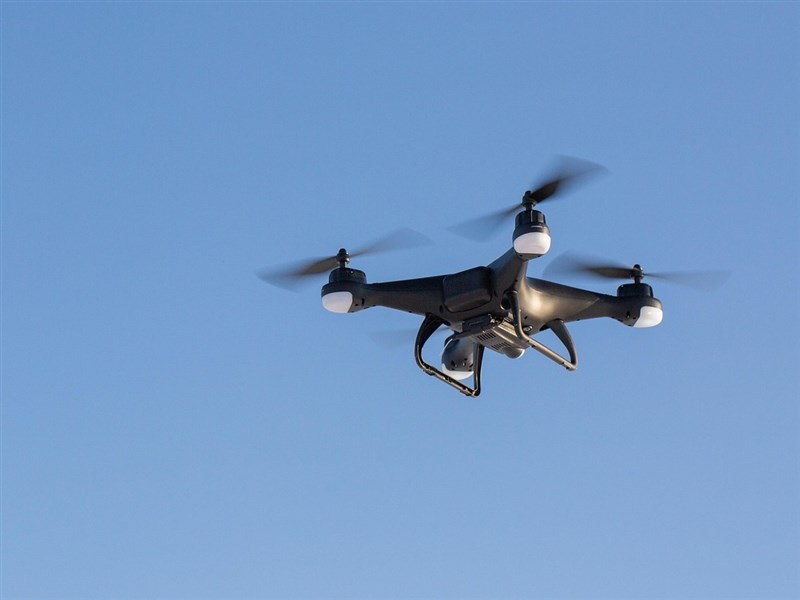
Taiwan's drone export value in the first quarter of this year has already surpassed the total export value for all of last year, indicating the rapid growth of the drone industry. The Ministry of Economic Affairs (MOEA) stated today that it estimates Taiwan's drone industry output value will exceed the originally set target of NT$40 billion by 2030. By then, the monthly production capacity for complete drones is expected to increase significantly from the current 15,000 units to 100,000 units. Regarding the export ratio, the MOEA hopes to increase it from the current level of about 20% to 50% by that time, and through economies of scale, to narrow the price difference between military-commercial drones and Chinese products to within a factor of two. Chiou Chyou-huey, director general of the MOEA's Industrial Development Administration, stated during a media exchange today that under the "Unmanned Vehicle Industry Development Coordination Program," Taiwan's drone output value already grew 2.5 times last year to NT$12.9 billion. The export performance in the first quarter of this year has surpassed last year's total. If the output value successfully doubles to NT$26 billion this year, the original 2030 target of NT$400 billion "should be adjustable upwards." Chiou pointed out that Taiwan's current monthly production capacity for complete drones is about 15,000 units. However, the drone industry can rapidly replicate and expand production lines. As long as market demand increases, production can be significantly boosted within a few months. Therefore, it is estimated that by 2030, the monthly production capacity for complete drones could exceed 100,000 units, establishing a sufficient economy of scale. Chiou said that at this stage, Taiwan's drone industry is still dominated by the domestic market, especially with military-commercial products accounting for a large share. The export ratio is just over 20%, with the top three export markets being the Czech Republic, Poland, and the United States. He did not rule out that the demand from the Czech Republic and Poland is related to the Russo-Ukrainian War. In the first four months of this year, drone export value reached US$147 million. The hope is to continue expanding exports and increase the export ratio to over 50% by 2030. Regarding the competitiveness of Taiwanese drones versus Chinese products, Chiou noted that for consumer drones, China already has a massive scale and mature technology, so the price difference could be several times greater. However, by focusing on military-commercial products, which emphasize anti-jamming, autonomous flight, and reliability, the price difference between Taiwanese and Chinese products "has a chance to be narrowed to within a factor of two," further enhancing market competitiveness. Chiou stated that the current high cost of drone-related components is mainly limited by insufficient market scale. However, as the global drone market continues to expand, if the market scale is sufficient to attract companies, Taiwanese chips and key components will be competitive. He also emphasized that Taiwan's drone industry does not necessarily need to fully engage in the low-price competition market, such as for low-cost blades or drones in the ten-thousand-dollar NT range. Instead, it should focus on high-value-added areas, combining chips and AI applications to develop products with differentiated advantages. In terms of key drone components, Chiou said that development of "three chips and two software" technology is underway through the Industrial Innovation Platform and the A+ Enterprise Innovative R&D Quenching Program. This includes communication, flight control, and satellite positioning chips, as well as ground control and flight control software. Most projects are expected to complete development by the end of this year, moving towards technological autonomy and mass production goals. Furthermore, the Industrial Technology Research Institute (ITRI) has already signed a Green UAS authorization, evaluation, and service agreement with the Association for Uncrewed Vehicle Systems International (AUVSI) in the United States. Chiou stated that it is expected to pass US verification in June, after which companies can apply for Green UAS certification directly in Taiwan, shortening the time for products to enter the market. Regarding the deletion of the drone-related budget in the special defense budget by the Legislative Yuan, Chiou emphasized that as a member of the administrative team, the MOEA will align with the Executive Yuan's policy direction and continue to assist the domestic drone industry's development in various ways. For example, by releasing demand from domestic markets such as defense and public services to expand industry participation opportunities and accelerate industrial autonomy, while also continuing to help companies expand into overseas markets. Additionally, in response to media reports about suspected overlapping subsidies between the Industrial Development Administration and the National Chung-Shan Institute of Science and Technology (NCSIST), Chiou responded that each ministry has different roles and responsibilities. The MOEA is mainly responsible for R&D subsidies, while the Ministry of National Defense allocates budgets for procurement. For domestically produced products that are not yet mature, after the defense procurement unit proposes performance and functional requirements, companies can apply for R&D subsidies from the MOEA. The division of labor is clear, and there is absolutely no overlapping subsidy situation.
FACT BOX
- Source: CNA (Central News Agency)
- Category: 產業