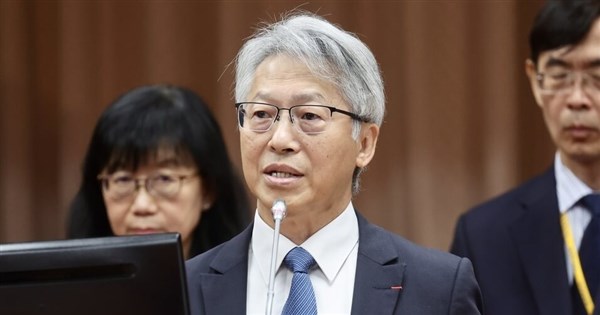
(CNA, Taipei, May 21) Academia Sinica President Liao Chun-chih stated in the Legislative Yuan today, in response to a question on "why not recruit" Sun An-tso (also known as Sun Kien-hao), son of entertainer Di Ying, that Academia Sinica does not conduct arms-related research, which might fall under the scope of the National Chung-Shan Institute of Science and Technology (NCSIST). Sun An-tso and a man surnamed Chen are suspected of testing a homemade flamethrower by a riverbank and posting a video of it. The Taiwan Shilin District Prosecutors Office's request to detain Sun incommunicado was approved by the Taiwan Shilin District Court after questioning. During a morning session of the Education and Culture Committee at the Legislative Yuan, Democratic Progressive Party Legislator Chen Hsiu-pao presented a media report quoting Di Ying asking, "Why doesn't Academia Sinica recruit (Sun An-tso)?" Liao responded that all of Academia Sinica's recruitment information is publicly disclosed, but some people might confuse Academia Sinica with institutions like NCSIST, which is more involved in arms-related work. Additionally, Kuomintang Legislator Ko Ju-chun stated that according to global benchmark research data, a researcher's annual salary is approximately US$90,000 (about NT$2.84 million) to US$160,000 (about NT$5.05 million), equivalent to about NT$240,000 to NT$430,000 per month. While the cost of living varies, the base salary for researchers at South Korea's national research institutions is also between NT$140,000 and NT$240,000. He said that a postdoctoral researcher at Academia Sinica starts at NT$64,000, and a full researcher starts at about NT$70,000. Including project grants, the monthly income can indeed exceed NT$100,000, but the gap compared to neighboring countries is still substantial. Liao stated that Academia Sinica has made many efforts to raise salaries and fully agrees that there needs to be a significant increase in compensation for researchers, from doctoral students to distinguished research fellows, to meet international standards; otherwise, talent cultivation and recruitment will face problems. He said that systematically, they are starting with what can be done first, like adjusting the academic research allowance for universities and Academia Sinica, which is simpler. A proposal to increase it by 15% was submitted to the Legislative Yuan in 2023 and approved, but it has been three years since the last adjustment, and "it should keep pace with the times." Liao stated that to persuade researchers to come to Taiwan under low-salary conditions, the research environment must also be strengthened. This includes whether society sufficiently respects researchers, funding that allows for long-term, substantive research—even challenging highly difficult problems—and providing encouragement when researchers fail, in order to attract talent. (Editor: Lee Ming-tsung)
FACT BOX
- Source: CNA (Central News Agency)
- Category: 政策