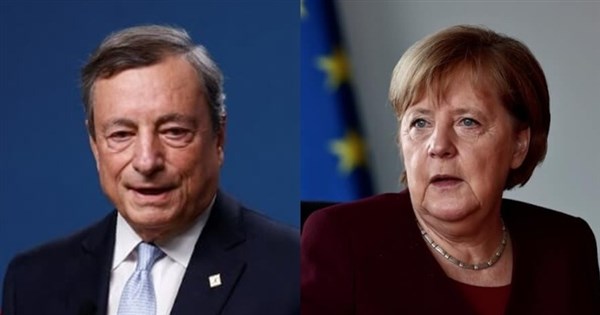
Amid growing calls to re-establish formal communication channels between the European Union and Russia, EU member states are discussing whether former European Central Bank President Mario Draghi or former German Chancellor Angela Merkel could represent the European side in negotiations with Russian President Vladimir Putin.
The Financial Times reports that, according to people familiar with the matter, EU foreign ministers will discuss the pros and cons of potential candidates at a meeting in Cyprus next week, with backing from both the United States and Ukraine.
Three sources revealed that with the Donald Trump administration currently focused on the war in the Middle East, it is not opposed to Europe engaging in a parallel dialogue with Russian President Vladimir Putin, even as the U.S. leads peace talks between Russia and Ukraine.
Ukrainian President Volodymyr Zelenskyy also recently stated, "All parties agree that Europe must be involved in the relevant negotiation efforts."
A high-ranking Ukrainian official indicated that Zelenskyy hopes for "someone like Mario Draghi" or "a capable current (national) leader" to lead the European negotiations with Russia.
After Russia's full-scale invasion of Ukraine in 2022, the EU promptly shut down its formal communication channels with Moscow, with only occasional attempts at contact by some EU leaders. However, with limited progress in the US-led Russia-Ukraine peace talks, the EU is concerned about being marginalized and potentially forced to accept a deal unfavorable to European interests.
This concern has led to growing calls within the EU to appoint a common envoy. Sources say that in addition to Draghi and Merkel, current Finnish President Alexander Stubb and former President Sauli Niinistö have also been proposed.
A spokesperson for Draghi declined to comment. Merkel's office has not yet responded to the Financial Times' request for comment.
A senior EU official said that while Niinistö "is one of the few Europeans who could maintain a working relationship with Putin... Russia is currently very unhappy with Finland." The Nordic country abandoned its policy of neutrality and joined NATO after the outbreak of the Russia-Ukraine war.
The official added, "I think the right person should come from a country like the Netherlands or Portugal, which doesn't have the (Eastern European) baggage."
Putin has expressed a willingness to engage in dialogue with a European representative, but on the condition that the appointed envoy "has never said any nasty things about Russia." He even named his old friend and Merkel's predecessor, former Chancellor Gerhard Schröder. However, his preferred candidate has been flatly rejected by the US, Europe, and Ukraine.
Sources say that the Russian side has conveyed that it would be more willing to engage in dialogue if Europe's response is more "constructive."
However, other reports suggest that the European side has "still not mentioned anything of value, saying only slogans like 'we support a just peace for Ukraine'."
One source added that Moscow might prefer to talk directly with a major European power rather than the entire EU, because "as the EU itself admits, the common position it ultimately compromises on to maintain the unity of its peripheral member states is often less than ideal."
FACT BOX
- Source: CNA (Central News Agency)
- Category: 國際