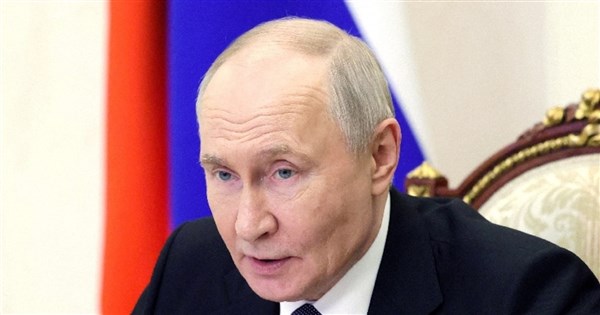
With the Russia-Ukraine war ongoing for over four years, Russian President Vladimir Putin's original goals, including taking full control of Ukraine, are becoming increasingly remote as Ukraine's combat power has been multiplied by drones. CNN reports that the United States should seize this opportunity to make Chinese President Xi Jinping understand that if he takes action against Taiwan, he will face a coordinated response.
The UK's Financial Times reported that Xi, during a meeting with US President Donald Trump last week, stated that Vladimir Putin might one day regret invading Ukraine.
Recent battlefield trends seem to confirm Xi's assessment. This presents a new opportunity for Trump to end the war through diplomacy, but the approach must be different from the past.
A CNN analysis indicates that Putin had originally expected that by 2026, Russian forces could leverage their superiority in force and numbers to break through the front lines and capture disputed territories in eastern Ukraine. However, this goal has not been achieved.
So far this year, it is Ukraine, not Russia, that has made territorial gains, while Ukrainian forces have also inflicted significant losses on the invading Russian troops.
Western countries estimate that Russia's monthly casualty count is near or exceeds 30,000 to 40,000, a staggering figure with no territorial progress. It is widely believed that since the invasion began, Russia's total casualties have far surpassed one million, and the rate of replenishing troops cannot keep up with the losses.
This pressure has begun to surface within Russia itself.
Amid soaring defense spending and worsening economic imbalances, a Russian member of parliament recently warned publicly that the Russian economy might not be able to sustain a long war indefinitely. Putin himself also recently stated that the war "may be nearing its end."
The CNN analysis suggests that today's Ukraine looks less like a defensive nation fighting for survival and more like a military innovator, reshaping warfare through the mass production of autonomous systems. This upends the initial assumption that Russia's sheer manpower advantage would decide the outcome.
Ukraine has established a 10- to 15-kilometer-long "kill zone" on the front lines, where any advancing Russian forces are exposed to relentless drone attacks.
Now, Ukrainian drones routinely strike targets deep inside Russian territory, including military airfields, factories, energy facilities, ammunition depots, and logistical hubs. It was reported that Putin was prompted to seek a temporary ceasefire during Moscow's May 9th "Victory Day" celebrations to prevent the parade from being disrupted by a sudden drone attack, as Ukrainian drones can now reach the Russian capital.
Russia's state news agency reported this week that Ukraine launched a large-scale drone attack near Moscow, indicating that Ukraine can now include Moscow within its strike range.
Putin's initial war aims at the time of the full-scale invasion included the complete submission of Ukraine, the weakening of the NATO alliance, and the restoration of Russia's status as a dominant Eurasian power. However, these goals are becoming increasingly unattainable for Moscow.
The current battlefield is concentrated in the Donbas region of eastern Ukraine, and it is now impossible for Russian forces to capture the Ukrainian capital of Kyiv—which was Putin's original objective.
Furthermore, with the accession of Finland and Sweden, NATO is now larger than it was when Russia launched its invasion. As member states increase their defense spending, NATO's strength has also grown.
Therefore, despite suffering huge and growing losses, Putin has achieved almost no tangible results in the Ukraine war, and the situation appears to worsen each month.
The significance of the report about Xi stating that Putin might regret invading Ukraine is not limited to the message it might send to Russia, but also lies in the lessons China might learn from the war itself and its intentions toward Taiwan.
Although Xi has ordered the People's Liberation Army (PLA) to be ready to take Taiwan by 2027, the PLA has not experienced actual combat, and the Russia-Ukraine war proves that it is not easy to quickly bring about a political collapse against a determined defender.
Over the next six months, Xi will carefully observe these trends and evaluate the pros and cons as he plans his ultimate strategy for Taiwan.
The United States has an opportunity to make Xi more cautious. In contrast, America's advantage lies in its relationships with allies and its ability to rally like-minded partners to defend each other and their common interests.
The wisest course of action now is to strengthen NATO's capabilities and its support for Ukraine, to make it clear to Putin that he cannot regain the initiative, and to make Xi understand that any action against Taiwan will be met with a coordinated response.
FACT BOX
- Source: CNA (Central News Agency)
- Category: 國際
- Organizations: CNN / Financial Times