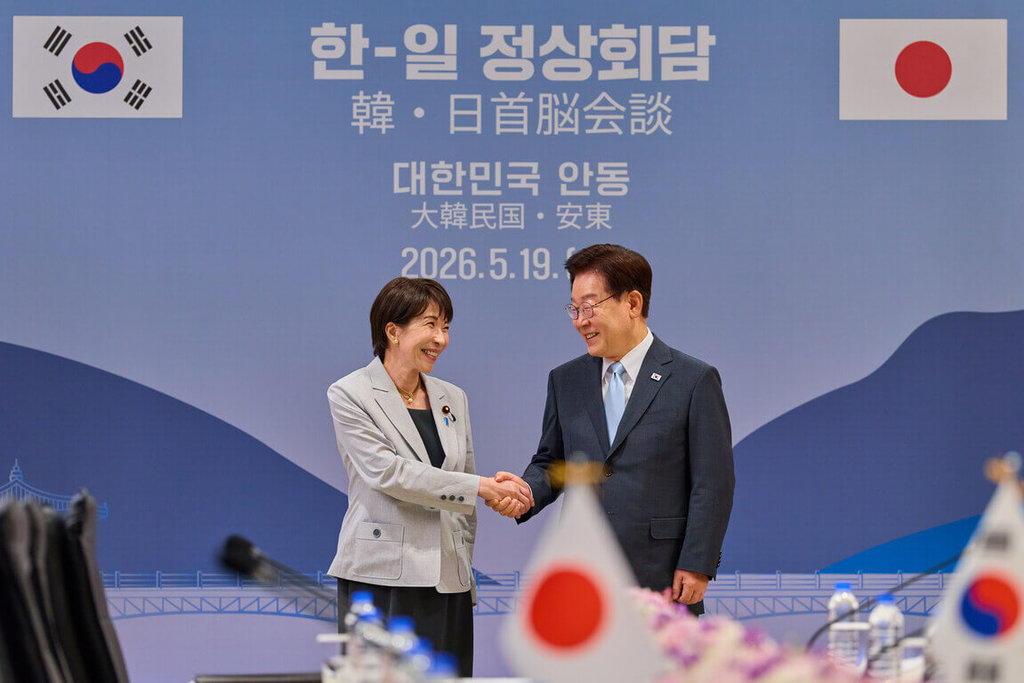
(CNA, Seoul, 19th) Japanese Prime Minister Sanae Takaichi visited Andong, the hometown of South Korean President Lee Jae-myung, today for a summit. Takaichi stated that amidst an unstable global situation, it is highly significant for Japan and South Korea to maintain close communication, and she emphasized the importance of Japan-ROK-U.S. security cooperation. Following the Japan-South Korea leaders' meeting, Takaichi said at a press conference, 'Last time, President Lee visited Nara in Japan. Through conducting shuttle diplomacy in each other's hometowns, I deeply feel that our friendship and relationship of trust have grown even stronger.' Takaichi also expressed her delight at visiting Andong, a place rich in tradition and culture, surrounded by beautiful nature. Takaichi mentioned that with the international community in turmoil and the global situation unstable, it is of great significance for the leaders of Japan and South Korea to continue close communication through shuttle diplomacy. Takaichi pointed out that the two sides frankly exchanged opinions on the situation in the Middle East and the Indo-Pacific region today. 'Both sides agreed that to promote stability, including ensuring the free and safe navigation of the Strait of Hormuz, each will continue its own efforts.' She stressed the importance of proactive efforts by both Japan and South Korea, including through the Japan-U.S. alliance, the ROK-U.S. alliance, and strengthening deterrence and response capabilities by maintaining strategic ties. Takaichi stated, 'Considering the current severe international environment, both sides agreed that strategic coordination, including Japan-South Korea and Japan-ROK-U.S. security cooperation, is extremely important.' Regarding the North Korean issue, Takaichi mentioned that the two sides also discussed responses to North Korea, including its nuclear and missile programs, and reaffirmed that Japan, South Korea, and the U.S. will work closely together. Japan and South Korea reached a consensus on two core issues. The first is to strengthen reserve capacity and energy supply in the Indo-Pacific region based on the 'Power Asia' partnership announced last month. The second is to enhance Japan-South Korea energy security through mutual accommodation and swap transactions of crude oil, petroleum products, and liquefied natural gas (LNG), and to jointly study concrete actions. In addition, the two sides also discussed cooperation in areas such as artificial intelligence (AI), transnational fraud, and security. Finally, Takaichi stated that for the peace and stability of the region and the international community, and to elevate Japan-South Korea relations to a higher level and expand the foundation of cooperation, they will continue to maintain close communication at all levels. She also said, 'Fortunately, there is no time difference between our two countries, so we promised this time to call each other often if we encounter difficult matters or have concerns regarding relations with other countries.' (Editor:
FACT BOX
- Source: CNA (Central News Agency)
- Category: 國際