News from the Central News Agency
(Central News Agency reporter Chen Yu-ting, Taipei, May 13th) Taipei City is strengthening its rodent control efforts. To track the effectiveness of its extermination measures, the Taipei City Department of Environmental Protection (DEP) is calling on the central government to establish a nationwide unified rodent monitoring model. Concurrently, the DEP will use an expanded cage trap method, tracking the number of active rat holes, and monitoring reported cases as bases for estimation.
The Taipei City Department of Environmental Protection held a press conference today to launch its Community Rodent Detection Service, announcing that starting May 15th, residents can download the "Community Rodent Detection Service Application Form" from the DEP's official website and apply by mail, fax, or email.
Regarding whether a rodent monitoring model and other methods for tracking effectiveness will be established, DEP Commissioner Hsu Shih-hsun stated that after discussions with experts and scholars, since there is currently no nationwide unified method for calculating overall numbers, while researching and establishing a monitoring model, they will first use the expanded cage trap method, tracking active rat hole numbers, and reported cases as estimation bases.
The DEP explained that the cage trap method is a way to evaluate the effectiveness of rodent control in a specific area. It involves placing bait stations before and after control efforts to serve as a pre- and post-measurement for rodent capture, thereby determining the effectiveness of the control.
As for the processing capacity after the launch of the rodent detection service, Hsu Shih-hsun pointed out that based on current reported cases, the existing staff of over 80 disinfection team members, paired with 1 to 2 sanitation workers as assistants per person, will be sufficient.
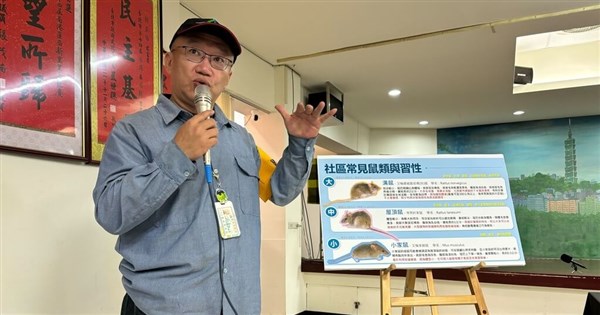
Kao Chien-fu, a rodent detection specialist and leader of the Taipei City DEP sanitation team's disinfection squad, stated that rodent control was originally one of his job duties. Typically, within a single household, it takes about two hours from rodent trace investigation, identifying the species, to explaining prevention methods; estimating for an entire community is more difficult.
Kao Chien-fu introduced three common types of rodents in communities. First, the roof rat, which most frequently invades homes. Its tail is longer than its body, it prefers vegetarian food like fruits and sweet potatoes, and it will settle down if it finds hiding places like ceiling spaces. "You won't catch them with meat in a trap."
The second type is the larger Norway rat, whose tail is shorter than its body, and it's not good at climbing. It often appears in sewers, garbage collection points, and traditional markets, having a mixed diet but preferring meat. The last type is the smaller house mouse, which likes to eat grains and is often mistaken for a young roof rat.
Kao Chien-fu stated that the key inspection points for rodent detection specialists include building openings, structural gaps near residences, and pipes and wires that can serve as vertical migration routes for rodents. This helps to understand rodent movement and hot spots of activity. At the same time, risk assessments are conducted for environmental factors like food source management and clutter accumulation, ultimately providing customized prescriptions based on diagnostic records. (Editor: Chang Ya-ching) 1150513
Choose to stand with facts; your every sponsorship is a force protecting press freedom.
Download the Central News Agency's "First-hand News" APP to stay updated with the latest news.
The text, images, and audio/video on this website may not be reproduced, broadcast, transmitted, or utilized without authorization.
FACT BOX
- Source: CNA (Central News Agency)
- Category: Taiwan
- Dates in source: 1150513