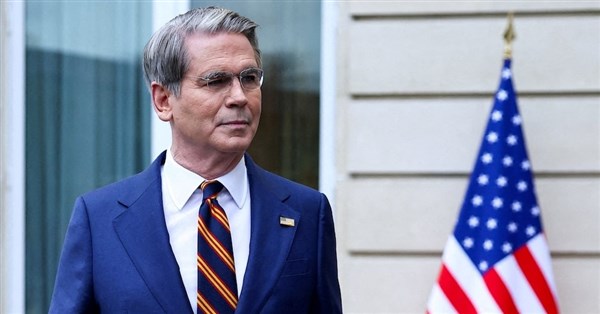
US Treasury Secretary: 301 Investigation to be Launched, Trump Tariffs Could Return to Original Levels as Early as July
US Treasury Secretary Scott Bessent stated that tariffs previously imposed by former President Trump, which were ruled unconstitutional by the Federal Supreme Court, could return to their original levels as early as July. This is expected to be achieved by launching or enforcing Section 301 investigations. Bessent emphasized that the authority of Section 301 has been validated by the courts, and businesses can consider this when planning capital expenditures. While the economic impact of the Middle East situation remains uncertain, the US economy is still robust, with a potential economic growth rate exceeding 3% to 3.5% this year.
📋 Article Processing Timeline
- 📰 Published: April 15, 2026 at 10:48
- 🔍 Collected: April 15, 2026 at 11:01 (12 min after Published)
- 🤖 AI Analyzed: April 15, 2026 at 17:49 (6h 47m after Collected)
Central News Agency
(Central News Agency, Washington, 14th, comprehensive foreign report) US Treasury Secretary Scott Bessent said today that many tariffs previously imposed by President Trump, which were ruled unconstitutional by the US Federal Supreme Court, are expected to return to their original tariff rates as early as July.
Bloomberg reported that Bessent said today at an event hosted by the Wall Street Journal in Washington: "Although our tariff policy hit a snag in the Supreme Court, we will launch or enforce Section 301 investigations, so the tariff policy is expected to return to its previous level by early July."
Bessent stated that since the authorization of Section 301 has been validated by the courts, business owners can plan for capital expenditures and make relevant decisions.
After the US Federal Supreme Court ruled at the end of February that US President Donald Trump had no right to impose global tariffs under the "International Emergency Economic Powers Act" (IEEPA), Trump is trying to use different legal authorizations to rebuild tariff barriers.
Bessent said that although it is difficult to judge when the impact of the Middle East war will "spill over" into the US economy, the US economy remains strong, and he believes that "this year's economic growth rate is still expected to exceed 3% to 3.5%."
He added that excluding volatile energy and food prices, core inflation continues to fall, which is a positive signal.
Bessent said: "I think the US Federal Reserve (Fed) made a mistake in judging inflation, and core inflation is falling. I understand they want to wait for clearer data, but that means interest rates should have more room for reduction."
Although the March report showed a slowdown in core inflation, the overall Consumer Price Index (CPI) after accounting for oil prices still showed a significant increase. (Compiled by Zhang Mingxuan) 1150415
Choose to stand with facts, every sponsorship is the power to protect press freedom.
Download the Central News Agency 'First-hand News' APP to stay updated with the latest news.
The text, images, and videos on this website may not be reproduced, publicly broadcast, or publicly transmitted and used without authorization.
(Central News Agency, Washington, 14th, comprehensive foreign report) US Treasury Secretary Scott Bessent said today that many tariffs previously imposed by President Trump, which were ruled unconstitutional by the US Federal Supreme Court, are expected to return to their original tariff rates as early as July.
Bloomberg reported that Bessent said today at an event hosted by the Wall Street Journal in Washington: "Although our tariff policy hit a snag in the Supreme Court, we will launch or enforce Section 301 investigations, so the tariff policy is expected to return to its previous level by early July."
Bessent stated that since the authorization of Section 301 has been validated by the courts, business owners can plan for capital expenditures and make relevant decisions.
After the US Federal Supreme Court ruled at the end of February that US President Donald Trump had no right to impose global tariffs under the "International Emergency Economic Powers Act" (IEEPA), Trump is trying to use different legal authorizations to rebuild tariff barriers.
Bessent said that although it is difficult to judge when the impact of the Middle East war will "spill over" into the US economy, the US economy remains strong, and he believes that "this year's economic growth rate is still expected to exceed 3% to 3.5%."
He added that excluding volatile energy and food prices, core inflation continues to fall, which is a positive signal.
Bessent said: "I think the US Federal Reserve (Fed) made a mistake in judging inflation, and core inflation is falling. I understand they want to wait for clearer data, but that means interest rates should have more room for reduction."
Although the March report showed a slowdown in core inflation, the overall Consumer Price Index (CPI) after accounting for oil prices still showed a significant increase. (Compiled by Zhang Mingxuan) 1150415
Choose to stand with facts, every sponsorship is the power to protect press freedom.
Download the Central News Agency 'First-hand News' APP to stay updated with the latest news.
The text, images, and videos on this website may not be reproduced, publicly broadcast, or publicly transmitted and used without authorization.
FAQ
When can former President Trump's tariffs return to their original levels?
They could return to their original levels as early as July.
Why are the tariffs returning to their original levels?
After being ruled unconstitutional by the Federal Supreme Court, the tariff policy is expected to return to its previous level by launching or enforcing Section 301 investigations.