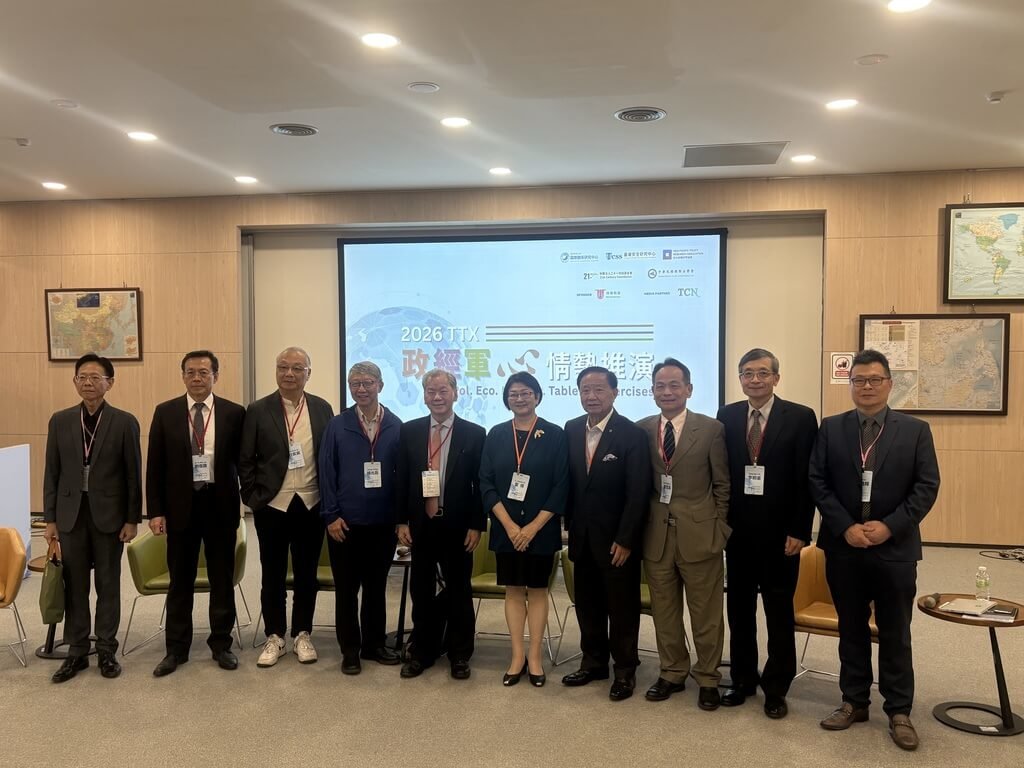
(Central News Agency, Taipei, April 16) The '2026 TTX Political-Economic-Military Simulation' concluded today. The organizers pointed out that the most prominent common conclusion from the two-day simulation was Taiwan's comprehensive test of military, economic, social, and technological resilience. Issues such as the narrowing strategic autonomy space for semiconductors are priority tasks that must be actively addressed before 2030.
The '2026 TTX Political-Economic-Military Simulation,' jointly organized by institutions including the National Chengchi University's Institute of International Relations, the Taiwan Security Research Center, and the Asia-Pacific Policy Research Association, was held from yesterday to today. The organizers released a press release this afternoon detailing the simulation process and results.
The organizers stated that yesterday's simulation focused on physical security, with Topics 1 and 2 focusing on grey zone scenarios, from PRC blockades of Kinmen and Matsu to coast guard vessels being forcibly towed and drone attacks. Each group directly confronted the real gaps in Taiwan's legal framework and rules of engagement. Topic 2 involved a frank debate on the legal space for preemptive self-defense. Topic 3 revealed Taiwan's multiple deficiencies in information and communication redundancy, wartime medical care, and infrastructure protection under a fifth column sabotage scenario.
The organizers mentioned that in Topic 4, the energy simulation, natural gas reserves were only 11 days under a blockade scenario, and the political tension surrounding nuclear power restarts remains unresolved, making it the most difficult topic to reach consensus.
The organizers explained that Topic 5, 'Economic Security,' held today, identified the top three gaps repeatedly pointed out during the simulation: the life insurance industry's overseas exposure exceeding US$700 billion, structural risks from cross-strait economic interdependence, and the lack of a cross-ministerial crisis coordination mechanism. Topic 6, 'Industrial Competitiveness and Economic Resilience,' highlighted that Taiwan's ICT exports account for nearly 80%, the wealth gap continues to widen, with the top 10% controlling nearly 50% of income, and Taipei's housing price-to-income ratio exceeding Hong Kong. Participants frankly stated that this is no longer just an issue of social equity but is the most fragile link in the security system.
The organizers pointed out that in Topic 7, 'Semiconductor and AI Strategy,' there are concerns that once TSMC truly becomes multinational, the divergence between its commercial interests and Taiwan's national strategy will be difficult to avoid. If the 'silicon shield' is gradually hollowed out, the incentive for the US to intervene in the Taiwan Strait may also weaken.
The organizers stated that the most prominent common conclusion from the two-day simulation was Taiwan's comprehensive test of military, economic, social, and technological resilience. The interconnected effects of all aspects are far more difficult to deal with than single risks. The absence of a crisis coordination mechanism, imbalances in industrial structure, and the narrowing strategic autonomy space for semiconductors are all priority tasks that must be actively addressed before 2030. (Editor: Lin Xingmeng) 1150416
Stand with the truth. Your sponsorship is the power to protect news freedom.
Download the CNA 'First-Hand News' APP for real-time updates.
This website's text, images, and videos may not be reproduced, broadcast, transmitted, or used without authorization.
FACT BOX
- Source: CNA (Central News Agency)
- Category: Survey
- Products / services: AI