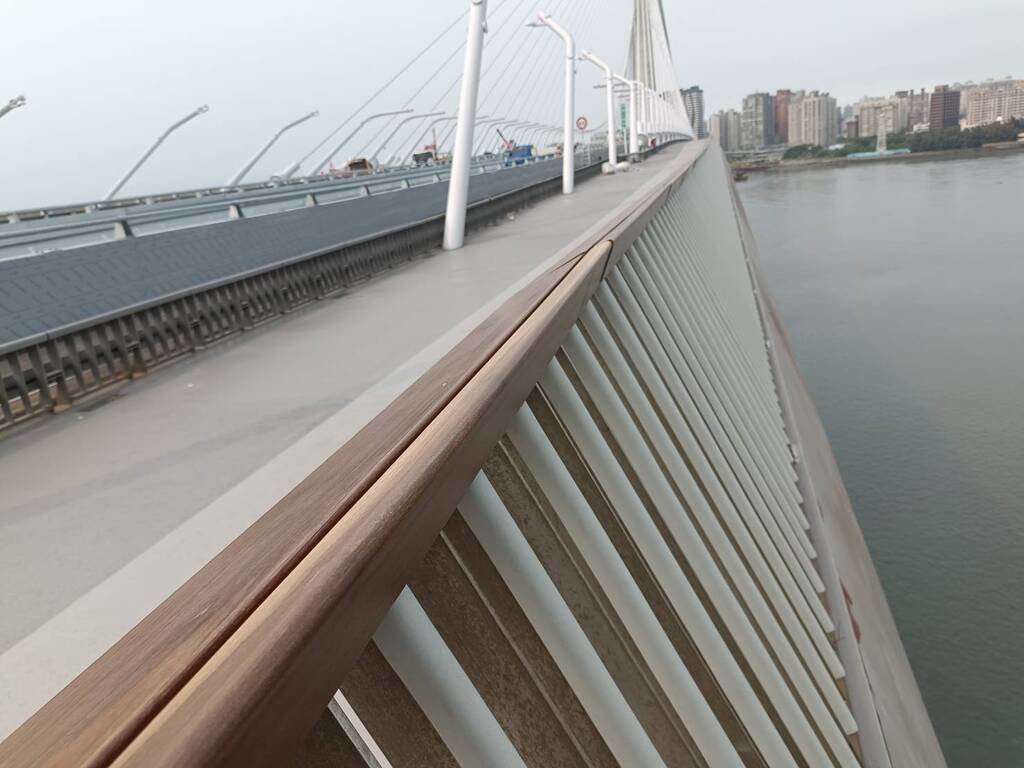
Central News Agency (CNA) -- (Reporter Huang Qiao-wen, Taipei, April 16) The Tamkang Bridge will open in May. Regarding the low-frequency wind noise caused by northeasterly winds, the Highway Bureau announced today that sound-dampening rubber strips have been installed on the outer side of the pedestrian and bicycle lane railings as a short-term improvement measure. The long-term solution will involve aluminum plate inserts, with completion expected by the end of August.
The Tamkang Bridge, connecting Tamsui and Bali in New Taipei City, has a main bridge length of approximately 920 meters and a main span of 450 meters, making it the world's largest single-pylon asymmetric cable-stayed bridge. It is scheduled to officially open on May 12.
Pedestrian railings on the Tamkang Bridge began installation in December last year and were largely completed in January this year. During northeasterly wind conditions, wind noise occurred under specific wind speeds and directions, with nearby residents recently complaining about the disturbance.
The Highway Bureau's Northern Region Highway Construction Branch, in conjunction with professional units, conducted on-site inspections and wind tunnel tests, immediately clarifying that the phenomenon was structural resonance occurring under specific wind speed and direction conditions.
After evaluating improvement methods through testing, and considering construction efficiency and improvement effects, the Highway Bureau's previously planned NT$11.5 million investment will be implemented in two phases: short-term and long-term. The short-term measure, the installation of sound-dampening rubber strips on the outer side of the 1200-meter upstream pedestrian and bicycle lane railings, was completed yesterday, effectively reducing the impact of wind noise on surrounding residents.
The Highway Bureau explained that it will continue to promote the long-term improvement plan to enhance overall durability and optimize improvement effects. The plan will involve aluminum plate inserts and is scheduled for construction after the bridge opens, with the goal of completion by the end of August this year.
Considering that the Tamkang Bridge is a design by the internationally renowned architect Zaha Hadid, possessing high aesthetic value, the Highway Bureau pointed out that, while ensuring the bridge's overall design is not compromised, short-term measures use materials similar in color to the railings. The long-term plan also incorporates overall landscape reviews and combines professional opinions from the international design team to ensure both functional improvement and aesthetic quality are maintained. (Editor: Guan Zhong-wei) 1150416 Stand with the facts. Your sponsorship is the power to protect news freedom. Download the CNA "One-Stop News" APP for the latest news. Text, images, and videos on this website may not be reproduced, publicly broadcast, transmitted, or used without authorization.
FACT BOX
- Source: CNA (Central News Agency)
- Category: Taiwan