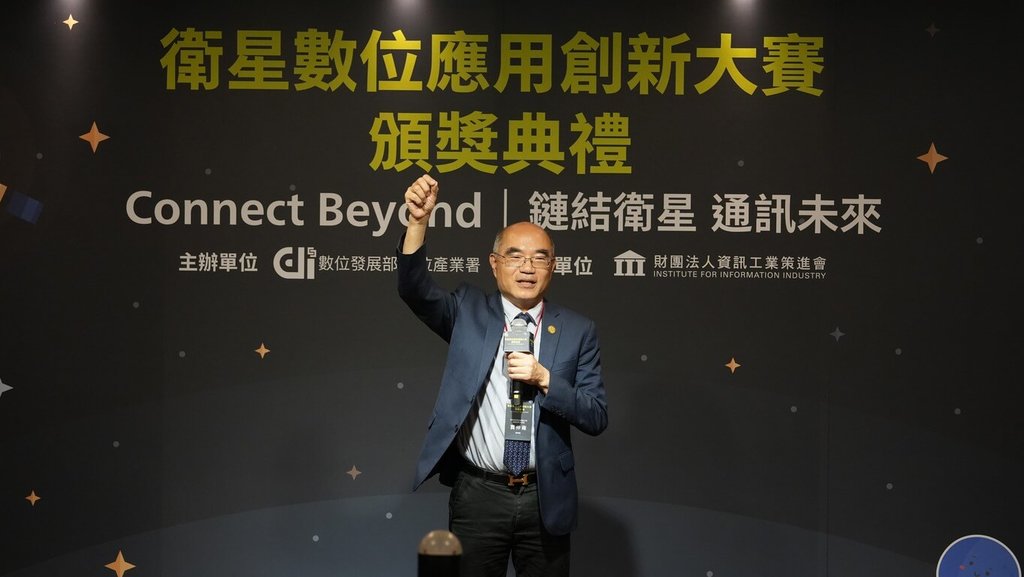
Taipei, April 14 (CNA) The results of the first "Satellite Digital Application Innovation Competition" were announced, with Chunghwa Telecom and Taiwan Mobile receiving awards. Chunghwa Telecom stated it is the only telecom operator in Taiwan with high, medium, and low multi-orbit satellite constellations. Taiwan Mobile integrated satellite-ground networks to create the PortShield-Sat system. Furthermore, low-orbit satellite Amazon Leo is expected to land in Taiwan, with rumors of a partnership with Far EasTone Telecommunications.
Since the launch of Taiwan's first "Commercial Satellite Application Laboratory" in early 2026, the government has collaborated with industry and startup teams to promote application implementation using asymmetric communication technology. The first "Satellite Digital Application Innovation Competition," organized by the Digital Industry Administration of the Ministry of Digital Affairs and executed by the Institute for Information Industry, announced its results. Five teams involving Chunghwa Telecom, leveraging their satellite communication capabilities and practical field applications, won the gold award and four special jury awards.
Chunghwa Telecom stated that as the only telecom operator in Taiwan with high, medium, and low multi-orbit satellite constellations, in addition to its existing high-orbit satellites, it obtained commercial licenses for OneWeb low-orbit satellites and SES O3b medium-orbit satellites last year. It also plans to strategically cooperate with the American satellite company Astranis, expecting to provide services in the second half of this year and launch Taiwan's first dedicated satellite. The application scope spans disaster relief, remote area connectivity, maritime and air communication, TV channel transmission, and IoT, becoming the strongest backing for the government and enterprises in developing resilient networks.
Chunghwa Telecom pointed out that the gold award-winning "Sky Sentinel" slope early warning system demonstrated technology for protecting mountain safety in extreme environments. Chunghwa Telecom also won four special jury awards, including: "Tribal Digital Twin Disaster Response System" combining AI modeling to strengthen disaster relief in remote areas; "OceanGuard Multi-Smart Cage Aquaculture Disaster Prevention System" solving communication blind spots at sea; "Formosa Constellation Smart Shield Network (F.S.S)" building a high-strength communication security shield; and "Guardian Digital Lifeline: Satellite/Mobile Communication Dual-Mode Internet" ensuring uninterrupted digital lifelines in extreme situations.
Taiwan Mobile led the "TNA Star Network Alliance," formed by AAEON Technology and Professor Ruey-Tang Wang's team from the Department of Electronics Engineering at National Taiwan University of Science and Technology, standing out among hundreds of teams and winning the gold award.
Taiwan Mobile stated that the award-winning PortShield-Sat Smart Harbor System implements a satellite-ground integrated network architecture, integrating low-orbit satellites, 5G networks, unmanned vehicles (UAV/USV), and AI technology to solve harbor monitoring blind spots and network outage risks. In normal operating conditions, the system can perform automated harbor monitoring, using AI smart recognition to instantly detect illegal mooring, unauthorized intrusion, or environmental pollution (such as oil spills), saving a large amount of inspection manpower. In the event of natural disasters such as strong earthquakes or typhoons that damage ground communication base stations, the system can immediately switch to low-orbit satellite links, achieving "zero blind spots, uninterrupted" communication.
Chu Hsiao-Hsing, Business Director of Taiwan Mobile's Enterprise Service Business, stated that Taiwan Mobile is deepening its non-terrestrial network (NTN) deployment and promoting the implementation of satellite-ground integrated network architecture. It has signed a "Memorandum of Understanding for Strategic Cooperation on Low-Orbit Satellite Communication Services" with AST SpaceMobile, where AST SpaceMobile will provide and operate low-orbit satellite mobile communication systems and technical resources, integrating with Taiwan Mobile's existing mobile network.
In addition, low-orbit satellite Amazon Leo is rumored to land in Taiwan. Far EasTone Telecommunications, holding the 28GHz frequency band required by Kuiper, is the most likely partner for operation, with services estimated to launch in Taiwan as early as 2027. Regarding the progress of the cooperation between Far EasTone Telecommunications and Amazon Leo, Far EasTone Telecommunications President Angela Hsiao-Ching Yi pointed out that they are currently awaiting good news. (Editor: Yang Kai-Hsiang) 1150414
FACT BOX
- Source: CNA (Central News Agency)
- Category: partnership