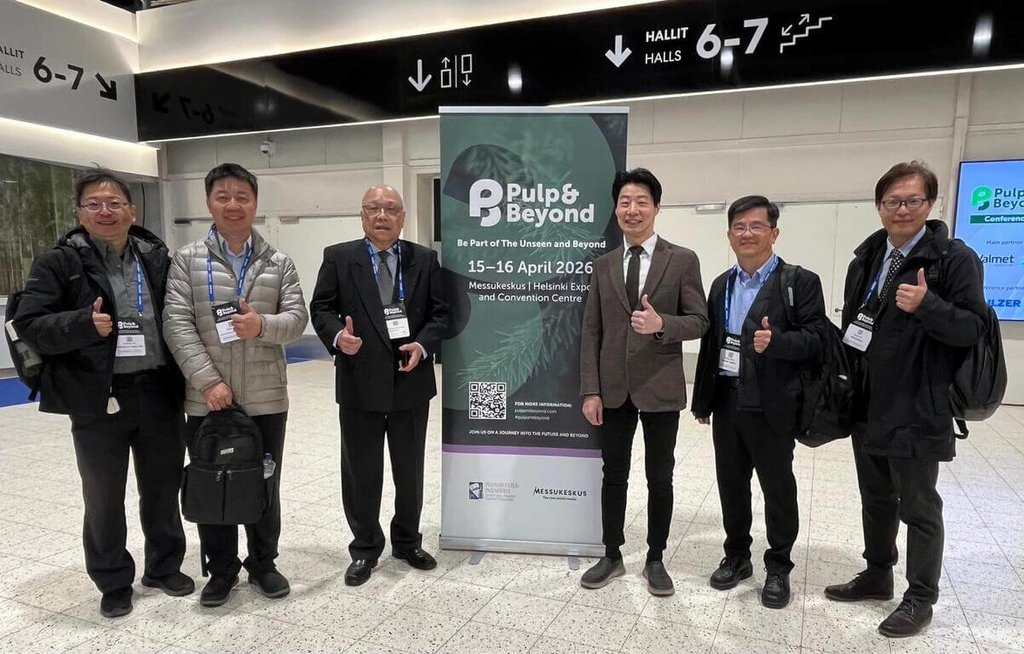
(Central News Agency reporter Wu Chi-lin, Helsinki, April 16) Wood turned into clothing, tree trunks refined into fuel. The "Pulp & Beyond" exhibition, showcasing pulp mills' chimneys capturing and reusing carbon dioxide, which opened this week, presents a face far removed from the traditional papermaking industry. A delegation of Taiwanese paper and pulp-related businesses visited, seeing in the forests a path of industrial transformation from paper to fiber, and from waste to energy, opening green business opportunities.
The exhibition runs from April 14th to 17th at the Messukeskus Helsinki Expo and Convention Centre, attracting over 8,000 participants from more than 50 countries, making it the largest annual event for the Nordic forest industry. Huang Kun-hsiung, Chairman of the Taiwan Paper Industry Association and Chairman of China Paper Corporation, led the delegation, accompanied by Chang Ching-ho, Chairman of the Chinese Pulp and Paper Technical Association, representing Taiwanese paper and pulp businesses.
Freddy Lim, Taiwan Representative to Finland, hosted the visiting delegation during a related forum, greeting them warmly in Taiwanese, which made the members who traveled from afar feel particularly close. He told CNA that bilateral trade between Taiwan and Finland reached $1.6 billion last year, three times that of the previous year, and this visit by traditional industry players is a microcosm of the rapid deepening of bilateral relations. The Representative Office will continue to serve as a bridge to elevate Taiwan-Finland business cooperation.
Huang Kun-hsiung told CNA that Finland, a global leader in the forest industry, has had ties with Taiwan's papermaking industry for over half a century, with close and continuous interaction in equipment procurement, technical exchange, and raw material trade. He pointed out that in the past decade, Finland has quietly moved in a direction that everyone overlooked: replacing oil with forests. The delegation also visited the Department of Pulp and Paper at Aalto University, where one-third of the curriculum now focuses on textile fibers, and another third on biochemical refining, setting the stage for the industry's future fifty years from now, beyond traditional papermaking techniques.
Huang Kun-hsiung stated that Finland leverages its forest resources, adding value to wood step-by-step, moving from pulp to textile fibers and then to biochemicals, with each stage significantly increasing added value. Finland, with a population of 5.5 million and inexhaustible forest resources, has surpassed Taiwan in GDP per capita, precisely by following this logic. While the traditional paper industry appears to be shrinking, its value is actually expanding as it moves towards fibers and energy.
Taiwan brings not only a learning perspective but also its own leverage. Huang Kun-hsiung emphasized that Taiwan is a global benchmark for recycling rates in metals, glass, and paper. The paper industry relies heavily on waste paper recycling, and the execution of the circular economy is already deeply embedded in the industry's daily operations. Fellow industry professionals also pointed out that Taiwan's papermaking technology is advanced in Asia and has strong implementation capabilities, making it a natural gateway for European green solutions to enter the Asian market. After introducing European technology, they are capable of disseminating this experience to emerging markets such as Vietnam and India. Solutions that work in Taiwan are applicable throughout Asia.
Chang Ching-ho, Chairman of the Chinese Pulp and Paper Technical Association, noted that the three main themes of this conference – AI integration in papermaking processes, circular economy and net-zero emissions, and innovation in wood-based new materials – precisely correspond to the most pressing upgrade directions for Taiwan's industry. "Our factories have basically achieved near-zero emissions in terms of circular economy, but how to elevate it further and achieve zero waste is why we are here to learn," he said. This time, the focus is on establishing connections with European businesses, especially in the context of global supply chain restructuring, seeking new cooperation opportunities.
The opening ceremony of this conference was presided over by Finnish Minister of Climate and Environment Sari Multala, with topics spanning AI-driven process efficiency, wood pulp for textile fibers, and carbon capture and storage, highlighting the rapid repositioning of the entire forest industry.
Huang Kun-hsiung mentioned that the uncertainty brought by US retaliatory tariffs has made Taiwanese traditional industry players re-evaluate the importance of the European market. "The biggest fear in business is uncertainty. Whether it's good or bad, once it's certain, you dare to move forward; the biggest fear is being stuck because you don't know if it's good or bad." In an era of uncertainty, it is time to deepen Taiwan-Europe industrial linkages. (Editor: Chen Cheng-kung) 1150416
Stand with the truth, and every sponsorship from you is a force to protect the freedom of the press. Download the CNA "First-Hand News" APP for real-time updates. The text, images, and videos on this website may not be reproduced, broadcast, or transmitted and used without authorization.
FACT BOX
- Source: CNA (Central News Agency)
- Category: partnership