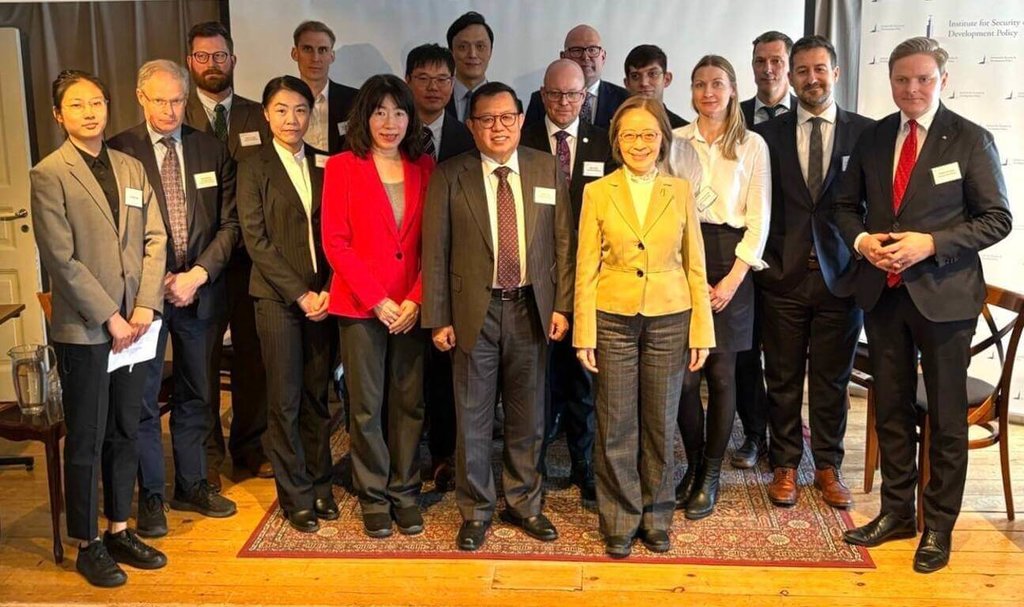
The 6th "Taiwan-Nordic Forum," hosted by the Swedish think tank "Institute for Security & Development Policy" (ISDP) on April 15th at "Sjöfartshuset" in Sweden, brought together experts from Taiwan and Nordic political and academic circles to discuss common challenges and how to enhance cooperation to build defense resilience. The forum, themed "Resilience as Defence," explored how Taiwan and Nordic countries (including the Baltic states), sharing common democratic values, can overcome threats from authoritarian regimes through enhanced cooperation, information sharing, and joint expansion and strengthening of their specialized fields. The organizing body stated in a press release that the forum focused on air and maritime security, with three discussion topics: "Taiwan and Nordic/European perspectives on critical maritime infrastructure," "The situation of airspace incursions in Taiwan and Europe," and "Cooperation in critical situations in Taiwan: geopolitical, economic, and technological perspectives." Yeh Fei-pi, Taiwan's representative in Sweden, delivered an opening speech, stating that authoritarian regimes are attempting to construct new international norms, and Taiwan faces continuous threats from China through sea, air, and cyberspace, as well as legal, cognitive, and psychological warfare. She said Taiwan seeks to achieve peace through strength by reinforcing security with three pillars: civil defense resilience, industrial cooperation, and national defense. The "Whole-Society Defense Resilience Committee" was established in June 2024 to build defense, civilian, disaster prevention, and democratic resilience, with strategies aimed at safeguarding sovereignty while promoting industrial innovation and global cooperation. Yeh Fei-pi pointed out that the partnership between Taiwan and Nordic countries is based on three foundations: their strategic role in defending democracy, economic and advanced technologies, and a firm commitment to shared democratic values. Cooperation areas include relevant information sharing, industrial cooperation, and "democratic supply chains." She added that both sides face issues of critical infrastructure damage, such as submarine cables, and Taiwan's Minister of Foreign Affairs, Lin Chia-lung, proposed the "International Submarine Cable Risk Management Initiative" (RISK) in October 2025, urging democratic countries to collectively enhance critical infrastructure resilience through Risk mitigation (R), Information sharing (I), System reform (S), and Knowledge building (K). Taiwan and Nordic countries can also strengthen cooperation to counter foreign information manipulation in the face of cyberattacks and disinformation. The forum discussed the importance of establishing a systematic cooperation model in the rapidly changing maritime security landscape between Taiwan and Nordic countries, with experts emphasizing that existing legal frameworks are outdated and inconsistent in key areas, allowing foreign vessels opportunities to enter and cause damage. Regarding airspace security, experts discussed the growing importance of drones and their increasing use in gray zone operations, indicating that knowledge and information exchange will become more crucial. Taiwan and Nordic countries should enhance cooperation in drone defense systems, information sharing, and even space. ISDP stated that the forum demonstrated that cooperation is the strongest way to build common defense, and that Taiwan and Nordic countries share common values and democratic beliefs, requiring not only institutional cooperation but also people-to-people exchange, academic engagement, and a willingness to learn from each other. (Editor: Chang Chih-hsuan) 1150418
FACT BOX
- Source: CNA (Central News Agency)
- Category: Event
- Organizations: ISDP