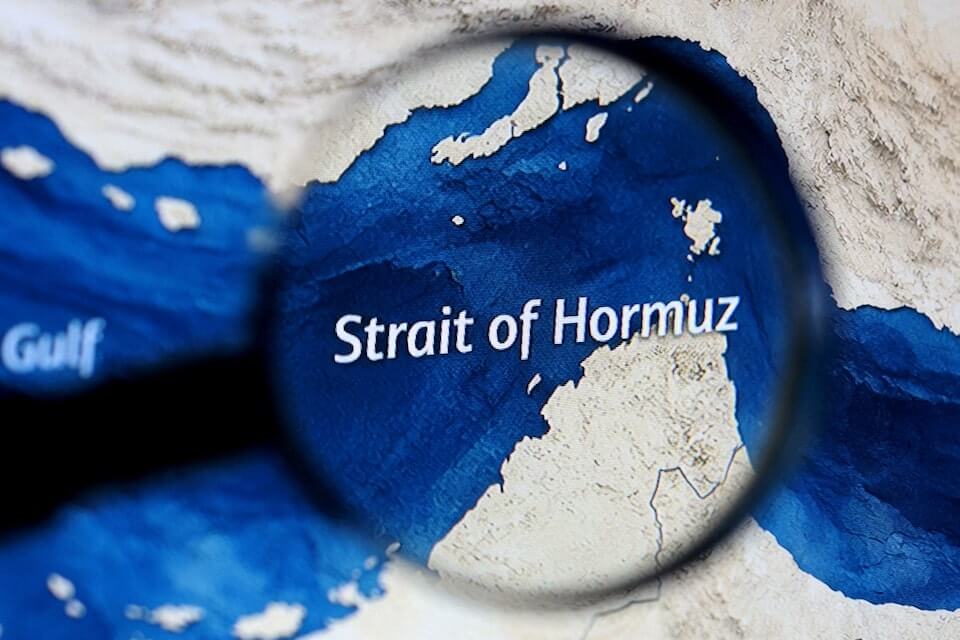
US financial media CNBC and "The Wall Street Journal" (WSJ) reported that the company sent an analyst to Oman's Musandam Peninsula. This person observed the shipping situation in the Strait of Hormuz firsthand by boat amidst rising tensions between the United States and Iran. The analyst's claimed observations challenge the widespread belief in global markets that the Strait of Hormuz is effectively closed.
This Citrini Research employee was referred to as "Analyst No. 3" in the report. He said that since the war began, both the number of ships passing through the Strait of Hormuz and the number of Iranian attacks were higher than publicly reported. The report included images of oil tankers on fire.
Due to the sensitive nature of the operation, the company did not disclose the analyst's name. According to the report published on the company's Substack platform, the analyst found that ships continue to pass through this critical oil channel, with about 15 passing daily recently. Although still far below normal levels, this traffic indicates that the disruption is partial and constantly changing, not a complete closure.
The company's post said: "Four or five oil tankers pass every day, but the Automatic Identification System (AIS) is completely turned off. The actual traffic is higher than the data shows, and the traffic passing through the Qeshm Channel has been accelerating in recent days."
A geographical map of the Strait of Hormuz. (Produced by Central News Agency) The Automatic Identification System is a ship tracking system that provides information on ship position, speed, identification, and route. The aforementioned company claimed that the actual shipping volume is higher than the reported data because many ships turn off their transponders, preventing official tracking systems from displaying them.
According to the company's post, the analyst interviewed fishermen, smugglers, and regional officials, finding that Iran is actually selectively permitting ships to pass. Oil tankers must obtain prior permission to sail in waters near Iranian territory, which the company described as a "functional checkpoint" rather than a blockade.
The analyst wrote: "US and allied ships will find it difficult to pass during the conflict, but others are waiting for approval."
The company stated: "This should explain that our observations of this conflict are actually more nuanced, not just the dichotomy of 'Strait of Hormuz open, crude oil prices fall' or 'Strait of Hormuz closed, crude oil prices soar.'"
However, these observations are based on a single field visit and some individual accounts that are difficult to independently verify, especially given the limited transparency in this region.
The company stated that it expects shipping disruptions to continue for longer, leading to a long-term risk premium in the oil market, but traffic may recover to 50% of pre-conflict levels within the next 4 to 6 weeks.
Citrini has always been bold in its predictions. In February this year, it published a post predicting an AI-induced economic apocalypse, which startled some investors and brought attention to this unconventional company. (Compiler: Lu Ying-tzu) 1150407
FACT BOX
- Source: CNA (Central News Agency)
- Category: financial