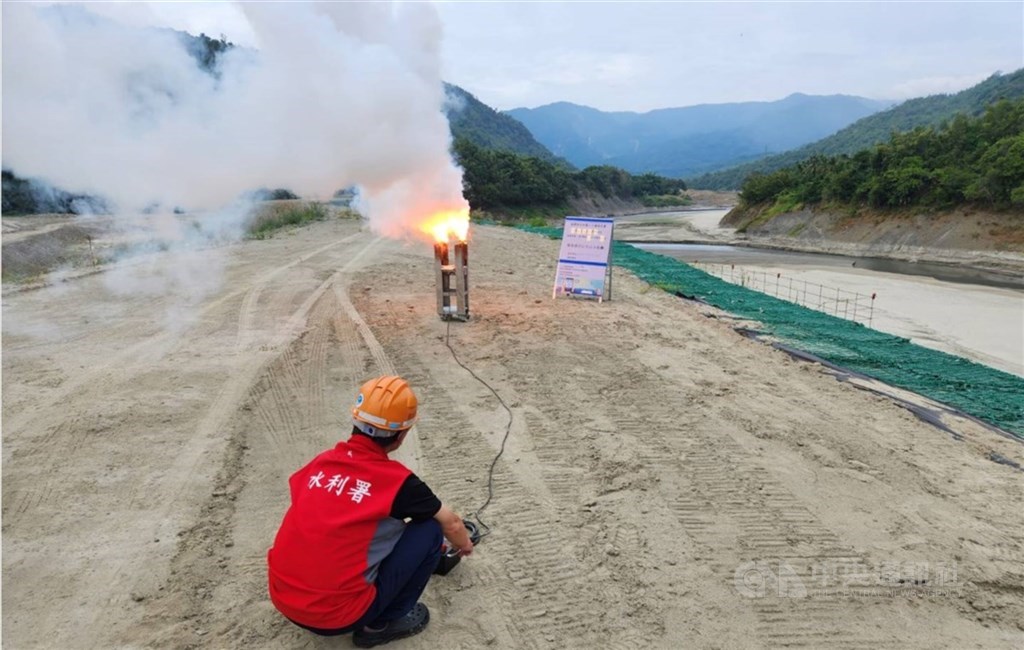
(Central News Agency, Taipei, April 18) Taking advantage of the passing of a cold front and the strengthening of the northeast monsoon, the Water Resources Agency of the Ministry of Economic Affairs conducted ground-based artificial rain operations at 9 a.m. at the Liyuetan, Mingde, Yongheshan, and Baogou reservoirs. Depending on cloud system movement, they will also evaluate additional rain-making operations at the Zengwen and Jiasian weirs. This year, a total of 14 ground-based flare seeding operations have been conducted, serving as an important measure for stabilizing water conditions.
The Water Resources Agency often conducts artificial rain operations in reservoir catchment areas during dry spells. Today, the agency provided a detailed explanation of the principles and methods involved to enhance public understanding of artificial rain.
The Water Resources Agency stated that artificial rain does not create rain out of nothing but enhances the efficiency of rainfall from existing thick cloud systems, making clouds that might otherwise produce less rain more likely to develop into effective precipitation. The operational principle involves adding catalysts into clouds to accelerate raindrop formation, a technique that "conforms to nature and strengthens the process."
In Taiwan's meteorological environment, the Water Resources Agency uses various methods, such as sprinkling water or introducing water-absorbing condensation nuclei into clouds, to further increase rainfall from clouds that are already likely to produce rain. Based on the altitude of operation, there are currently four types of rain-making methods: sprinkling water with assistance from the Air Force at altitudes near cloud tops; using UAVs to carry flare columns (up to 1000 meters high); high-altitude flares (at altitudes of 100 or 500 meters); and ground-based burning of flares.
The Water Resources Agency explained that the effectiveness of artificial rain is influenced by factors such as cloud thickness, water vapor content, air currents, and topography, meaning not every operation yields the same results. The agency conducts careful evaluations based on weather forecasts, radar observations, and local data, executing operations at the most favorable times.
Based on years of experience, the Water Resources Agency has established a standard procedure, entrusting professional teams to monitor weather conditions at all times. They identify potential operation dates five days in advance. Two to three days prior, based on the latest weather forecasts, they decide on the target areas, release times, and locations. One day prior, they estimate release times, locations, and the quantity of seeding flares based on forecasted cloud water content periods, cloud thickness reaching 5 kilometers, and cloud top temperatures between minus 15 to minus 20 degrees Celsius.
On the day of the operation, they review the latest model results and real-time meteorological satellite and radar imagery. They then release flares in the most favorable atmospheric conditions before precipitation occurs. After about two hours of ascent and cloud seeding, more rain can fall as the cloud system passes over the catchment area.
The Water Resources Agency emphasized that all 21 artificial rain operation sites are located within reservoir catchment areas. The increased rainfall flows entirely into the reservoirs and does not cause flooding in downstream areas. Furthermore, the concentration of catalytic substances used in artificial rain is extremely low, dispersing rapidly in the atmosphere to background levels after release, and does not cause other problems. (Editor: Lin Shuyuan) 1150418
FACT BOX
- Source: CNA (Central News Agency)
- Category: Taiwan