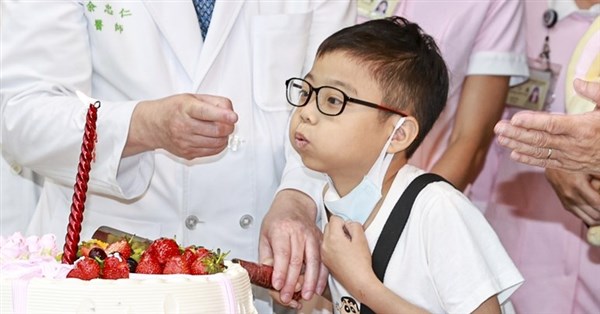
(Central News Agency reporter Tseng Yi-ning, Taipei, April 15) A 12-year-old boy surnamed Hsu, suffering from rare diseases such as congenital hepatic fibrosis and congenital bile duct dilatation, experienced progressive deterioration of his liver and kidneys. Within one year, he successively received a liver donation from his mother and a kidney donation from his father, with National Taiwan University Hospital (NTUH) completing its first pediatric liver and kidney dual organ transplant.
The boy's mother recalled at today's treatment outcome press conference that her son was diagnosed with a rare disease at four months old and had been taking medication since childhood, which was heartbreaking to witness. Therefore, she and her husband had long been mentally prepared to donate organs, believing that "if the child has a defect, we must do our best to compensate."
She said that to meet the organ donation standards, the couple had diligently maintained their health for the past 10 years. Her husband, who had a history of diabetes, worked hard to lose several kilograms, and she herself lost 10 kilograms.
The boy was initially transferred to NTUH due to cardiogenic shock. Dr. Tsai Yi-jung, director of NTUH's Pediatric Nephrology Department, pointed out that the boy already had conditions such as high blood pressure and acute kidney injury at that time. He was later diagnosed with the rare diseases congenital hepatic fibrosis and congenital bile duct dilatation, combined with liver fibrosis and splenomegaly, and also suffered from autosomal recessive polycystic kidney disease.
Dr. Tsai Yi-jung explained that autosomal recessive polycystic kidney disease is a recessive genetic disorder, and both parents happened to be carriers, meaning there was a 1/4 chance of the child inheriting it. Furthermore, the boy later progressed to stage 5 chronic kidney disease, making his condition complex and treatment extremely difficult.
Dr. Li Chih-yuan, associate professor at NTUH's Department of Surgery, stated that cases like the boy's, involving successive liver and kidney transplants within one year, are very rare, even among adult patients, and this is the first such case for a child at NTUH.
Dr. Li Chih-yuan said that the boy first underwent a living donor liver transplant in January 2025, receiving part of his mother's liver. Unexpectedly, his kidney function rapidly deteriorated after the surgery. Considering that peritoneal dialysis was not possible immediately after the liver transplant, he then underwent a living donor kidney transplant in January 2026, receiving a kidney from his father. Now, as long as he carefully takes anti-rejection medication, the boy can resume a normal school life.
Regarding related-donor transplants, Dr. Li Chih-yuan noted that due to limited organ sources in Taiwan, there are currently over 8,000 people waiting for kidney transplants and 936 for liver transplants. He hopes the public will continue to support the concept of organ donation to bring new life opportunities to more critically ill patients.
NTUH President Yu Chung-jen stated that NTUH completed Asia's first living donor kidney transplant in 1968. To date, it has accumulated over 1,500 kidney transplant cases, the highest in the nation, with a 10-year survival rate of 85%, higher than the national average of 77%, placing it in a leading position nationwide. The successful completion of this highly difficult pediatric living organ transplant case further highlights NTUH's profound strength and outstanding achievements in transplant medicine. (Edited by Chen Ching-fang) 1150415
Choose to stand with facts; every sponsorship you provide is a force for protecting press freedom.
Download the Central News Agency "First-hand News" APP to stay updated with the latest news.
Text, images, and audio-visual content on this website may not be reproduced, publicly broadcast, publicly transmitted, or utilized without authorization.
FACT BOX
- Source: CNA (Central News Agency)
- Category: research