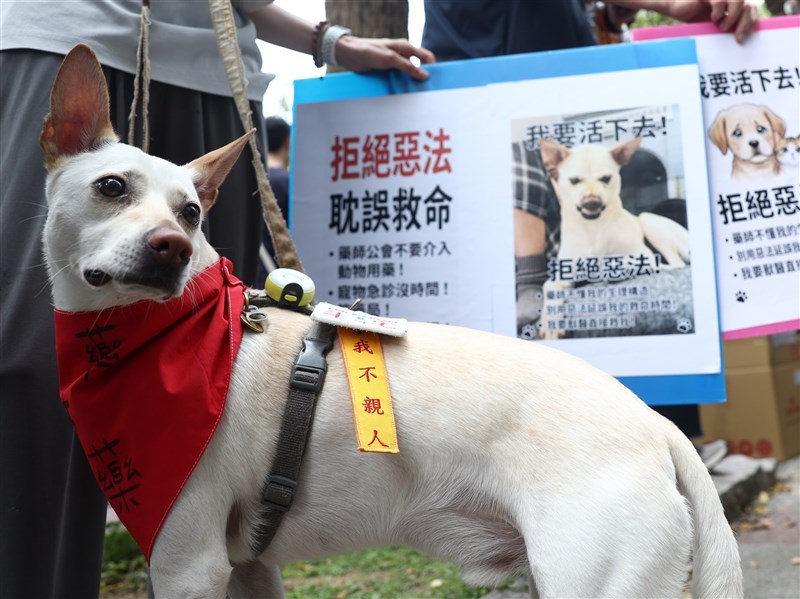
Taipei, April 15 (CNA) The new regulations for animal drugs, originally scheduled to take effect in July this year, have caused controversy due to insufficient supporting measures. The Ministry of Agriculture recently voted to temporarily suspend implementation, revoke the current plan, and propose new measures. Several legislators today questioned the crude approach and demanded that management measures be completed and a more comprehensive system be established within one year.
The Animal and Plant Health Inspection Agency (APHIA) of the Ministry of Agriculture convened a meeting on the afternoon of April 10 with the Food and Drug Administration (FDA) of the Ministry of Health and Welfare, pharmacists' associations, and veterinarians' associations to discuss the draft amendment to the "Regulations on the Use and Management of Human Drugs for Dogs, Cats, and Non-Economic Animals." Facing demands for a clear outcome from attendees, Deputy Minister of Agriculture Du Wen-chen called for a "show of hands vote!" to pass the temporary suspension of the new regulations.
This morning, at the Legislative Yuan's Social Welfare and Environmental Hygiene Committee, Minister of Health and Welfare Shih Chung-liang, APHIA Director-General Du Li-hua, and other officials reported on issues such as the new pet drug regulations and were questioned. Several legislators focused on the latest progress and procedures.
Du Li-hua revealed in her response that the new pet drug regulations are in the process of being revoked, and if all goes smoothly, "it will be announced in the next day or two," and new measures will be formulated. Democratic Progressive Party legislator Liu Chien-kuo exclaimed, "I don't understand!" How can a regulation that has undergone two years of deliberation and discussion be announced as postponed by the Deputy Minister through a show of hands vote, and now be revoked? "The handling method is so crude!"
Liu Chien-kuo also questioned, "You first postponed it, and now you're revoking it. How can pet parents, veterinarians, and pharmacists trust your new regulations?"
Du Li-hua stated that "the context has changed," and considering pragmatic implementation, it is necessary to ensure that drug flow control does not get out of hand. Currently, only a small portion of the 701 drugs have completed registration. If rushed into implementation, it will lead to information discontinuity. Therefore, it was decided to complete the revocation process in the next few days and move towards formulating more appropriate measures.
Kuomintang legislator Wang Yu-min asked whether there would be a drug shortage after the revocation. Shih Chung-liang explained that according to the "Animal Protection Act," when animal drugs are insufficient, human drugs can temporarily be used as substitutes, so drug supply will not be an obstacle; the focus of the new measures is "safety and flow management." In the past, the registration process for human drugs used for animals was more cumbersome, and in the future, it will move towards simplifying procedures and strengthening guidance.
FDA Director-General Chiang Chih-kang added that in the short term, drug merchant distribution records will be used to ensure stable supply, and in the medium to long term, the Ministry of Agriculture needs to establish a complete system that links with the FDA's drug tracking system to achieve precise management of flow and end-use.
Wang Yu-min specifically requested that a complete legal framework and system, from registration to flow management, be completed within one year to meet societal expectations. Du Li-hua responded that the Ministry of Agriculture and the Ministry of Health and Welfare at the ministerial level have reached a preliminary consensus and will handle it quickly.
Given the lack of drugs for sick pets, the "Regulations on the Use and Management of Human Drugs for Dogs, Cats, and Non-Economic Animals" was originally scheduled to be implemented in July, hoping to legalize management and prevent abuse. The supporting regulations positively listed 701 human drugs that must first be registered by drug merchants before they can be used for animals, but the registration progress is less than 30%, causing veterinarians, pet owners, and animal protection groups to worry about the discontinuity of pet medical care; the alternative was to obtain a veterinarian's drug purchase certificate to get drugs from pharmacies for veterinarians to use, which also did not consider night and emergency needs. (Editor: Chen Ching-fang) 1150415
FACT BOX
- Source: CNA (Central News Agency)
- Category: regulation