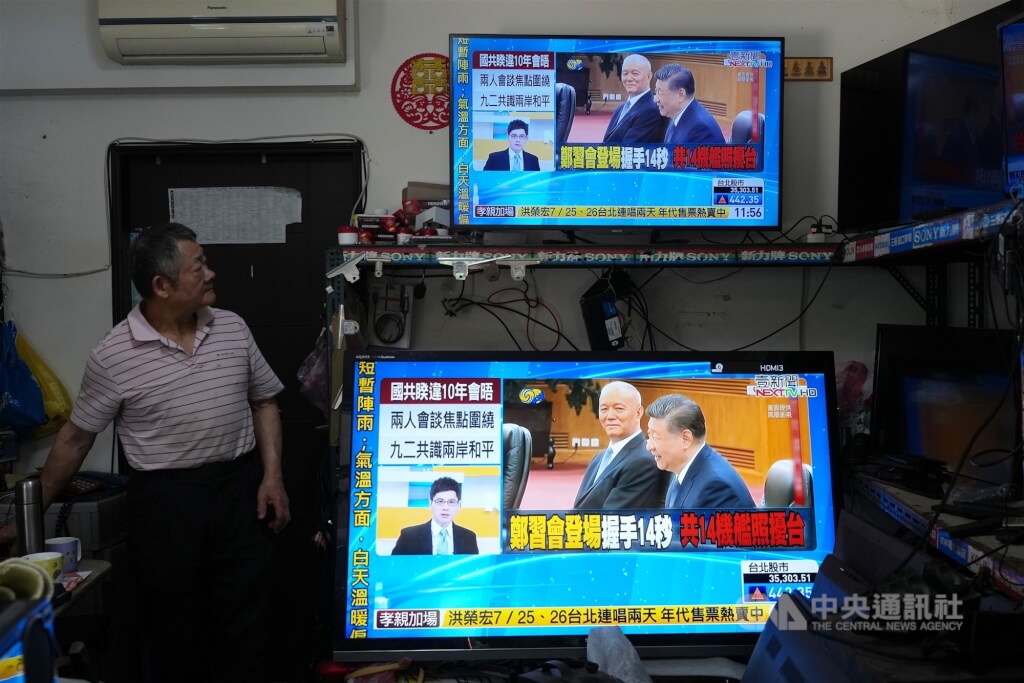
National Security Sources: Beijing Uses Cheng-Xi Meeting to Promote Taiwan's Anti-Japan, Anti-US, and Anti-Arms Sales Stance
Following the meeting between KMT Chairwoman Cheng Li-wun and Xi Jinping, Taiwan's national security sources analyze that Beijing's true intention is not the announced measures, but to use the opposition party to broadcast an anti-Japan, anti-US, and anti-arms sales narrative internationally.
📋 Article Processing Timeline
- 📰 Published: April 16, 2026 at 20:15
- 🔍 Collected: April 16, 2026 at 20:32 (16 min after Published)
- 🤖 AI Analyzed: April 19, 2026 at 00:15 (51h 43m after Collected)
Central News Agency
(CNA Reporter Wen Kuei-hsiang, Taipei, 16th) The meeting between Kuomintang (KMT) Chairwoman Cheng Li-wun and Chinese Communist Party (CCP) General Secretary Xi Jinping has sparked outside discussion. National security sources analyzed today that the "10 measures" announced by the CCP after the Cheng-Xi meeting are not the core. Instead, Beijing is using the meeting to manipulate three major themes: "anti-Japan, anti-US, and anti-arms sales," and transmitting political signals externally through interactions with Taiwan's opposition party.
The Taiwan Affairs Office of the CCP Central Committee announced 10 Taiwan-related policy measures on the morning of the 12th, including promoting the resumption of pilot programs for individual travel to Taiwan by residents of Shanghai and Fujian Province, and promoting the full normalization of cross-strait air passenger direct flights.
National security sources pointed out that the "10 favorable measures for Taiwan" that the outside world focuses on after the "Cheng-Xi meeting" are not the core. The true strategic significance lies in the Beijing authorities using this meeting to synchronously advance three external propaganda axes: "anti-Japan, anti-US, and anti-arms sales." By interacting "party-to-party" with Taiwan's opposition party, they provide endorsement from Taiwan for related narratives, intending to reshape the discourse on cross-strait issues internationally, specifically paving the way for the upcoming US-China summit "Trump-Xi meeting" (US President Trump meeting with Chinese President Xi Jinping).
National security sources said that this "Cheng-Xi meeting" is highly integrated in its propaganda layout, with the three major themes echoing each other.
On the "anti-Japan" theme, Beijing is trying to re-label Japan with "neo-militarism." By emphasizing the "common anti-Japanese memory of the Chinese nation," it incorporates Taiwan into its historical narrative and manipulates issues such as comfort women, the Diaoyutai Islands, and history textbooks to further question the legitimacy of Taiwan-Japan cooperation, even characterizing the government's policy towards Japan as a betrayal of national sentiment.
Regarding the "anti-US" theme, national security sources pointed out that the Beijing authorities characterize democratic allies as "external forces" in the cross-strait issue, intending to internalize the Taiwan issue and frame it within "One China." This is a key narrative paving the way for the upcoming "Trump-Xi meeting." Beijing wants to convey to the Trump administration that the Taiwan issue has always been the Chinese people's own business, and it is US intervention that has made it complicated.
National security sources said Beijing intends to convey the narrative that "the Taiwan issue is China's internal affair" to the outside world, while labeling US arms sales to Taiwan and support from democratic countries as "foreign interference." By strengthening the "skepticism towards the US" theory, they release the message that "the US is unreliable," thereby influencing the international community and US decision-making.
As for the "anti-arms sales" theme, national security sources pointed out that in recent years, the opposition party's boycotts of defense budgets and arms sales bills in the Legislative Yuan have echoed Beijing's narrative. Beijing publicly claims that Taiwanese public opinion does not support arms purchases, while Taiwan's opposition party criticizes arms purchases as a waste of resources. The two form a "multi-source corroboration" effect, further influencing international perception and achieving the strategic goal of weakening Taiwan's self-defense capabilities.
National security sources stated that the core pivot integrating these three major themes is the "Cheng-Xi meeting." Through the leader of Taiwan's main opposition party visiting China, it provides evidence "from Taiwan" for Beijing's narrative and shapes the narrative that "Taiwan does not support the US and arms sales, and leans towards peaceful exchanges" on the eve of US-China interactions.
As for the CCP's "10 favorable measures for Taiwan," national security sources bluntly said there is nothing new, and most are repetitions or adjustments of past policies. Some are even measures that China had previously restricted itself and then released again, so their substantive significance is limited.
National security sources pointed out that indicators testing Beijing's goodwill should include six points: stopping military harassment against Taiwan, stopping the suppression of Taiwan's international participation, stopping gray-zone incursions, stopping united front work, stopping cognitive warfare, and resuming dialogue with Taiwan's democratically elected government. However, none of these key issues were touched upon this time. (Editor: Lin Ke-lun) 1150416
(CNA Reporter Wen Kuei-hsiang, Taipei, 16th) The meeting between Kuomintang (KMT) Chairwoman Cheng Li-wun and Chinese Communist Party (CCP) General Secretary Xi Jinping has sparked outside discussion. National security sources analyzed today that the "10 measures" announced by the CCP after the Cheng-Xi meeting are not the core. Instead, Beijing is using the meeting to manipulate three major themes: "anti-Japan, anti-US, and anti-arms sales," and transmitting political signals externally through interactions with Taiwan's opposition party.
The Taiwan Affairs Office of the CCP Central Committee announced 10 Taiwan-related policy measures on the morning of the 12th, including promoting the resumption of pilot programs for individual travel to Taiwan by residents of Shanghai and Fujian Province, and promoting the full normalization of cross-strait air passenger direct flights.
National security sources pointed out that the "10 favorable measures for Taiwan" that the outside world focuses on after the "Cheng-Xi meeting" are not the core. The true strategic significance lies in the Beijing authorities using this meeting to synchronously advance three external propaganda axes: "anti-Japan, anti-US, and anti-arms sales." By interacting "party-to-party" with Taiwan's opposition party, they provide endorsement from Taiwan for related narratives, intending to reshape the discourse on cross-strait issues internationally, specifically paving the way for the upcoming US-China summit "Trump-Xi meeting" (US President Trump meeting with Chinese President Xi Jinping).
National security sources said that this "Cheng-Xi meeting" is highly integrated in its propaganda layout, with the three major themes echoing each other.
On the "anti-Japan" theme, Beijing is trying to re-label Japan with "neo-militarism." By emphasizing the "common anti-Japanese memory of the Chinese nation," it incorporates Taiwan into its historical narrative and manipulates issues such as comfort women, the Diaoyutai Islands, and history textbooks to further question the legitimacy of Taiwan-Japan cooperation, even characterizing the government's policy towards Japan as a betrayal of national sentiment.
Regarding the "anti-US" theme, national security sources pointed out that the Beijing authorities characterize democratic allies as "external forces" in the cross-strait issue, intending to internalize the Taiwan issue and frame it within "One China." This is a key narrative paving the way for the upcoming "Trump-Xi meeting." Beijing wants to convey to the Trump administration that the Taiwan issue has always been the Chinese people's own business, and it is US intervention that has made it complicated.
National security sources said Beijing intends to convey the narrative that "the Taiwan issue is China's internal affair" to the outside world, while labeling US arms sales to Taiwan and support from democratic countries as "foreign interference." By strengthening the "skepticism towards the US" theory, they release the message that "the US is unreliable," thereby influencing the international community and US decision-making.
As for the "anti-arms sales" theme, national security sources pointed out that in recent years, the opposition party's boycotts of defense budgets and arms sales bills in the Legislative Yuan have echoed Beijing's narrative. Beijing publicly claims that Taiwanese public opinion does not support arms purchases, while Taiwan's opposition party criticizes arms purchases as a waste of resources. The two form a "multi-source corroboration" effect, further influencing international perception and achieving the strategic goal of weakening Taiwan's self-defense capabilities.
National security sources stated that the core pivot integrating these three major themes is the "Cheng-Xi meeting." Through the leader of Taiwan's main opposition party visiting China, it provides evidence "from Taiwan" for Beijing's narrative and shapes the narrative that "Taiwan does not support the US and arms sales, and leans towards peaceful exchanges" on the eve of US-China interactions.
As for the CCP's "10 favorable measures for Taiwan," national security sources bluntly said there is nothing new, and most are repetitions or adjustments of past policies. Some are even measures that China had previously restricted itself and then released again, so their substantive significance is limited.
National security sources pointed out that indicators testing Beijing's goodwill should include six points: stopping military harassment against Taiwan, stopping the suppression of Taiwan's international participation, stopping gray-zone incursions, stopping united front work, stopping cognitive warfare, and resuming dialogue with Taiwan's democratically elected government. However, none of these key issues were touched upon this time. (Editor: Lin Ke-lun) 1150416