Middle East Conflict Reaches India, People's Daily Tea-Drinking Pleasure Lost
The Middle East conflict has impacted daily life in India, particularly due to the disruption of shipping in the Strait of Hormuz, leading to energy shortages. This has caused LPG prices to skyrocket and severe supply issues, affecting the traditional Indian tea-drinking culture. Many tea shops have temporarily closed, and long queues for tea are seen in cities like Delhi and Kolkata.
📋 Article Processing Timeline
- 📰 Published: April 15, 2026 at 13:51
- 🔍 Collected: April 15, 2026 at 14:01 (10 min after Published)
- 🤖 AI Analyzed: April 15, 2026 at 20:03 (6h 1m after Collected)
Central News Agency
Central News Agency correspondent Li Jin-wei in New Delhi
2026/4/15 12:31 (Updated 4/15 12:51)
Recommended reading
The United States and Israel launched military actions against Iran, and Iran's control of the Strait of Hormuz is one of the key means of response, as 20% of the world's oil, natural gas, and other energy sources need to be transported through this waterway.
As shipping in the Strait of Hormuz continues to be suspended worldwide, problems caused by energy shortages are constantly emerging, further affecting people's livelihoods and economies in various countries.
Indians' lives are also affected. Economically, stocks have plummeted and the rupee has depreciated sharply. In daily life, the price of bottled liquefied petroleum gas (LPG, bottled gas) has soared several times, and it is impossible to buy it even with money. Recently, people have even lost the chance to "have a cup of tea to calm down."
For Indians, the so-called "tea" (Chai) usually refers to a drink made by boiling spices in water, then adding tea leaves and milk to simmer, and finally filtering out the spices and tea leaves before drinking. The taste is similar to the milk tea familiar to Taiwanese people.
Indians love to drink tea, just as Taiwanese love to drink hand-shaken drinks. Tea shops, tea stalls, and tea carts are everywhere. They basically drink tea three times a day, for quenching thirst, gatherings, entertaining guests, etc. Tea is also the first choice of drink.
Tea culture is deeply ingrained in every Indian's bones and is reflected in daily life. Whether they are busy with work, or have any annoying trivial matters in life, or even if the sky is falling, the thought that always flashes through an Indian's mind is "let's have a cup of tea first."
However, no one would have thought that such a major international event as the Middle East war would affect the small matter of Indians drinking tea every day.
After the outbreak of the Middle East war, Indian society initially did not feel much change, but from mid-March, bottled gas began to be out of stock, causing many Indian families to encounter difficulties in cooking. Restaurants also changed their menus or reduced meal times, making Indians begin to "feel" the Middle East war.
As April approached, although the supply of bottled gas stabilized slightly, another phenomenon that made Indians uneasy did not disappear, that is, there were fewer places to drink tea on the streets.
● Fewer places to drink tea, milk tea chaos quietly staged
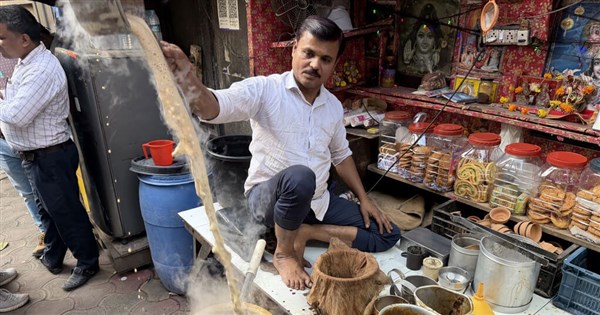
Including Delhi, many tea shops in India have temporarily closed due to unstable bottled gas supply. Tea stalls have switched to traditional charcoal cooking, which is much slower. Tea carts no longer continuously brew tea, only selling pre-brewed tea in thermoses, so the quantity is limited. Therefore, every place that sells tea has long queues, and a large group of people gather together to wait for a cup of tea. This "milk tea chaos" is quietly being staged on the streets of India.
D. Kadirl, a staff member of an Indian chain tea shop, told the Central News Agency reporter that there were originally 7 places selling tea within 500 meters on the same street near his workplace, but now only 2 are still open. "Although not all were forced to close, the number of temporarily closed shops is so large that you cannot ignore the shortage of bottled gas."
Sandeep, the owner of a tea stall in Kolkata, while busy brewing tea, told the Central News Agency reporter through an English-speaking customer: "Bottled gas just can't be ordered, and we can't do anything about it. Switching to other fuels to brew tea will be slower, indirectly affecting our income."
Gorish Arora, a customer at a tea stall in New Delhi, helplessly told the Central News Agency reporter that drinking tea after work is a spiritual sustenance. "Recently, I wanted to buy a cup of tea, but I went to several places and found nothing. The places that sell tea are also crowded, and it takes a long time to get a cup of tea, which is very annoying."
Indians' daily tea-drinking activity, which is now affected by the Middle East war thousands of miles away, is probably something no one expected. Most Indians may not fully understand the changes the war brings to the world, but many will probably feel like Arora, "give me back my tea." (Editor: Tian Ruihua) 1150415
Choose to stand with the facts, every sponsorship you make is a force to protect press freedom
Download the Central News Agency "First-hand News" APP to get the latest news instantly
The text, pictures, and videos on this website may not be reproduced, publicly broadcast, or publicly transmitted and used without authorization.
Keywords: None
Central News Agency correspondent Li Jin-wei in New Delhi
2026/4/15 12:31 (Updated 4/15 12:51)
Recommended reading
The United States and Israel launched military actions against Iran, and Iran's control of the Strait of Hormuz is one of the key means of response, as 20% of the world's oil, natural gas, and other energy sources need to be transported through this waterway.
As shipping in the Strait of Hormuz continues to be suspended worldwide, problems caused by energy shortages are constantly emerging, further affecting people's livelihoods and economies in various countries.
Indians' lives are also affected. Economically, stocks have plummeted and the rupee has depreciated sharply. In daily life, the price of bottled liquefied petroleum gas (LPG, bottled gas) has soared several times, and it is impossible to buy it even with money. Recently, people have even lost the chance to "have a cup of tea to calm down."
For Indians, the so-called "tea" (Chai) usually refers to a drink made by boiling spices in water, then adding tea leaves and milk to simmer, and finally filtering out the spices and tea leaves before drinking. The taste is similar to the milk tea familiar to Taiwanese people.
Indians love to drink tea, just as Taiwanese love to drink hand-shaken drinks. Tea shops, tea stalls, and tea carts are everywhere. They basically drink tea three times a day, for quenching thirst, gatherings, entertaining guests, etc. Tea is also the first choice of drink.
Tea culture is deeply ingrained in every Indian's bones and is reflected in daily life. Whether they are busy with work, or have any annoying trivial matters in life, or even if the sky is falling, the thought that always flashes through an Indian's mind is "let's have a cup of tea first."
However, no one would have thought that such a major international event as the Middle East war would affect the small matter of Indians drinking tea every day.
After the outbreak of the Middle East war, Indian society initially did not feel much change, but from mid-March, bottled gas began to be out of stock, causing many Indian families to encounter difficulties in cooking. Restaurants also changed their menus or reduced meal times, making Indians begin to "feel" the Middle East war.
As April approached, although the supply of bottled gas stabilized slightly, another phenomenon that made Indians uneasy did not disappear, that is, there were fewer places to drink tea on the streets.
● Fewer places to drink tea, milk tea chaos quietly staged
Including Delhi, many tea shops in India have temporarily closed due to unstable bottled gas supply. Tea stalls have switched to traditional charcoal cooking, which is much slower. Tea carts no longer continuously brew tea, only selling pre-brewed tea in thermoses, so the quantity is limited. Therefore, every place that sells tea has long queues, and a large group of people gather together to wait for a cup of tea. This "milk tea chaos" is quietly being staged on the streets of India.
D. Kadirl, a staff member of an Indian chain tea shop, told the Central News Agency reporter that there were originally 7 places selling tea within 500 meters on the same street near his workplace, but now only 2 are still open. "Although not all were forced to close, the number of temporarily closed shops is so large that you cannot ignore the shortage of bottled gas."
Sandeep, the owner of a tea stall in Kolkata, while busy brewing tea, told the Central News Agency reporter through an English-speaking customer: "Bottled gas just can't be ordered, and we can't do anything about it. Switching to other fuels to brew tea will be slower, indirectly affecting our income."
Gorish Arora, a customer at a tea stall in New Delhi, helplessly told the Central News Agency reporter that drinking tea after work is a spiritual sustenance. "Recently, I wanted to buy a cup of tea, but I went to several places and found nothing. The places that sell tea are also crowded, and it takes a long time to get a cup of tea, which is very annoying."
Indians' daily tea-drinking activity, which is now affected by the Middle East war thousands of miles away, is probably something no one expected. Most Indians may not fully understand the changes the war brings to the world, but many will probably feel like Arora, "give me back my tea." (Editor: Tian Ruihua) 1150415
Choose to stand with the facts, every sponsorship you make is a force to protect press freedom
Download the Central News Agency "First-hand News" APP to get the latest news instantly
The text, pictures, and videos on this website may not be reproduced, publicly broadcast, or publicly transmitted and used without authorization.
Keywords: None
FAQ
How is the Middle East conflict affecting India?
The disruption of shipping in the Strait of Hormuz has led to energy shortages, causing LPG prices to soar and severe supply issues. This has impacted the daily tea-drinking habits of Indians.
Why is there a "milk tea chaos" in India?
Due to LPG shortages, many tea shops have temporarily closed, and those that remain open have limited supplies, leading to long queues of people waiting for tea.