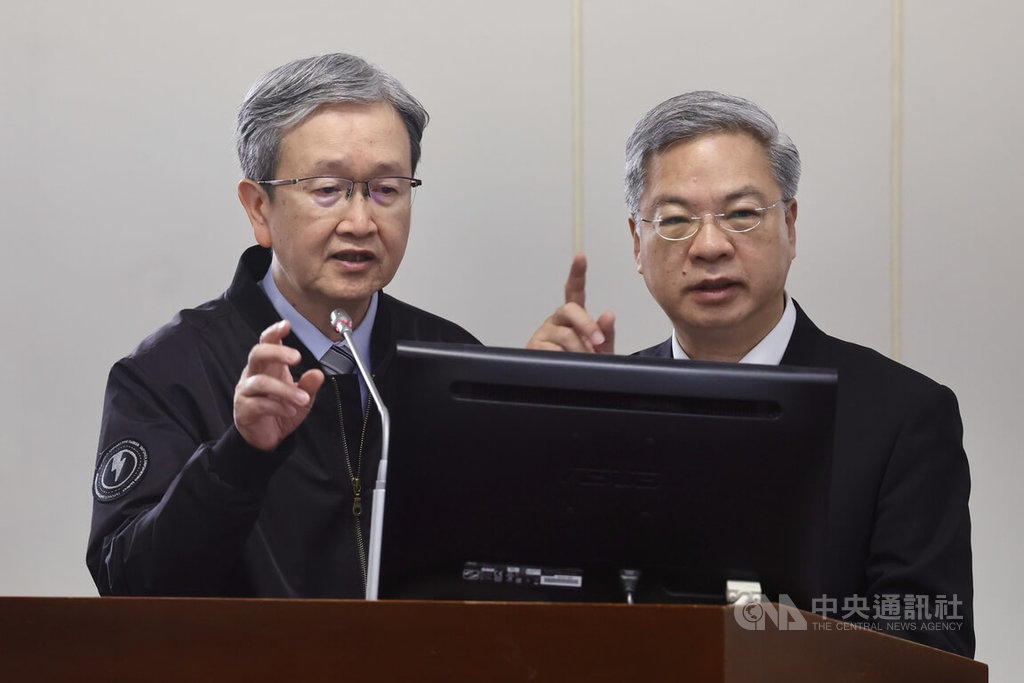
Taipei, April 16 (CNA) The government's original target for 2025 power generation mix was 50% natural gas, 30% coal, and 20% green energy. However, the green energy target has been postponed to November this year, raising concerns among legislators from both ruling and opposition parties. Minister of Economic Affairs Kung Ming-hsin admitted that due to continuous changes in the numerator and denominator, especially the rapid increase in the denominator, the current focus is on achieving renewable energy installed capacity targets to meet the demands of RE100 companies.
The Legislative Yuan's Economic Committee today invited Minister Kung Ming-hsin and other ministry heads to report on "The current status, progress, capacity targets, promotion difficulties, regulatory obstacles, and related improvement strategies for Taiwan's renewable energy and grid resilience," and to answer interpellations, with legislators focusing on renewable energy generation targets.
The government's original power generation structure for 2025 was 50% natural gas, 30% coal, and 20% green energy; for 2030, it was 50% natural gas, 20% coal, and 30% green energy. However, in recent years, the Ministry of Economic Affairs has postponed the 20% green energy ratio target, citing a "growing denominator," with the latest postponement to November 2026.
The National Development Council's written report indicates that by the end of 2025, the total installed capacity of renewable energy will be 22.872 GW, with solar PV at 15.474 GW, wind power at 4.517 GW, and hydro power at 2.124 GW being the largest components. In terms of generation, renewable energy generation in 2025 is projected to be 37.814 billion kWh, accounting for approximately 13.1% of the national power generation for that year.
Taiwan People's Party Legislator Hung Yu-hsiang directly questioned that the 20% renewable energy generation ratio target has been repeatedly missed. The National Development Council's written report also mentioned the 2030 installed capacity target, but he expressed a lack of confidence, worrying that setting targets would only lead to an endless cycle. Kung Ming-hsin for the first time conceded that whether the ratio is a good target should be reviewed, as both the numerator and denominator are constantly changing. The current goal is to strive to achieve whatever the renewable energy installed capacity target is.
In addition, Hung Yu-hsiang mentioned that the National Development Council's report stated that geothermal installed capacity would be 7 MW by the end of 2025, increasing to 1.2 GW by 2030, a 200-fold increase. Kung Ming-hsin stated that the current target has been changed to 200 MW. Democratic Progressive Party Legislator Chiu Chih-wei also pointed out that the written reports from the National Development Council and the Ministry of Economic Affairs had completely different data, with the Ministry of Economic Affairs clearly stating a 2030 geothermal target of 200 MW, while the National Development Council wrote 1.2 GW, a difference of 6 times. Kung Ming-hsin responded that this was a pragmatic adjustment, admitting that achieving 1 GW would be difficult.
Democratic Progressive Party Legislator Lai Jui-lung expressed concern that Taiwanese companies, including TSMC, have joined RE100. Taking TSMC as an example, it only reached RE25 in 2024. He questioned whether this could meet corporate demands and whether domestic green energy planning was already lagging. Kung Ming-hsin said that they have been continuously reviewing and consulting with RE100 companies about their needs. Regarding green energy supply, the percentage target might not be met, but the goal is installed capacity, meaning the total amount of green energy can meet corporate demands. Discussions with companies about demand until 2035 are currently underway.
Lai Jui-lung further stated that the 20% green energy target has been postponed to November this year, and it might not be completed even by next year, suggesting a change in rhetoric. Kung Ming-hsin said that green energy promotion is continuous and active, but he did not deny that the denominator is increasing rapidly. For example, this year alone, four large natural gas units have been connected to the grid. He will do his best to promote the green energy target. (Editor: Lin Shu-yuan) 1150416
FACT BOX
- Source: CNA (Central News Agency)
- Category: regulation