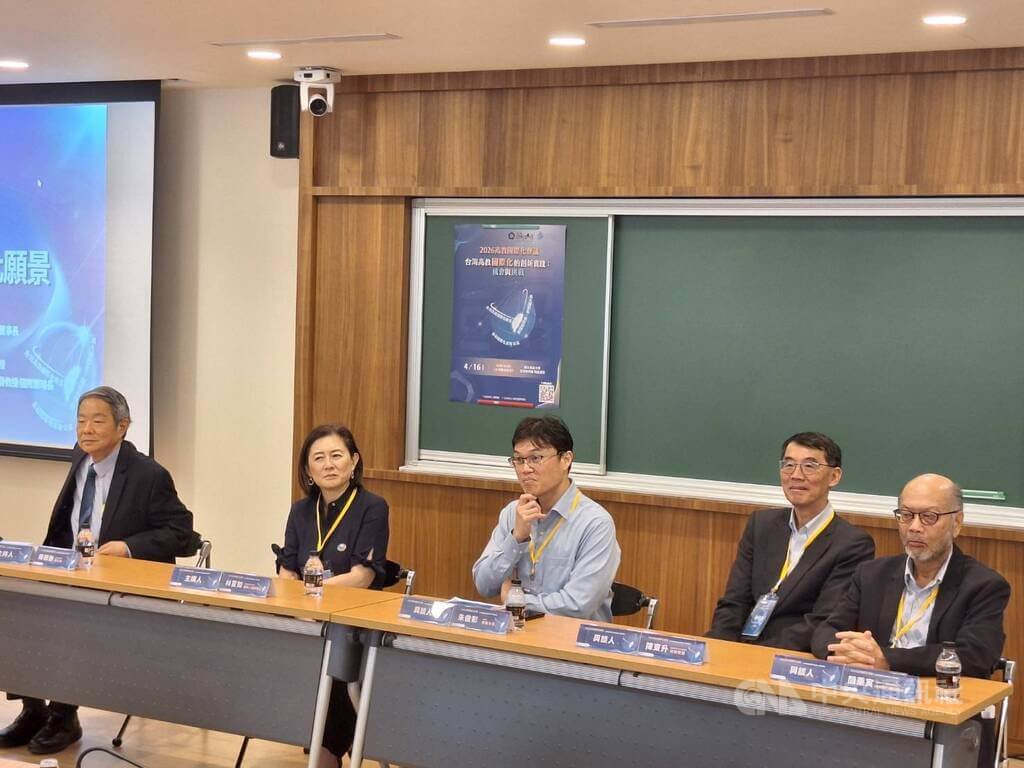
(Central News Agency reporter Hsu Chih-wei, Taipei, 16th) The International College of Innovation at National Chengchi University held a forum on higher education internationalization today. Experts pointed out a disconnect between "education, employment, and immigration" in Taiwan, expressing concerns that Taiwan's degrees have been reduced to a career stepping stone for international talent. The Ministry of Education responded that it has actively strengthened talent retention and recruitment in recent years.
The International College of Innovation at National Chengchi University hosted a forum titled "Innovative Practices in Taiwan's Higher Education Internationalization: Opportunities and Challenges" to jointly discuss how Taiwan's higher education can reshape its talent competition strategy through international innovation.
Lin Hsia-ju, Chair of the Center for Asia-Pacific Resilience and Innovation, stated that Taiwan has fallen into an internationalization trap in the past, long adopting a mindset of "spending money to invite people to experience the good things," but lacking incentives for career transition and policy participation. These talents will eventually be absorbed by larger markets; one-sided hospitality offers extremely limited help in realistic international competition.
Lin believes there is a disconnect between "education, employment, and immigration" in Taiwan. She heard of an entire class of foreign students on government scholarships where fewer than 5 stayed in Taiwan after graduation. Foreign students will exceed 140,000 in 2025, but data from the Ministry of Education and the Ministry of Labor shows a retention rate of only 30-40%. Nearly 60% of those who stay flow into traditional industries and not into high-level management positions. Taiwan's degrees may simply become a career stepping stone for top-tier talent.
Deputy Minister of Education Chu Chun-chang pointed out that universities previously worked hard to boost numbers in recruiting foreign students, which also led to some problems, such as students not understanding classes taught in Chinese or English, or foreign students becoming disguised migrant workers. In recent years, the Ministry of Education has begun to verify teaching quality. In the future, it will adopt a "differentiated opening" strategy. Departments and schools that perform well will be given maximum flexibility and openness, while those unable to ensure quality will face restrictions or suspensions.
In response to future industrial and demographic changes, Chu mentioned that higher education internationalization policies also require some adjustments. For foreign students coming to study in Taiwan, the Ministry of Education actively encourages them to stay and serve in Taiwan after graduation. At the same time, it is recruiting talent abroad, hoping that excellent Taiwanese international students will return to serve after graduation.
Kuan Ping-yin, Professor Emeritus at NCCU's International College of Innovation, stated that many countries face low birth rates, and universities worldwide are competing for enrollment. Taiwan hopes to attract international students through internationalization to support industrial innovation and R&D. In terms of cultural export, it is also hoped that through international students coming to Taiwan and Taiwanese students going abroad, the Taiwan experience can be brought to the world, allowing the whole world to see Taiwan.
Kuan mentioned there are currently two approaches for universities promoting internationalization. One is similar to segregation, such as placing international students in a specific program with dedicated staff to handle related affairs. However, the ideal approach should be shared classrooms, spaces, and management, so that truly integrated policies, support systems, and campus culture can be realized.
FACT BOX
- Source: CNA (Central News Agency)
- Category: Event