Fuel Vehicle Restrictions, Rising Oil Prices Lead to Electric Scooter Shortage in Vietnam
Demand for electric scooters in Vietnam is surging due to upcoming fuel vehicle restrictions and rising oil prices, with some stores seeing sales increase 3 to 4 times since March. VinFast, a leading Vietnamese electric scooter manufacturer, reported record orders in March and is struggling to meet demand. Analysts suggest that transitioning from gasoline to electric motorcycles will take time, requiring further development of charging infrastructure and changes in consumer habits.
📋 Article Processing Timeline
- 📰 Published: April 14, 2026 at 20:25
- 🔍 Collected: April 14, 2026 at 20:31 (6 min after Published)
- 🤖 AI Analyzed: April 14, 2026 at 21:59 (1h 27m after Collected)
Hanoi, April 14 (CNA) According to statistics, demand for electric scooters in Vietnam is sharply increasing, with some stores seeing sales grow 3 to 4 times since March. The reasons include upcoming restrictions on fuel motorcycles and rising oil prices due to the Middle East situation, which is a major driving force. VinFast, a leading Vietnamese electric scooter manufacturer, stated that orders in March hit a new high, and currently, deliveries cannot keep up.
Vietnam News Agency reported today that according to the Vietnam Association of Motorcycle Manufacturers (VAMM), the Vietnamese motorcycle market showed significant development in the first quarter of 2026. While the fuel motorcycle market continued stable growth, the electric motorcycle market saw strong growth.
Association members, including Honda Vietnam, Yamaha, Piaggio, SYM, and Suzuki, saw their annual sales of fuel motorcycles increase by 8.3% compared to the previous year, reaching nearly 730,000 units.
Sales of gasoline motorcycles nationwide continue to grow and dominate the market, especially in suburban and rural areas where electric vehicle charging infrastructure is not yet complete. During the transition period, consumers still prefer affordable and convenient gasoline motorcycles.
While traditional motorcycles account for a large share of the Vietnamese market, electric motorcycles have also developed rapidly recently, with fuel prices and policies being important drivers.
In early March, gasoline prices once rose to nearly 30,000 Vietnamese dong (about 1.2 USD) per liter, an increase of 43.3% from three months ago, pushing up the cost of using fuel motorcycles and making electric motorcycles more attractive.
Emission control policies are also changing consumer behavior. Hanoi's low-emission zone policy is prompting more consumers to actively consider switching to electric vehicles.
Hanoi and Ho Chi Minh City are advancing plans to restrict fuel vehicles in city centers. Starting July 1 this year, gasoline motorcycles will be restricted from operating during certain hours in Hanoi's central "egg yolk" zone, with the scope expected to gradually expand and implementation to become stricter.
According to a report by Lao Dong Newspaper on the 10th, dealers in Ho Chi Minh City stated that demand for fuel motorcycles has significantly decreased since oil prices rose in March, and this slowdown is expected to continue into April.
Retailers said that more and more consumers are switching to electric motorcycles, with sales in some stores increasing 3 to 4 times since early March.
Hoàng Hà, CEO of VinFast's electric motorcycle business, stated that in March alone, they received over 135,000 electric motorcycle orders and delivered 93,000 units, a historical high.
The surge in orders highlights a growing preference for green transportation, mainly driven by rising fuel costs and increased environmental awareness.
VinFast, which holds a dominant position in the Vietnamese market due to policy and geographical advantages, pointed out that despite current production reaching historical highs, it still cannot meet the strong market demand. The company is working to optimize its supply chain, and manufacturers are increasing production and building more charging and battery swapping infrastructure.
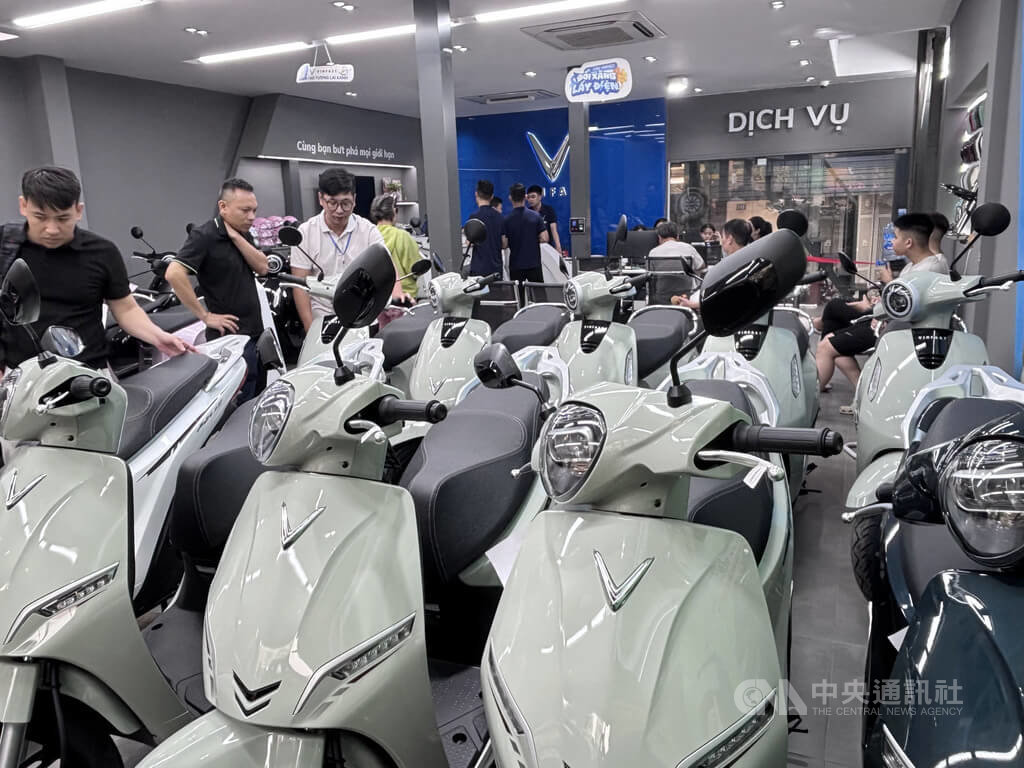
CNA reporters visited a VinFast electric motorcycle store in Hanoi, where it was crowded with high inquiry rates.
VinFast electric motorcycles are mainly divided into charging models and battery-swapping models. A store employee told reporters that the latest battery-swapping models are sold out, and pre-orders would require a two to three-week wait.
However, analysts told Vietnamese media that the transition from gasoline to electric motorcycles will take time, as it requires further development of charging infrastructure and service ecosystems, as well as changes in consumer habits.
Additionally, how to enable low- and middle-income groups to afford electric vehicles, and whether subsidy measures can be implemented, are also key. With less than three months until mandatory electric motorcycle measures take effect in central Hanoi, public sentiment remains divided on whether supporting measures such as purchase subsidies, charging facilities, grid stability, and regulatory measures are ready. (Editor: Hsieh Yi-hsuan) 1150414
Choose to stand with facts, every sponsorship you provide is a force to protect press freedom.
Download CNA's "First-hand News" APP to stay updated with the latest news.
Text, images, and videos on this website may not be reproduced, publicly broadcast, publicly transmitted, or utilized without authorization.
Vietnam News Agency reported today that according to the Vietnam Association of Motorcycle Manufacturers (VAMM), the Vietnamese motorcycle market showed significant development in the first quarter of 2026. While the fuel motorcycle market continued stable growth, the electric motorcycle market saw strong growth.
Association members, including Honda Vietnam, Yamaha, Piaggio, SYM, and Suzuki, saw their annual sales of fuel motorcycles increase by 8.3% compared to the previous year, reaching nearly 730,000 units.
Sales of gasoline motorcycles nationwide continue to grow and dominate the market, especially in suburban and rural areas where electric vehicle charging infrastructure is not yet complete. During the transition period, consumers still prefer affordable and convenient gasoline motorcycles.
While traditional motorcycles account for a large share of the Vietnamese market, electric motorcycles have also developed rapidly recently, with fuel prices and policies being important drivers.
In early March, gasoline prices once rose to nearly 30,000 Vietnamese dong (about 1.2 USD) per liter, an increase of 43.3% from three months ago, pushing up the cost of using fuel motorcycles and making electric motorcycles more attractive.
Emission control policies are also changing consumer behavior. Hanoi's low-emission zone policy is prompting more consumers to actively consider switching to electric vehicles.
Hanoi and Ho Chi Minh City are advancing plans to restrict fuel vehicles in city centers. Starting July 1 this year, gasoline motorcycles will be restricted from operating during certain hours in Hanoi's central "egg yolk" zone, with the scope expected to gradually expand and implementation to become stricter.
According to a report by Lao Dong Newspaper on the 10th, dealers in Ho Chi Minh City stated that demand for fuel motorcycles has significantly decreased since oil prices rose in March, and this slowdown is expected to continue into April.
Retailers said that more and more consumers are switching to electric motorcycles, with sales in some stores increasing 3 to 4 times since early March.
Hoàng Hà, CEO of VinFast's electric motorcycle business, stated that in March alone, they received over 135,000 electric motorcycle orders and delivered 93,000 units, a historical high.
The surge in orders highlights a growing preference for green transportation, mainly driven by rising fuel costs and increased environmental awareness.
VinFast, which holds a dominant position in the Vietnamese market due to policy and geographical advantages, pointed out that despite current production reaching historical highs, it still cannot meet the strong market demand. The company is working to optimize its supply chain, and manufacturers are increasing production and building more charging and battery swapping infrastructure.
CNA reporters visited a VinFast electric motorcycle store in Hanoi, where it was crowded with high inquiry rates.
VinFast electric motorcycles are mainly divided into charging models and battery-swapping models. A store employee told reporters that the latest battery-swapping models are sold out, and pre-orders would require a two to three-week wait.
However, analysts told Vietnamese media that the transition from gasoline to electric motorcycles will take time, as it requires further development of charging infrastructure and service ecosystems, as well as changes in consumer habits.
Additionally, how to enable low- and middle-income groups to afford electric vehicles, and whether subsidy measures can be implemented, are also key. With less than three months until mandatory electric motorcycle measures take effect in central Hanoi, public sentiment remains divided on whether supporting measures such as purchase subsidies, charging facilities, grid stability, and regulatory measures are ready. (Editor: Hsieh Yi-hsuan) 1150414
Choose to stand with facts, every sponsorship you provide is a force to protect press freedom.
Download CNA's "First-hand News" APP to stay updated with the latest news.
Text, images, and videos on this website may not be reproduced, publicly broadcast, publicly transmitted, or utilized without authorization.
FAQ
What are the main reasons for the surge in electric scooter demand in Vietnam?
The main reasons are upcoming restrictions on fuel vehicles and rising oil prices.
Is VinFast able to meet the current demand?
VinFast reported record orders in March but is currently unable to meet the strong market demand.