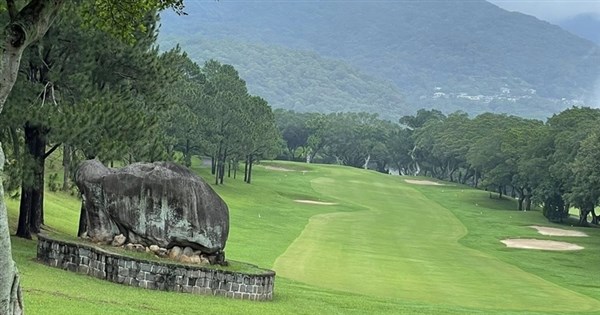
Kuohua Golf Club aims to overturn the perception of golf courses as environmentally unfriendly through scientific evidence. As part of its ESG initiatives, it conducted a one-year carbon audit and biodiversity survey of its golf course, becoming Taiwan's first. He Lichun, Vice Chairman of Beito Kuohua Golf Club, stated that they want to use a third-party scientific inspection to understand the areas for environmental improvement. Liu Wanyu, a professor from the Department of Forestry at National Chung Hsing University, led the team for the carbon audit and biodiversity survey of Kuohua Golf Club. She mentioned that her team usually conducts carbon audits for scenic areas, and this was their first for a golf course. She initially thought the carbon footprint of an artificial course wouldn't be good, despite the presence of plants and trees, due to fertilizer emissions. However, the final results exceeded her expectations, leading the team to re-verify the calculations. Liu Wanyu explained that Kuohua Golf Club covers approximately 78 hectares, with about 46 hectares of tree cover. According to the ISO 14064-1 international standard for greenhouse gas inventory (excluding buildings, only counting the course area), its greenhouse gas emissions in 2024 were 74.685 tCO2e/yr, while absorption reached 124.971 tCO2e/yr. This indicates a very high carbon sink effect, resulting in an overall negative carbon footprint for the course. It demonstrates that Kuohua Golf Club is a green field with environmental benefits and represents Taiwan's capability to align its ecological management and sustainability practices with international standards. Regarding biodiversity, Liu Wanyu stated that Kuohua Golf Club is located in the Tamsui Hills and is one of the few sites combining grassy areas, ponds, secondary forests, and forest edge environments. Over the year's four seasons of investigation, the team recorded 126 species, covering diverse ecosystems including mammals, birds, amphibians, reptiles, and insects. Liu Wanyu pointed out that Kuohua Golf Club hosts several protected and indicator species, such as the Level 3 protected Formosan Blue Magpie, Level 2 protected Crested Serpent Eagle, Osprey, Brown Hawk-Owl, and Spotted Owlet. Native mammals like Masked Palm Civets and Red Giant Flying Squirrels were also observed. Furthermore, unique Taiwanese species like the Taiwan Barbet and Chinese Bamboo Partridge were spotted. The favorable environment of the course allows these animals not just to pass through but to stay and raise their young, making the course's ecosystem comparable to a natural habitat. He Lichun shared her practices for maintaining the course environment, likening it to human health, emphasizing daily attention. For instance, they check the grass root system for normal drainage daily, not administering medication proactively to prevent grass diseases but rather allowing plants and animals to live as naturally as possible, treating problems only when necessary. Despite achieving a negative carbon footprint in its first audit, He Lichun said this year is considered the 'Year One' for Kuohua Golf Club's golf operations. She hopes for continuous improvement and an increase in biodiversity species in the future. International ecology expert Delphine Tseng, who has been involved in golf course ecology certification in the US for 15 years and participated in research for Ryder Cup courses, has written an ecological monograph for Kuohua Golf Club. Based on the biodiversity survey, it integrates the course's 'Luohan' landscape features as its core, transforming the relationship between the flora, fauna, and natural habitats within the course into more artistic and understandable content. The book is expected to be released in Chinese and English by the end of the year and is planned in a picture book format to introduce the course's ecology and natural environment to more children. Kuohua Golf Club also collaborates with nearby elementary schools on ecological education, organizing 'Ecological Photography Day' and joint learning activities with the Society for Environmental Education, Taiwan, starting in April. He Lichun expressed her hope that by opening the course to the public, more people can witness how golf courses can coexist with nature.
FACT BOX
- Source: CNA (Central News Agency)
- Category: Survey