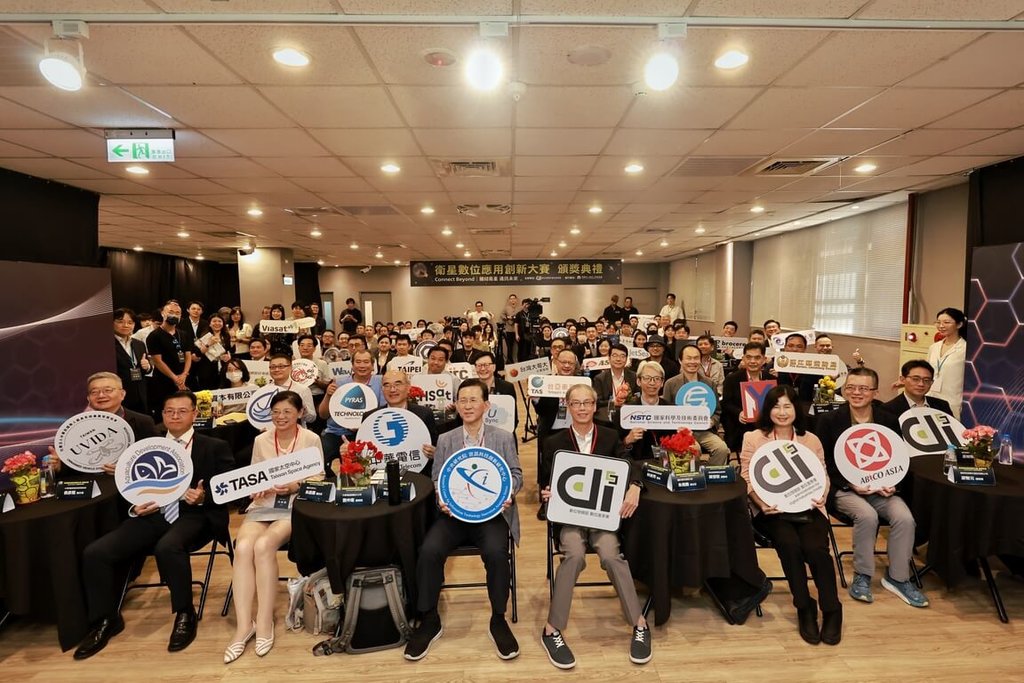
Taipei, April 15 (CNA) The Digital Industry Agency (DIA) of the Ministry of Digital Affairs held the awards ceremony for its first Satellite Digital Application Innovation Competition. The winning entries covered diverse fields such as disaster prevention, smart fisheries, remote healthcare, and cold chain logistics. DIA Director Lin Chun-hsiu stated that the competition effectively promotes the matching of participating teams with demand-side entities and IT service providers, accelerating the transition of research results from Proof of Concept (PoC) to practical application.
The DIA announced today in a press release that the awards ceremony for the first Satellite Digital Application Innovation Competition was held yesterday. The competition, themed "Connect Beyond: Linking the Future of Satellite Communications," attracted 131 teams from across Taiwan. Ultimately, 20 teams were selected for the gold award and special jury awards, demonstrating Taiwan's innovative strength in satellite communication, positioning, and remote sensing applications.
Lin Chun-hsiu pointed out that this competition is not only a arena for creativity but also a mechanism centered on "driving innovation through industrial demand." The competition specifically invited entities such as Yang Ming Marine Transport Corporation, Fang Hsing Technology, the Aquaculture Association, and the Overseas Fisheries Development Council to propose real industrial pain points, allowing participating teams to develop solutions for real-world scenarios.
Lin Chun-hsiu stated that this mechanism effectively promotes the matching of participating teams with demand-side entities and IT service providers, accelerating the transition of research results from Proof of Concept (PoC) to practical application. Among the 20 award-winning teams, as many as 18 were "academic-industrial cooperation" teams, indicating that the competition has successfully driven deep integration between ICT companies and academic research capabilities.
The DIA explained that the award-winning works cover diverse fields. For example, Chunghwa Telecom collaborated with the Lienchiang County Fire Department on a "Satellite/Mobile Communication Dual-Mode Network" solution. This scheme uses satellites as a communication backup mechanism during disasters, maintaining disaster relief command and information transmission even when ground networks are interrupted, becoming a crucial "digital lifeline" to ensure uninterrupted response.
The DIA noted that many works focused on issues such as deep-sea fishery communication, smart cold chain logistics, and maritime safety management. By using low-orbit satellites to supplement the limitations of communication in international waters, medical support, logistics monitoring, and safety management can operate in real-time, demonstrating high potential for practical implementation.
The DIA stated that this competition successfully connected 16 universities, including National Taiwan University of Science and Technology, National Taipei University of Technology, National Central University, National Sun Yat-sen University, National Cheng Kung University, and National Taitung University, with 26 ICT companies to form a cross-domain cooperation network. In the future, the DIA will continue to optimize the competition and verification mechanisms, combining subsidy programs to promote a "competition, verification, industrial cooperation" trinity model, assisting excellent solutions in commercialization and linking to international markets, and gradually building a complete satellite application service ecosystem in Taiwan. (Editor: Pan Yi-ching) 1150415
FACT BOX
- Source: CNA (Central News Agency)
- Category: product_launch