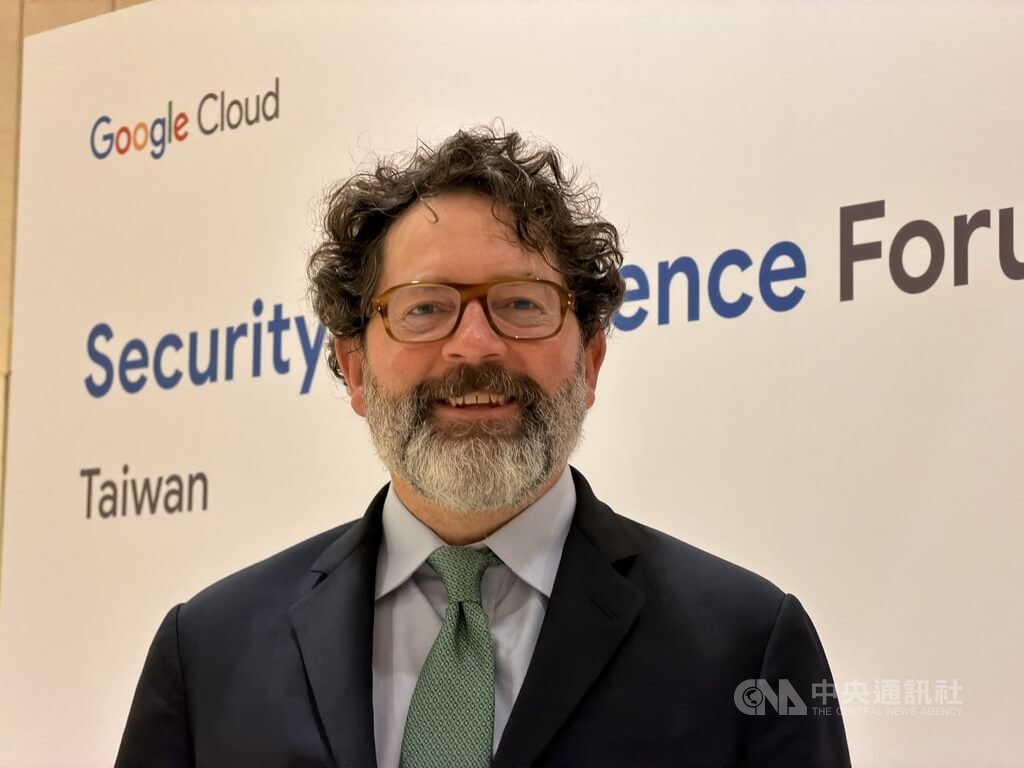
Taipei, April 15 (CNA) With the rapid advancement of artificial intelligence (AI) technology, Google's Vice President of Engineering, Royal Hansen, said today that hackers are using AI to accelerate attacks, with the collaboration and handover time among members having drastically reduced from the previous 8 hours to 22 seconds, and will soon enter the "nanosecond" level. Cybersecurity defense must shift to an "immune system" mindset, achieving scalable defense through "built-in security."
Hansen leads the "Privacy, Security, and Protection" team, a core engineering department at Google responsible for building and expanding foundational technologies to ensure the online security of billions of users worldwide.
Hansen delivered a speech today at the Google Cloud Security & Resilience Forum Taiwan in Taipei and accepted interviews with a few media outlets, including CNA. He said that cyberattacks are showing a "bipolar" trend: one end is a lightning-fast blitz, where hackers go from scanning vulnerabilities to stealing data in an instant; the other end is a long-term, years-long latent infiltration.
When asked by a CNA reporter how Taiwan, being in a geopolitically sensitive region, should strengthen its digital resilience, he said that although Taiwan is currently under the spotlight, many regions around the world face similar challenges. "If we want to rely on individual companies, individual government departments, individual small businesses, or individuals to defend, it will not succeed."
Hansen emphasized that digital resilience must be viewed as an "immune system," just like adding fluoride to water. "The 'medicine' must be directly placed into the cloud, models, emails, spreadsheets, and mobile phones. 'Built-in security' is the only way to achieve scalable defense."
Facing endless cyberattacks, Hansen believes that defenders must become experts in using AI if they want to win, because attackers are already doing so. AI agents can handle tedious cybersecurity maintenance tasks, such as automatically cleaning up sensitive data that has not been used for a year, or automatically patching vulnerabilities when detected.
Regarding industry concerns about the risk of excessive permissions for AI agents, Hansen proposed the concepts of "Guardian Agent" and "permission bubbles." This mechanism is like an "angel on the shoulder," instantly determining the minimum permissions required for an agent to perform a task and quickly revoking access after the task is completed, ensuring a balance between innovation and responsibility.
In addition to AI threats, the encryption crisis brought by quantum computing is also counting down. Hansen revealed that Google has advanced the "readiness" deadline for post-quantum cryptography (PQC) to 2029; many hackers are now massively storing encrypted data, waiting for the advent of future quantum computers to crack them, which means "we are currently in a vulnerable state, just not yet aware."
He suggested that Taiwanese enterprises and governments should build a modern infrastructure with "Crypto Agility," which can quickly replace algorithms in a modular way, rather than just a one-time technology upgrade.
Hansen said that software engineering used to be described as building architecture or bridges, but now it is entering a world more like "biology." Some startups in Silicon Valley rewrite their applications every day to ensure security, and the speed of software changes will be extremely fast and continuous. "Don't see this as engineering; see it as biology, as a cellular immune system."
Hansen frankly stated that he engages in cybersecurity defense to enable society to boldly promote major technological innovations such as cancer treatment and energy transition, without worrying about handing over all permissions to agents. He hopes that Taiwan, as the "engine" of global technology, can play a key role in this cybersecurity paradigm shift from an architectural engineering concept to an "immune system" mindset. (Editor: Chang Liang-chih) 1150415
FACT BOX
- Source: CNA (Central News Agency)
- Category: research