Adding Taiwan to the World's Pulse: Paris Student Remedial Class Trend Blends Art and Ecology
A series of "Taiwan History Remedial Classes" was held in Paris, co-organized by INALCO and NTNU, introducing Taiwan's history and culture to French students through art and ecology. Professor Bai Shi-ming presented two modern Taiwanese artists, while Professor Fang Wei-da explained the importance of wetland conservation. Participating students learned about Taiwan's history and ecology, deepening their understanding through painting workshops.
📋 Article Processing Timeline
- 📰 Published: April 15, 2026 at 19:51
- 🔍 Collected: April 15, 2026 at 20:01 (10 min after Published)
- 🤖 AI Analyzed: April 15, 2026 at 20:32 (30 min after Collected)
Central News Agency
(Central News Agency reporter Li Ruoyun, Paris, 15th) When Taiwan history remedial classes spread to Paris, what was shared with French students was not just the history of a distant Taiwan, but Taiwan's participation in the world's pulse.
The Paris student version of the "Taiwan History Remedial Class" series of activities was co-organized by the French National Institute of Oriental Languages and Civilizations (INALCO) and the International Taiwan Studies Research Center of National Taiwan Normal University (NTNU). From the perspectives of "art" and "ecology," it presented how Taiwanese people explore and contribute themselves to the world between sensibility and rationality.
Bai Shi-ming, director of the Taiwan Art History Research Center at NTNU, and Fang Wei-da, associate dean of academic affairs at NTNU and chairman of the Taiwan Wetland Society, specially traveled from Taiwan to Paris to share one-hour courses, combining film screenings and interactive workshops.
Bai Shi-ming's Taiwan art history remedial class selected two representative Taiwanese painters: Li De (1921-2010), born in Jiangsu, China, who settled in Taipei in 1948 and studied under Taiwanese painter Chen Dewang, exploring emptiness and form through abstract painting with an otherworldly philosophical thinking; Liu Geng-yi (1938-), born in Japan, whose mother was Japanese and father was Taiwanese painter Liu Qixiang, returned to Taiwan with his parents in 1946 and settled in Tainan, exploring family memories through figure painting with an earthly concern for the land.
Bai Shi-ming stated in an exclusive interview with the Central News Agency that although the styles of these two artists are very different, they both used Western media such as oil painting and sketching, which were introduced to Taiwan after the Japanese colonial period, rather than traditional media such as brush and ink. They both considered themselves modern artists at the time and were influenced by the French painter Paul Cézanne, which is why he chose to introduce them to Parisian students.
Bai Shi-ming said: "Taiwan's art history reflects the hybridity of Taiwanese culture, which has expanded from a single Greater China culture to include Japanese, indigenous, Asian, and Western cultures. Taiwanese self-identity needs to be achieved through a more inclusive attitude, otherwise, we will never be able to clearly say who we are."
Bai Shi-ming stated that with the development of Taiwan's democratization, the discipline of "Taiwan Art History" was only established in 2003; in the past, there was only Chinese and Western art history. Even though he had studied Japanese art history in Kyoto, he could not learn Taiwan art history from the previous generation, and everyone had to catch up on their own.
Bai Shi-ming added that research on Taiwan art history has been going on for more than 20 years. In addition to establishing a clearer context for the general history of Taiwanese art, scholars are actively promoting Taiwan to the world and enhancing cross-cultural communication skills by participating in ongoing global discussions on issues such as post-colonialism and gender, so that the world can empathize with Taiwan and participate in Taiwan.
Fang Wei-da's Taiwan ecology history remedial class chose to introduce "Taiwan's wetland ecology."
He stated in an exclusive interview with the Central News Agency that to conserve waterbirds and wetland ecology, the international community signed the "Ramsar Convention" in Iran in 1971. Taiwan was unable to participate at that time due to its withdrawal from the United Nations, but many years later, as a member state of the International Wetland Scientists Society (SWS), it hosted the "International Wetland Conference" in Taiwan in 2024, attracting representatives from the United Nations and 30 countries.
Fang Wei-da explained that since the establishment of the "Wetland Conservation Act" in Taiwan in 2015, "carbon sinks" have been actively promoted in recent years, meaning that wetlands have the function of absorbing and storing carbon. If wetlands are properly conserved and managed, it helps maintain their ecological functions, reduces the risk of greenhouse gas emissions, and helps mitigate global warming.
Fang Wei-da added that when promoting wetland conservation, in addition to scientific research, artistic creation and cultural narratives are also used. For example, on World Wetlands Day on February 2, 2026, there will be a theme related to indigenous peoples. Wetland culture connects river and ocean cultures, carrying the inheritance of seeds, agriculture, and history.
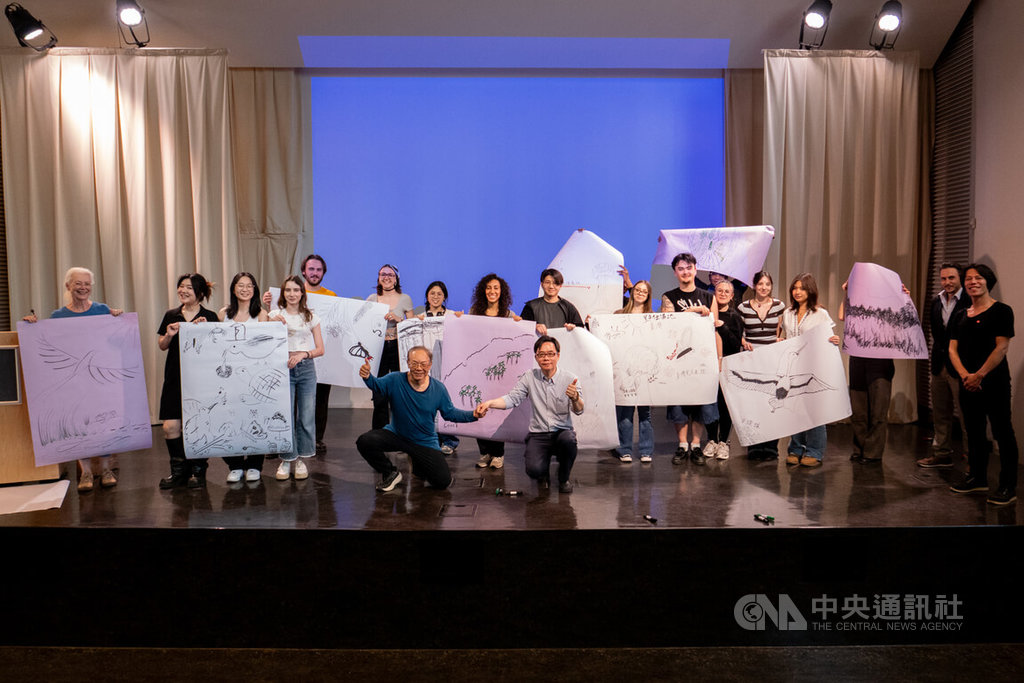
Fang Wei-da prepared large drawing papers in the course, allowing Parisian students to draw their interpretations of Taiwan's ecology.
Fang Wei-da said that through drawing, different Eastern and Western perspectives can be observed, as well as everyone's different perspectives on nature, whether from a panoramic view or a single species. He welcomes the world to Taiwan to experience the wetlands, touch the clear water quality, and adjust body and mind balance through the five senses.
The Paris student version of the "Taiwan History Remedial Class" series of activities consists of 3 courses and workshops. In addition to art and ecology themes, there is also a Taiwan history class from 1945 to 1980 and a screening of the documentary "Hand in Hand," held on the 9th and 15th at INALCO. (Editor: Chen Chenggong) 1150415
Choose to stand with the facts, every sponsorship you make is a force to protect press freedom.
Download the Central News Agency "First-hand News" APP to get the latest news instantly.
The text, pictures, and audio-visual content of this website may not be reproduced, publicly broadcast, or publicly transmitted and used without authorization.
(Central News Agency reporter Li Ruoyun, Paris, 15th) When Taiwan history remedial classes spread to Paris, what was shared with French students was not just the history of a distant Taiwan, but Taiwan's participation in the world's pulse.
The Paris student version of the "Taiwan History Remedial Class" series of activities was co-organized by the French National Institute of Oriental Languages and Civilizations (INALCO) and the International Taiwan Studies Research Center of National Taiwan Normal University (NTNU). From the perspectives of "art" and "ecology," it presented how Taiwanese people explore and contribute themselves to the world between sensibility and rationality.
Bai Shi-ming, director of the Taiwan Art History Research Center at NTNU, and Fang Wei-da, associate dean of academic affairs at NTNU and chairman of the Taiwan Wetland Society, specially traveled from Taiwan to Paris to share one-hour courses, combining film screenings and interactive workshops.
Bai Shi-ming's Taiwan art history remedial class selected two representative Taiwanese painters: Li De (1921-2010), born in Jiangsu, China, who settled in Taipei in 1948 and studied under Taiwanese painter Chen Dewang, exploring emptiness and form through abstract painting with an otherworldly philosophical thinking; Liu Geng-yi (1938-), born in Japan, whose mother was Japanese and father was Taiwanese painter Liu Qixiang, returned to Taiwan with his parents in 1946 and settled in Tainan, exploring family memories through figure painting with an earthly concern for the land.
Bai Shi-ming stated in an exclusive interview with the Central News Agency that although the styles of these two artists are very different, they both used Western media such as oil painting and sketching, which were introduced to Taiwan after the Japanese colonial period, rather than traditional media such as brush and ink. They both considered themselves modern artists at the time and were influenced by the French painter Paul Cézanne, which is why he chose to introduce them to Parisian students.
Bai Shi-ming said: "Taiwan's art history reflects the hybridity of Taiwanese culture, which has expanded from a single Greater China culture to include Japanese, indigenous, Asian, and Western cultures. Taiwanese self-identity needs to be achieved through a more inclusive attitude, otherwise, we will never be able to clearly say who we are."
Bai Shi-ming stated that with the development of Taiwan's democratization, the discipline of "Taiwan Art History" was only established in 2003; in the past, there was only Chinese and Western art history. Even though he had studied Japanese art history in Kyoto, he could not learn Taiwan art history from the previous generation, and everyone had to catch up on their own.
Bai Shi-ming added that research on Taiwan art history has been going on for more than 20 years. In addition to establishing a clearer context for the general history of Taiwanese art, scholars are actively promoting Taiwan to the world and enhancing cross-cultural communication skills by participating in ongoing global discussions on issues such as post-colonialism and gender, so that the world can empathize with Taiwan and participate in Taiwan.
Fang Wei-da's Taiwan ecology history remedial class chose to introduce "Taiwan's wetland ecology."
He stated in an exclusive interview with the Central News Agency that to conserve waterbirds and wetland ecology, the international community signed the "Ramsar Convention" in Iran in 1971. Taiwan was unable to participate at that time due to its withdrawal from the United Nations, but many years later, as a member state of the International Wetland Scientists Society (SWS), it hosted the "International Wetland Conference" in Taiwan in 2024, attracting representatives from the United Nations and 30 countries.
Fang Wei-da explained that since the establishment of the "Wetland Conservation Act" in Taiwan in 2015, "carbon sinks" have been actively promoted in recent years, meaning that wetlands have the function of absorbing and storing carbon. If wetlands are properly conserved and managed, it helps maintain their ecological functions, reduces the risk of greenhouse gas emissions, and helps mitigate global warming.
Fang Wei-da added that when promoting wetland conservation, in addition to scientific research, artistic creation and cultural narratives are also used. For example, on World Wetlands Day on February 2, 2026, there will be a theme related to indigenous peoples. Wetland culture connects river and ocean cultures, carrying the inheritance of seeds, agriculture, and history.
Fang Wei-da prepared large drawing papers in the course, allowing Parisian students to draw their interpretations of Taiwan's ecology.
Fang Wei-da said that through drawing, different Eastern and Western perspectives can be observed, as well as everyone's different perspectives on nature, whether from a panoramic view or a single species. He welcomes the world to Taiwan to experience the wetlands, touch the clear water quality, and adjust body and mind balance through the five senses.
The Paris student version of the "Taiwan History Remedial Class" series of activities consists of 3 courses and workshops. In addition to art and ecology themes, there is also a Taiwan history class from 1945 to 1980 and a screening of the documentary "Hand in Hand," held on the 9th and 15th at INALCO. (Editor: Chen Chenggong) 1150415
Choose to stand with the facts, every sponsorship you make is a force to protect press freedom.
Download the Central News Agency "First-hand News" APP to get the latest news instantly.
The text, pictures, and audio-visual content of this website may not be reproduced, publicly broadcast, or publicly transmitted and used without authorization.
FAQ
Where was the "Taiwan History Remedial Class" series held?
It was held in Paris, France, at the French National Institute of Oriental Languages and Civilizations (INALCO), co-organized with the International Taiwan Studies Research Center of National Taiwan Normal University.
What themes were covered in this event?
The event primarily covered Taiwan's history and culture from two perspectives: "art" and "ecology." Specifically, lectures and workshops on Taiwan's art history and wetland ecology were conducted.