165 Anti-Fraud Hotline Charges, Legislator Urges Government to Make it Free for All
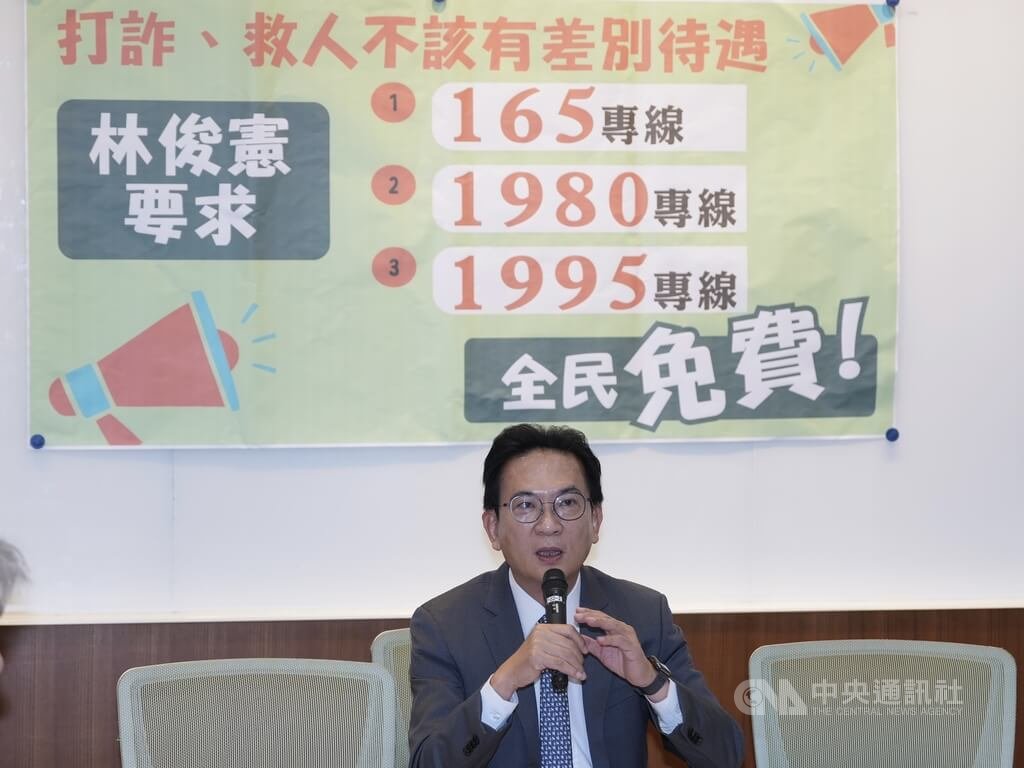
Legislator Lin Chun-hsien called on the government to allocate a budget to make public service hotlines, including the 165 anti-fraud hotline, 1980 counseling hotline, and 1995 lifeline, free for all citizens. Currently, some telecom providers charge non-Chunghwa Telecom users for these calls. Usage of the 165 hotline increased significantly in 2023, highlighting the need for accessible services.
📋 Article Processing Timeline
- 📰 Published: April 17, 2026 at 12:18
- 🔍 Collected: April 17, 2026 at 12:31 (13 min after Published)
- 🤖 AI Analyzed: April 17, 2026 at 17:15 (4h 43m after Collected)
Taipei, April 17 (CNA) Democratic Progressive Party (DPP) Legislator Lin Chun-hsien held a press conference today, stating that public service hotlines such as the 165 anti-fraud hotline, 1980 Chang Teachers counseling hotline, and 1995 Lifeline psychological counseling and suicide prevention hotline are all crucial for public safety and have public welfare性质. However, citizens using non-Chunghwa Telecom numbers to dial these three hotlines are charged. He urged the government to allocate a budget to make these services free for all citizens.
Lin Chun-hsien held a press conference at the Legislative Yuan today titled "165, 1980, 1995 Hotlines Free for All." He stated that some citizens have complained that while the government considers anti-fraud a major task and spends a lot of money on prevention, these highly public welfare-oriented and protective hotlines still charge fees. He later found that not all calls are charged; it depends on the telecom provider. Chunghwa Telecom users are not charged, but Far EasTone and Taiwan Mobile users are.
Lin Chun-hsien pointed out that Far EasTone and Taiwan Mobile charge for voice interconnection fees. Calls to the 165 hotline from these two providers are routed through Chunghwa Telecom, costing NT$0.3 during normal hours, with the two providers then charging citizens NT$1.
Lin Chun-hsien mentioned that government statistics show that in 2023, citizens made 475,000 calls to the 165 hotline, with an average call duration of about 213 seconds, an increase of nearly 9% from 2022, indicating increasing public usage. He believes the government should show care and consideration for its citizens, and these fees should not be collected from the public but subsidized by the government to telecom providers. Besides 165, 1980 and 1995 also charge fees. He believes these public welfare hotlines, which can save lives, should not charge fees.
Huang Tian-yang, Deputy Director of the Platform Business Management Department of the National Communications Commission (NCC), explained that the two providers charge because they first filter customer service calls before transferring them to the 165 hotline, and 1980 and 1995 are charged based on interconnection fees. He added that if the government, based on public-private cooperation, believes that providers are willing to calculate rates based on costs, and the Ministry of Interior and Ministry of Health and Welfare fund these with public money, it would certainly help those in need.
Cheng Shu-hsin, Deputy Director of the Department of Mental Health, Ministry of Health and Welfare, explained that if call fees were completely waived, it would reduce hesitation for people seeking help and welcomed the suggestion to lower barriers to seeking help. However, further evaluation is needed because the 1980 and 1995 hotlines are established by private organizations. If free calls increase usage, call volume will rise, requiring more volunteer staff. If staffing cannot keep up, it might become even harder for people to get through.
Lin Gu-yan, Deputy Director of the Criminal Investigation Bureau, National Police Agency, Ministry of Interior, pointed out that as the Ministry of Health and Welfare mentioned, regarding the overall service capacity, if the government allocates a budget and the Legislative Yuan approves it, the police agency will then consider how to increase service capacity. (Editor: Chang Ruo-yao) 1150417
Lin Chun-hsien held a press conference at the Legislative Yuan today titled "165, 1980, 1995 Hotlines Free for All." He stated that some citizens have complained that while the government considers anti-fraud a major task and spends a lot of money on prevention, these highly public welfare-oriented and protective hotlines still charge fees. He later found that not all calls are charged; it depends on the telecom provider. Chunghwa Telecom users are not charged, but Far EasTone and Taiwan Mobile users are.
Lin Chun-hsien pointed out that Far EasTone and Taiwan Mobile charge for voice interconnection fees. Calls to the 165 hotline from these two providers are routed through Chunghwa Telecom, costing NT$0.3 during normal hours, with the two providers then charging citizens NT$1.
Lin Chun-hsien mentioned that government statistics show that in 2023, citizens made 475,000 calls to the 165 hotline, with an average call duration of about 213 seconds, an increase of nearly 9% from 2022, indicating increasing public usage. He believes the government should show care and consideration for its citizens, and these fees should not be collected from the public but subsidized by the government to telecom providers. Besides 165, 1980 and 1995 also charge fees. He believes these public welfare hotlines, which can save lives, should not charge fees.
Huang Tian-yang, Deputy Director of the Platform Business Management Department of the National Communications Commission (NCC), explained that the two providers charge because they first filter customer service calls before transferring them to the 165 hotline, and 1980 and 1995 are charged based on interconnection fees. He added that if the government, based on public-private cooperation, believes that providers are willing to calculate rates based on costs, and the Ministry of Interior and Ministry of Health and Welfare fund these with public money, it would certainly help those in need.
Cheng Shu-hsin, Deputy Director of the Department of Mental Health, Ministry of Health and Welfare, explained that if call fees were completely waived, it would reduce hesitation for people seeking help and welcomed the suggestion to lower barriers to seeking help. However, further evaluation is needed because the 1980 and 1995 hotlines are established by private organizations. If free calls increase usage, call volume will rise, requiring more volunteer staff. If staffing cannot keep up, it might become even harder for people to get through.
Lin Gu-yan, Deputy Director of the Criminal Investigation Bureau, National Police Agency, Ministry of Interior, pointed out that as the Ministry of Health and Welfare mentioned, regarding the overall service capacity, if the government allocates a budget and the Legislative Yuan approves it, the police agency will then consider how to increase service capacity. (Editor: Chang Ruo-yao) 1150417
FAQ
Is the 165 anti-fraud hotline currently free?
No, if you are using a telecom provider other than Chunghwa Telecom (Far EasTone, Taiwan Mobile), call charges apply.
Why do some telecom providers charge for calls?
Far EasTone and Taiwan Mobile charge for voice interconnection fees to transfer calls to Chunghwa Telecom, and then charge users an additional NT$1.