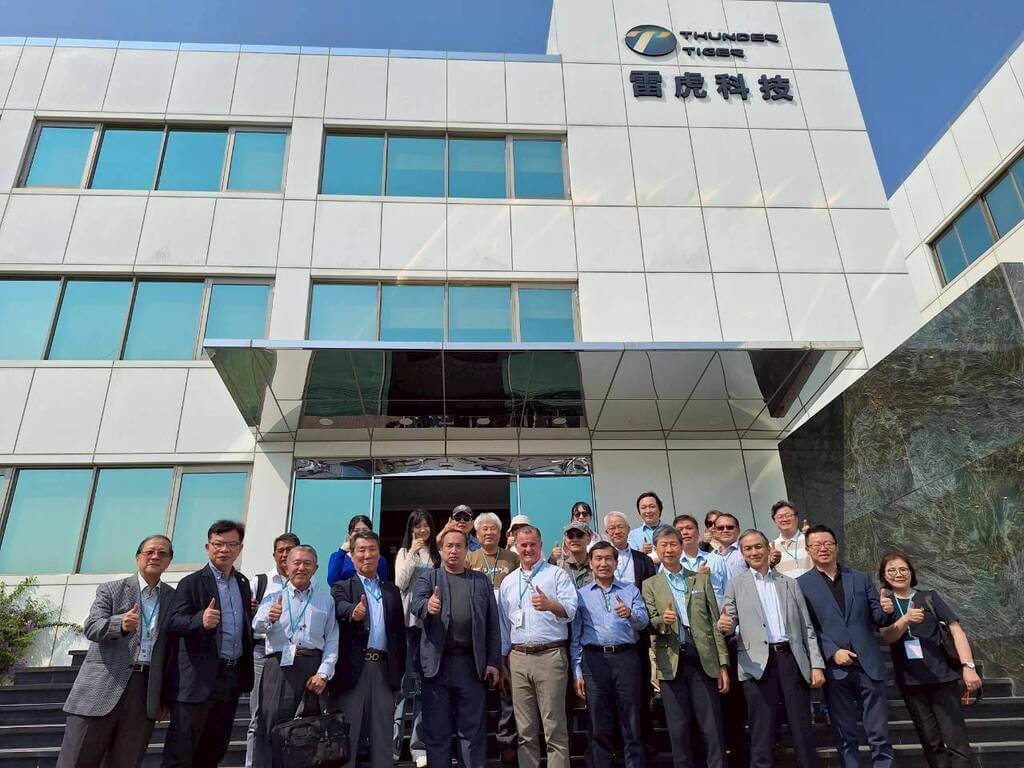
On April 13, Thunder Tiger Technology announced the release of its "Iron Triangle" drone PapaDELTA series loitering munition. This new series utilizes an aluminum alloy stamping process, a departure from traditional composite material hand-manufacturing, significantly enhancing production capacity, structural consistency, and manufacturing efficiency. The goal is to establish an overwhelming "quantity advantage" in asymmetric warfare through industrialized, self-destructing drone systems. This announcement aligns with the strategic perspective shared by Thunder Tiger Technology Chairman Chen Kuan-ju at the "Democracy's Shield: First Island Chain All-Society Resilience Cooperation International Forum" held on April 11 at the Regent Taipei. Chen Kuan-ju stated that asymmetric warfare has entered an era of "attrition," where the decisive factor is not the performance of a single piece of equipment, but rather the ability for industrialized mass production and continuous supply. He emphasized that an industrial system capable of stably and massively delivering low-cost unmanned vehicles is the true core competitiveness on the battlefield. The Formosa Club, which hosted the forum, visited Thunder Tiger Technology's headquarters on April 12 to gain a deeper understanding of Taiwan's unmanned aerial vehicle (UAV) supply chain and manufacturing capabilities. The PapaDELTA series is designed to meet the requirements of the US LUCAS architecture and features a highly modular design, allowing its application to unmanned surface vehicles (USV) and other unmanned vehicle platforms, thereby creating cross-platform mass production capabilities and overall combat power output. Through standardization and industrialized production, Thunder Tiger aims to transition unmanned vehicles from "boutique" to "scaled" production. Thunder Tiger explained that aluminum stamping offers advantages such as a mature supply chain, controllable costs, and rapid production, while also meeting international "non-red supply chain" requirements, crucial for supporting high-intensity battlefield attrition. The company stressed that future battlefields will compete on the "production capacity curve" of unmanned vehicles, including USVs and UAVs, rather than the performance of individual equipment. Furthermore, Thunder Tiger Technology has obtained US Blue UAS certification for its First Person View (FPV) loitering munition system. This certification provides cybersecurity and supply chain compliance advantages, enabling direct integration into US and allied procurement systems. Combined with its aluminum stamping mass production capability, Thunder Tiger has established a dual competitive advantage: "mass-producible and compliant." In response to escalating security tensions in the Indo-Pacific, Thunder Tiger Technology affirmed its commitment to deepening cooperation with democratic partners such as the US and Japan. The company aims to strengthen its non-red supply chain and industrial manufacturing capabilities, positioning itself as a critical and sustainable supply node within the First Island Chain defense system, and actively seizing strategic business opportunities in the rapidly growing global unmanned vehicle market.
FACT BOX
- Source: CNA (Central News Agency)
- Category: product_launch