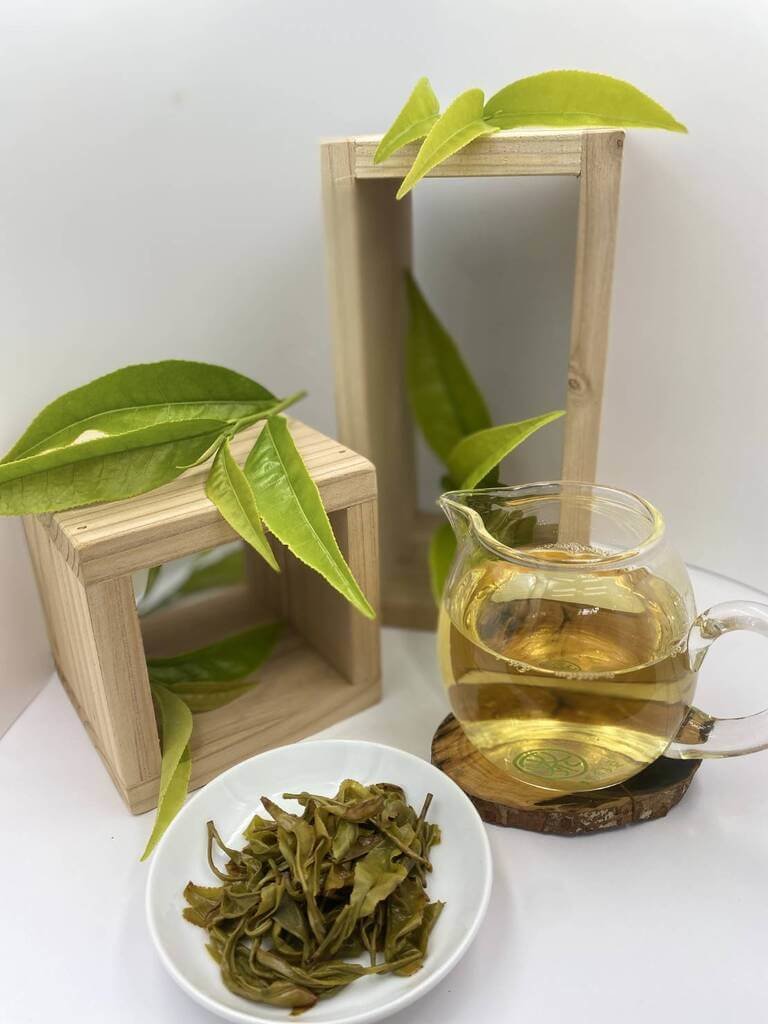
TAIPEI (CNA) – Taiwan's Tea Research and Extension Station (TRES) under the Ministry of Agriculture has successfully developed a new variety, "Shanyun" (台茶24號), through special tea-making processes, transforming a native tea species dubbed "Taiwan's tea industry's Formosan landlocked salmon" into a high-functional Oolong tea.
The Ministry of Agriculture announced today in a press release that TRES, aiming to give Taiwan's native tea trees a new market position, successfully transformed the native tea species, known as "Taiwan's tea industry's Formosan landlocked salmon," into a high-functional GABA Oolong tea through special tea-making processes. Analysis of its γ-aminobutyric acid (GABA) and L-theanine content showed significantly higher levels than commercially available products, injecting strong momentum into Taiwan's healthy functional tea beverage market and understory economy industry.
TRES Director Su Tsung-chen stated that Taiwan Tea No. 24 not only holds significant academic and conservation value, but the developed GABA high-value processing method further proves the market potential of Taiwan's native species for developing top-tier health teas. Tests have confirmed that the development process for Taiwan Tea No. 24 GABA Oolong tea is mature and can stably produce high-quality functional tea that meets specifications.
TRES explained that Taiwan's native mountain tea is an endemic species found only in Taiwan. Due to its rarity, it is listed as "near threatened." While similar in appearance to common tea species, it can grow into small trees up to 10 meters tall, currently scattered in mountainous areas of central, southern, and eastern Taiwan at altitudes of 600 to 1500 meters.
TRES stated that the development of "Shanyun" involved 19 years of selection and breeding. It is currently the only pure native species in the Taiwan Tea series and possesses extremely strong resistance to pests and adverse conditions, making it very suitable for organic and friendly cultivation.
TRES noted that unlike ordinary Oolong tea, "Shanyun" has a unique woody mushroom flavor, accompanied by the warm sweet aroma of brown sugar and roasted chestnuts. Through gas chromatography-mass spectrometry analysis, its important characteristic aroma molecules have been successfully identified, which can serve as a scientific basis for tea production quality control in the future.
The Forestry and Nature Conservation Agency of the Ministry of Agriculture began promoting the "understory economy" policy in 2019, and after cross-ministerial coordination in December 2021, Taiwan's native mountain tea was officially added to the understory economy product list. TRES stated that this policy not only maintains biodiversity but also makes Taiwan's native mountain tea a key bridge for promoting local economy and environmental conservation. (Editor: Wu Su-jou) 1150414
Choose to stand with facts, every sponsorship you make is a force to protect press freedom.
Download the CNA "First-hand News" APP to stay updated with the latest news.
The text, images, and audio-visual content of this website may not be reproduced, publicly broadcast, publicly transmitted, or utilized without authorization.
FACT BOX
- Source: CNA (Central News Agency)
- Category: product_launch