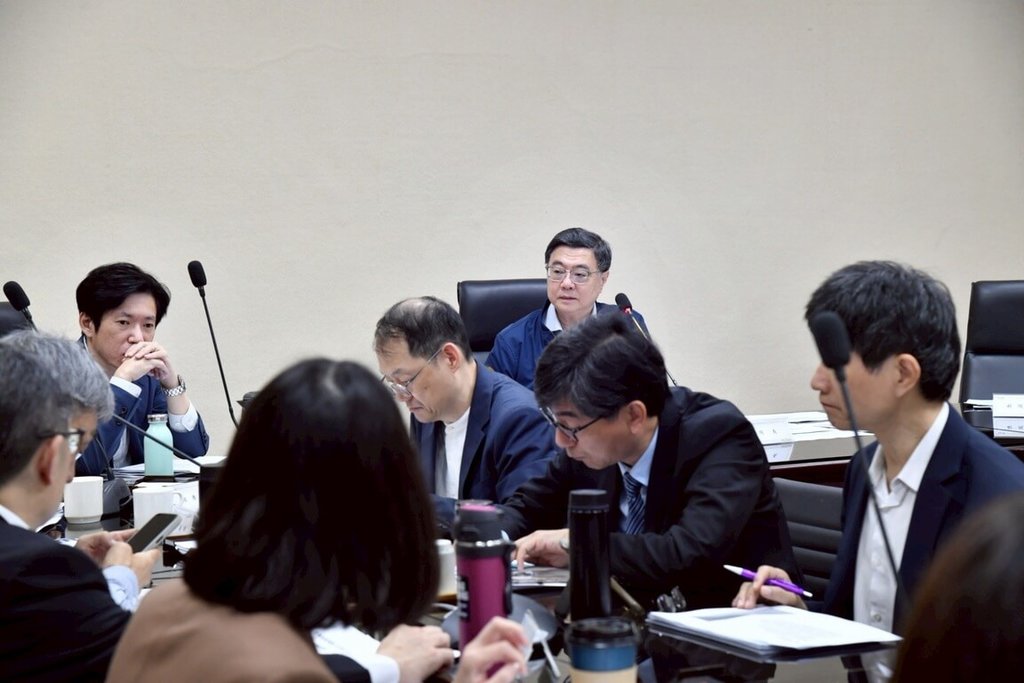
In response to the Middle East situation, Premier Cho Jung-tai explained today that natural gas shipments for April to May have been dispatched, ensuring ample supply; 95% of natural gas sources for June have been dispatched, and arrangements for after July are being made to ensure a stable domestic natural gas supply. For medicines and medical materials vital to public health, supply chains will be coordinated to ensure sufficient supply.
The Executive Yuan stated in a press release that Cho Jung-tai, chairing the "Special Project Meeting on People's Livelihood Stability in Response to Middle East Conflict" today, said that facing the high uncertainty of the Middle East situation, the government continues to monitor the dynamics of energy and various raw material supply chains, maintaining a stable supply of important daily necessities such as oil, gas, plastics, and medical materials. It also strengthens cross-ministerial joint inspection mechanisms to strictly investigate price gouging, hoarding, and unreasonable pricing behaviors, ensuring economic and livelihood stability.
Cho Jung-tai stated that in terms of energy supply, the government continues to prioritize stable supply. Currently, domestic oil prices, electricity prices, and liquefied natural gas (LNG) supply remain stable.
Cho Jung-tai explained that to care for the domestic livelihood, domestic gasoline and diesel prices maintain the "lowest prices among neighboring Asian countries." Natural gas shipments for April to May have been dispatched, ensuring ample supply, and 95% of natural gas sources for June have been dispatched, with arrangements for after July underway, ensuring a stable domestic natural gas supply. In terms of plastic supply, 5,000 tons of raw material ethylene have been increased, which can produce approximately 1.25 billion 1-jin plastic bags. The principle is domestic priority, and priority is given to supplying medical materials, agricultural production materials, daily necessities, and other industrial uses.
Cho Jung-tai mentioned that for medicines and medical materials vital to public health, the Food and Drug Administration of the Ministry of Health and Welfare collaborates with the Industrial Development Bureau of the Ministry of Economic Affairs to coordinate domestic pharmaceutical and medical material upstream and downstream supply chains, ensuring sufficient supply.
Cho Jung-tai explained that the Middle East situation has not yet eased, and there are still uncertain variables for energy and various raw material supplies in the future. He urged all ministries to continue closely monitoring all raw material sources, processes, dispatch, distribution, and coordination mechanisms, fully grasping supply chain dynamics to ensure stable supply and demand order for various materials.
Cho Jung-tai also mentioned that currently, the supply of fertilizers, feed, and agricultural and fishery related products is stable, and price freeze measures have been adopted. He asked for continued attention to relevant situational changes, rolling reviews, and timely proposals for related improvement measures.
Cho Jung-tai stated that the supply and demand order for certain items is becoming stable. For various daily necessities, consumer goods, medical supplies, and industrial products, if raw material production is sufficient and product supply is ample, but unreasonable price increases still occur in the mid-to-downstream supply chain, or if costs are not promptly reflected in sales prices after recovery, or if there are illegal hoarding and price gouging, he asked the Ministry of Justice and the Fair Trade Commission to strengthen joint inspections. He also asked all counties and cities to take corresponding actions to fully assist, effectively curb improper behaviors, and restore market order.
Cho Jung-tai emphasized that in the face of international situational changes, the government actively promotes various domestic constructions to ensure economic development; on the other hand, it also strengthens cross-ministerial joint inspection efforts to intensify investigations and punishments for illegal acts, ensuring market order and people's livelihood stability. (Editor: Chang Ruo-yao) 1150413
FACT BOX
- Source: CNA (Central News Agency)
- Category: regulation