Carbon trading
Sustainable Taiwan
International trends
Carbon inventory
Net-zero timeline
Net-zero encyclopedia
2026/04/13 21:06:23
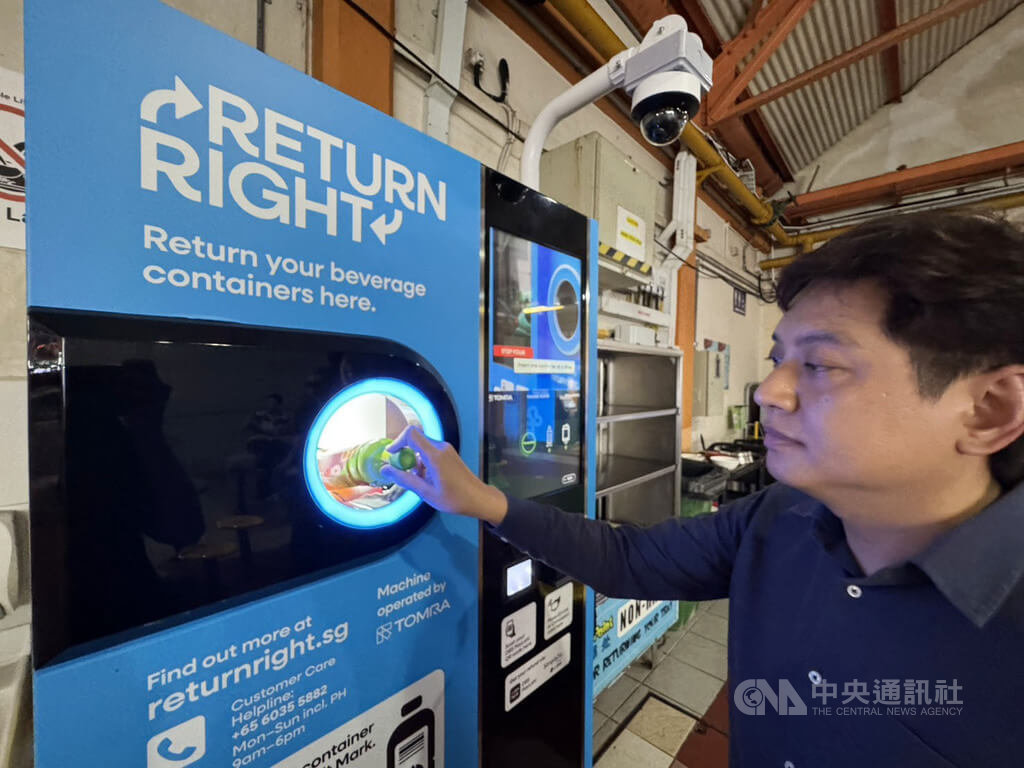
Singapore has launched a deposit-refund scheme for beverage bottles and cans. When purchasing bottled or canned beverages, consumers first pay a deposit of 10 Singapore cents (approximately NT$2.5). After consuming the beverage and depositing the empty container into a recycling machine, the deposit is returned to an e-wallet or other tools. This initiative hopes to increase public participation in recycling. Photo by CNA reporter Wu Shen-hung in Singapore, April 13, 2026.
(CNA reporter Wu Shen-hung, Singapore, April 13 exclusive report) Singapore has launched a deposit-refund scheme for beverage bottles and cans. When purchasing bottled or canned beverages, consumers first pay a deposit of 10 Singapore cents (approximately NT$2.5). After consuming the beverage and depositing the empty container into a recycling machine, the deposit is returned to an e-wallet or other tools. The authorities are striving to achieve a 55% recycling rate target this year. However, some are concerned that hidden costs may be passed on to consumers.
From April 1 to September 30 is the transition period for the beverage container refund system. Aluminum cans and plastic bottles with capacities ranging from 150 ml to 3 liters will gradually be affixed with deposit labels. The public can receive a refund of 10 Singapore cents per item by depositing empty bottles into recycling machines. To alleviate cost pressures on businesses, the Singapore National Environment Agency also provides subsidies to help them transition to the new system.
The new system will be fully implemented on October 1, by which time all designated containers must bear deposit labels. The target for the first year of trial operation is to recycle at least 60% of beverage containers, increasing to 80% in the third year. In the long term, it is estimated that over 16,000 metric tons of materials can be recycled annually from at least 1 billion beverage containers.
This evening, Singaporean cultural historian Ming Yong-chang visited the Maxwell Food Centre near Chinatown with a CNA reporter to observe the beverage container recycling machines. Ming Yong-chang said that people's awareness of climate change and emphasis on environmental protection are more profound than ever before. If there is a system to boost motivation and increase incentives, people are more likely to participate. This is why recycling machines are very important, as they are easy to operate and allow people to get their deposits back, making recycling a convenient daily habit.
However, Ming Yong-chang pointed out that although the policy's intention is environmental protection, there are also hidden concerns, such as the possibility of disguised price increases. That is, although the public pays only 10 Singapore cents as a deposit, the costs brought by the system exceed this amount. Some beverage manufacturers have mentioned that due to the procedures for handling empty bottle recycling and logistics transportation, hidden costs may ultimately be passed on to consumers. If beverage prices increase in the future, consumers, even if they get their deposits back, may still bear the expense due to the overall price increase.
The bottle and can recycling work is handled by the non-profit organization Beverage Container Return Scheme. The authorities plan to install approximately 2,000 beverage bottle and can recycling machines across Singapore within one year of the new system's launch. To promote the circular reuse of waste packaging plastic film and reduce the amount of plastic waste, the Singapore authorities have also launched the "Zero Waste Masterplan," aiming to reduce the per capita amount of waste sent to landfills by 30% by 2030.
According to Lianhe Zaobao, Singapore is striving to achieve a 55% recycling rate target this year. Assistant Professor Huang Yao-hui of Urban Studies at the Singapore Management University's College of Interdisciplinary Studies stated that the final recycling rate for 2026 remains to be seen, but with the launch of the beverage container refund system and increased public participation in food waste management, an increase in the recycling rate can be optimistically expected. (Editor: Chang Chih-hsuan) 1150413
Related News
Singapore promotes beverage bottle and can deposit system, recycling returns 10 cents SGD, hoping to increase participation
2026/04/13 21:06
Czech 'power sharing' emerges, solar power surplus matches demand without waste
2026/04/07 08:15
UK carbon emissions to drop 2% by 2025, renewable energy generation over half
2026/04/03 10:37
Hotline: 0800-256-688 | Email: services@mail.cna.com.tw
copyright © 2026 Central News Agency All Rights Reserved
Facing the challenges of global warming and extreme weather, Taiwan, as a member of the global community, has an undeniable responsibility. As CNA approaches its centennial, it upholds professionalism and has established a net-zero carbon emissions website, using international reports as warp and domestic reports as weft, to provide first-hand, real-time net-zero trends, laws, and technological new knowledge, leading readers to synchronize with the international community and move towards a low-carbon future.
Logo design concept: Combines CNA's corporate identity and two infinity symbols (∞), symbolizing a commitment to environmental sustainability and continuous cycles.
This website uses related technologies to provide a better reading experience, while respecting user privacy. Click here to learn about CNA's privacy statement. By closing this window, you agree to the above regulations. Keywords: None
FACT BOX
- Source: CNA (Central News Agency)
- Category: regulation