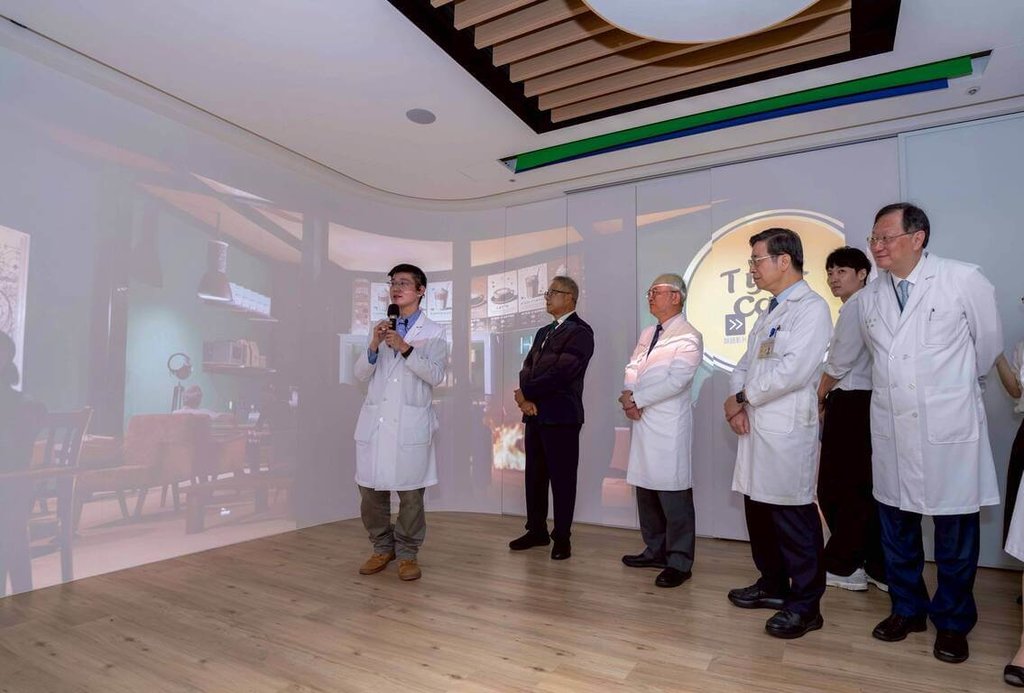
Taipei, April 13 (CNA) When facing the triage and emergency treatment of multiple trauma patients, with immersive scenarios and real-time interactive operations, trainees make decisions and receive emergency treatment training in simulated situations. National Taiwan University Hospital's Smart Learning Classroom introduces immersive technology, transforming traditional medical education.
National Taiwan University Hospital held the inauguration ceremony for its Smart Learning Classroom today, announcing the official launch of the newly built classroom. By introducing immersive projection, virtual reality (VR), and interactive digital learning systems, it creates a flexible and technologically advanced teaching space, hoping to open up a new model for medical education.
National Taiwan University Hospital stated in a press release that with the rapid evolution of medical education and technology, traditional teaching spaces can no longer meet diverse learning needs. The Smart Learning Classroom comprehensively upgrades the original simulation operating room, control room, and computer classroom of the Clinical Skills Center, integrating them into a smart learning classroom with immersive experience and high interactivity. The most distinctive feature is the three-sided panoramic immersive projection system.
The three-sided panoramic immersive projection system creates a highly realistic teaching environment through multiple laser projectors and ambient lighting, allowing students to train in situations close to real clinical settings. The hospital explained that the classroom is also equipped with a 98-inch interactive touch screen, a radar sensing interactive system, and various flexible teaching modes, significantly enhancing classroom interaction and learning effectiveness.
In addition to supporting immersive teaching, the Smart Learning Classroom also integrates multiple innovative functions, including VR self-learning, remote video teaching, and real-time cross-classroom connections. National Taiwan University Hospital stated that it hopes teaching will no longer be limited to a single space. Through a wireless conference system, teachers can simultaneously display teaching materials and remote participants' screens, enhancing the sense of presence in remote teaching.
National Taiwan University Hospital pointed out that the construction of this Smart Learning Classroom is not only an upgrade of space and equipment but also represents a significant transformation of medical education from traditional to digitized, personalized, and contextualized. By integrating clinical teaching needs with advanced technological applications, it will continue to develop more innovative teaching models in the future to cultivate a new generation of medical professionals with clinical judgment and technological literacy. (Editor: Kuan Chung-wei) 1150413
FACT BOX
- Source: CNA (Central News Agency)
- Category: research