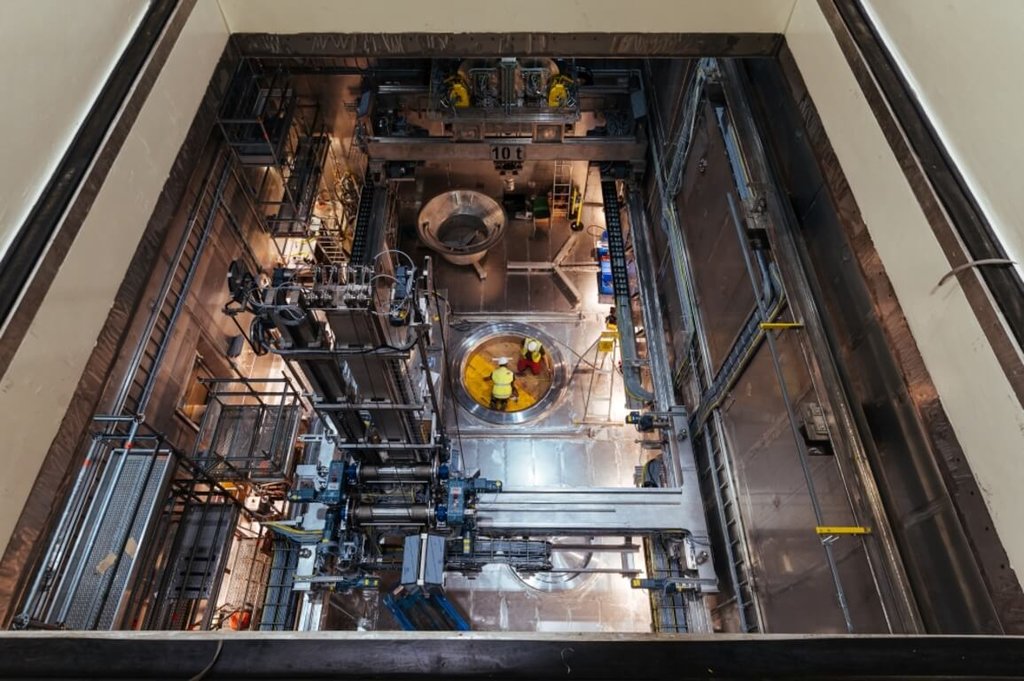
HELSINKI, April 14 (CNA) Since the advent of nuclear energy, the disposal of nuclear waste has remained an unresolved challenge, with nearly 400,000 tons of global nuclear waste, two-thirds of which is still accumulated in temporary storage. The world's first deep geological nuclear waste repository, Onkalo in Finland, is about to begin trial operations and is expected to obtain formal permits within months, marking a significant milestone in the history of nuclear power.
Onkalo is located on Olkiluoto Island on Finland's west coast, where three of Finland's five nuclear reactors are situated. Construction of the nuclear waste facility began in 2004, with construction costs alone reaching approximately 1 billion euros (about NT$37 billion). An additional 4 billion euros (about NT$148 billion) will be required for the subsequent century of operation and final sealing, all to be funded by Finland's two nuclear power companies, which have been allocating funds annually from electricity revenue for decades.
Used nuclear fuel rods are first encapsulated in copper containers at a surface packaging plant, then transported by unmanned machinery into a 430-meter-deep tunnel, where they are secured by a clay layer within 1.9-billion-year-old granite bedrock. The facility is designed to hold 6,500 tons, enough to accommodate all waste generated by Finland's nuclear power plants throughout their entire operational lifespan. The entire facility is expected to operate until the 2120s, after which the tunnels will be sealed permanently.
According to the Associated Press, Pasi Tuohimaa, spokesperson for Posiva, the company responsible for Finland's long-term nuclear waste management, said, "This solution is precisely the missing piece for the sustainable use of nuclear energy."
However, criticism has never ceased. According to reports, Edwin Lyman, Director of Nuclear Safety at the Union of Concerned Scientists in the United States, directly stated that deep geological disposal is still full of "uncertainties": "There are no good options for nuclear waste disposal, but finding the least bad option is important, and geological disposal, overall, is the least bad among various bad options."
Lyman pointed out that copper containers will eventually corrode, and there is still debate in the scientific community about the rate of corrosion. For nuclear waste radioactivity to decay to harmless levels, some elements require up to 100,000 years. The core assumption of the design is that the corrosion rate is slow enough for most radioactive materials to decay before the containers fail. Lyman said that the risk will ultimately be borne by future generations.
Finland's ability to reach this stage is key to a 1994 amendment to its law: all nuclear waste within its borders must be permanently disposed of domestically and cannot be exported. According to the Associated Press, Environment Minister Sari Multala said, "We have also walked the talk, which is different from many other countries." She added that small-scale acceptance of waste from other countries is not ruled out in the future.
Although Onkalo has taken the first step, there is still a long way to go. The radioactive hazard of nuclear waste can last for over 100,000 years, far exceeding the history of any human civilization. How to inform future generations tens of thousands of years from now that danger is buried beneath their feet currently has no definitive answer. To this end, linguists, archaeologists, and anthropologists have formed an interdisciplinary research team dedicated to "nuclear semiotics," such as designing symbols and markings that can convey "danger here" across millennia. (Edited by Tien Jui-hua) 1150414
FACT BOX
- Source: CNA (Central News Agency)
- Category: Taiwan