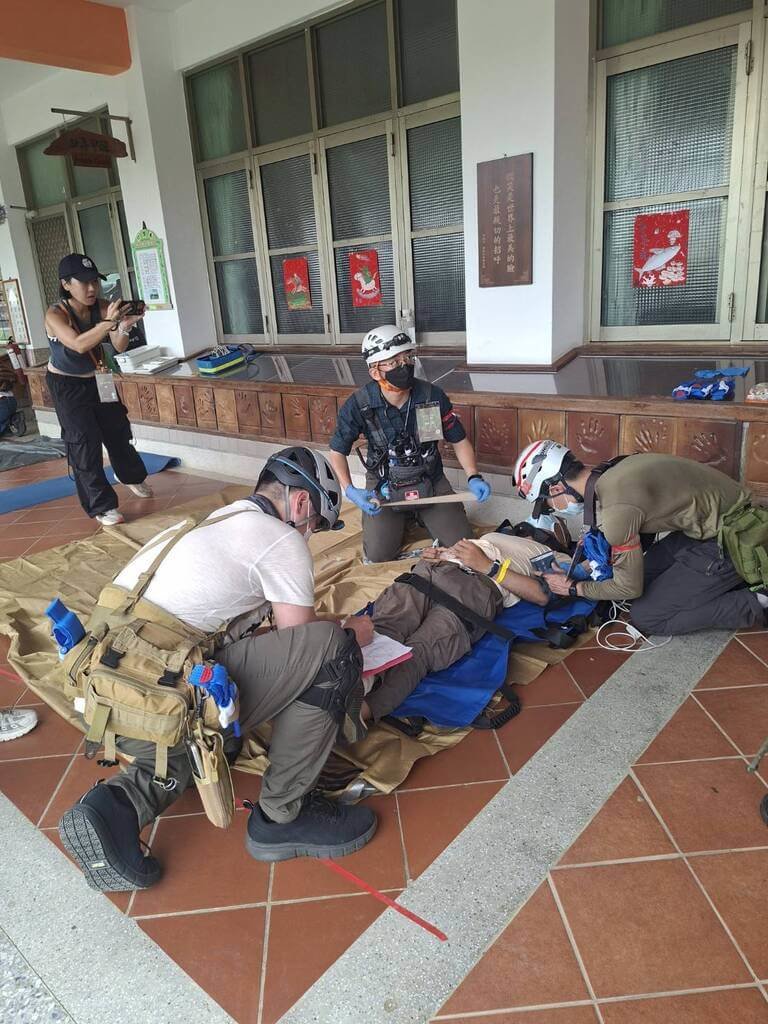
The Fuhhe Association held the 'Fuhhe Association 2026 Civil Defense Joint Training' in Zhongliao, Nantou from the 11th to the 13th. Unlike last year's training, which was held at the National Fire Agency's training center, this year's event took place in Fucheng Village, Zhongliao Township, to more closely simulate actual conditions. About 100 people from civil defense self-training groups across Taiwan participated, with an additional 65 serving as staff.
The training scenario covered the period from 36 days before a PLA invasion of Taiwan to landing day, incorporating various attacks such as blockades, airstrikes, fifth columns, harassment, and disinformation. Participants were required to coordinate with the armed forces on combat casualty care and military-civilian handovers, assist in civilian evacuation, set up emergency medical stations to treat civilian injuries and shelters, and conduct community security patrols to respond to security incidents. Trainees were divided into five groups: forward, security, medical, shelter, and command.
For example, in the medical group drill, staff members acted as casualties, with referees describing their conditions. Trainees had to apply their learned first-aid skills. If they made mistakes, referees provided immediate reminders or feedback.
Dr. Lai You-an, a dentist serving as a referee for the medical group, shared that this year's scenario involved a higher level of military threat, with frequent attack situations creating a high-pressure environment for participants. Many medical group trainees held EMT-1 certification, but some struggled with unfamiliarity due to nervousness or lack of recent practice, and found their knowledge insufficient for advanced scenarios.
He emphasized that in a real situation, they must act. Therefore, the joint training tests how people find help or act within their existing capabilities.
Furthermore, this year's training strengthened war-disaster scenarios, with a significant increase in conflict elements compared to last year. Reserve soldiers from self-training groups were seen playing the roles of the national army and fifth columns, drilling scenarios like combat and harassment, and using it as a 'refresher' for their own combat skills.
Liu Yu-hsi, convener of the joint training and a member of the Presidential Office's All-Out Defense Resilience Committee, told CNA that this year's training was more intense than last year's and was explicitly based on a war-disaster scenario. Malicious attacks in a war-disaster situation would be far more numerous than in a natural disaster, testing the psychological state of civil defense personnel. These scenarios were added in response to geopolitical risks.
Liu stated that a high proportion of 70% of participants were women, higher than last year, which aligns with the reality of civil defense in a war, as men might be conscripted, leaving women as the main civilian force. Many of this year's participants were newcomers, recognizing the need to defend Taiwan and hoping to find their role in the civil defense team.
Feng Ai-li, co-founder of the Taiwan Defense Research Initiative who observed the event, pointed out that the drill tested the civil defense groups' ability to not only maintain civilian life and medical capacity but also to handle harassment from fifth columns and drones. It also tested how the civil defense team would relocate when the PLA lands and approaches their command post. Therefore, the drill fully considered scenarios for civil defense in homeland defense operations.
One participant told CNA that the drill showed there is still room for optimization in how the chain of command connects vertically and horizontally. Too often, information from below couldn't get through, and orders from above couldn't get down. Some groups lacked horizontal communication, leading to time-consuming information transfer that affected response times. An After Action Review (AAR) will be conducted on the 13th, hoping to identify the causes. (Editor: Lin Ke-lun, Yang Kai-hsiang) 1150412
FACT BOX
- Source: CNA (Central News Agency)
- Category: Event