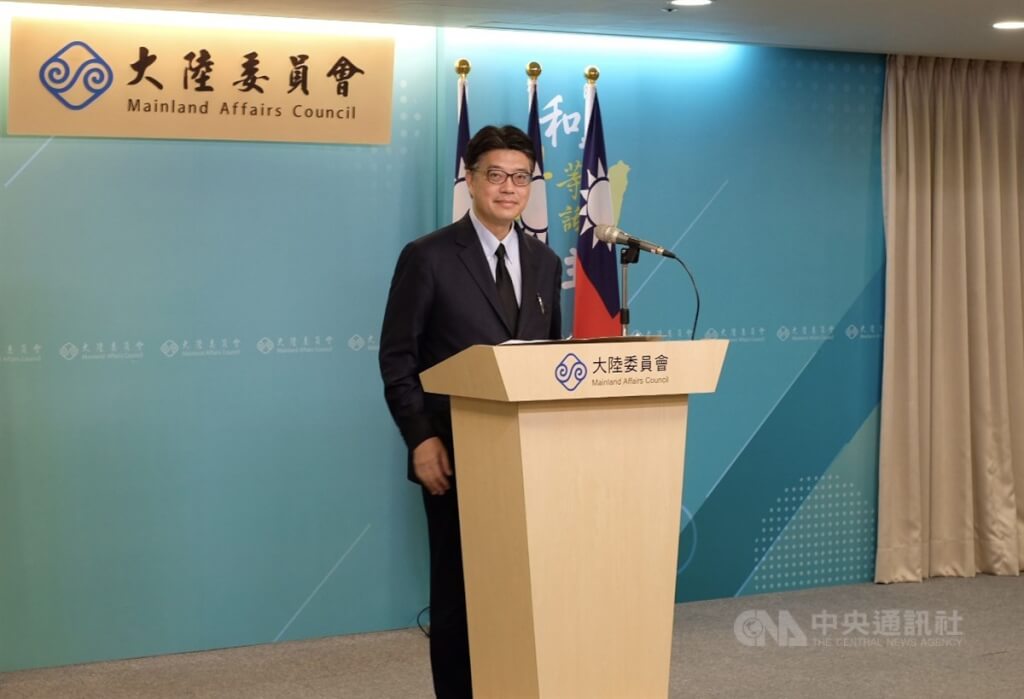
Taipei, April 14 (CNA) Following the meeting between KMT Chairwoman Cheng Li-wen and CCP General Secretary Xi Jinping, Mainland Affairs Council (MAC) Minister Chiu Tai-san stated today on a program that the 1992 Consensus is a "poison of annexation, not a panacea for peace." Therefore, the government will not accept negotiations on the 10 cross-strait policies proposed by the CCP if they are premised on the 1992 Consensus.
Chiu Tai-san was interviewed today by Huang Wei-han, host of "POP Hit News," discussing KMT Chairwoman Cheng Li-wen's statement of "1992 Consensus, opposing Taiwan independence" during her meeting with CCP General Secretary Xi Jinping.
Huang Wei-han mentioned that CCP General Secretary Xi Jinping had clearly defined the 1992 Consensus in his 2019 speech on the 40th anniversary of the "Message to Compatriots in Taiwan," stating that the ultimate political arrangement is the "One Country, Two Systems Taiwan Solution." Therefore, the 1992 Consensus has been a consensus to eliminate the Republic of China since 2019, and Cheng Li-wen met with Xi Jinping under this premise.
Chiu Tai-san responded that even for the traditional KMT's 1992 Consensus, Cheng Li-wen should have insisted on "one China, respective interpretations," expressing it as the Republic of China. "Did she make this effort? No, she completely echoed the other side's statement of 'respective interpretations, one China'."
Chiu Tai-san also expressed regret that Cheng Li-wen did not strive for "not setting political preconditions." He stated that it is impossible for the government to accept negotiations on the 10 cross-strait measures under preset political preconditions, as "it would become the elimination of the Republic of China. It's impossible for us to accept these conditions."
Chiu Tai-san pointed out, "Chairwoman Cheng blindly echoed the CCP's narrative, retreated, and made the 1992 Consensus a precondition for dialogue with the CCP. This is actually endorsing the CCP's intention to eliminate the Republic of China. So this is a poison of annexation, not a panacea for peace."
Regarding "opposing Taiwan independence," Chiu Tai-san stated that from Beijing's perspective, any statements and actions that advocate for cross-strait non-subordination, insist on the sovereignty of the Republic of China, reject "one country, two systems," or do not conform to other claims regarding Taiwan, will be labeled as "Taiwan independence." He added, "The CCP's definition of opposing Taiwan independence is to make you accept that Taiwan is part of the People's Republic of China; they want to eliminate the Republic of China and annex Taiwan."
Regarding the 10 cross-strait measures, Chiu Tai-san also stated that this is an old trick that has been continuously played since 2005, often being halted for fabricated reasons. For example, in the past, when Taiwan's fruit industry became dependent on the Chinese mainland market, it was suddenly halted for various reasons, causing immense losses to farmers and industries.
Chiu Tai-san pointed out that the Chinese mainland has recently been "weaponizing" Taiwan's economic dependence on China, using it for political blackmail or coercion, which is essentially a strategy of "nurture, entrap, and kill." For instance, regarding tourists visiting Taiwan, China announced on the afternoon of July 31, 2019, that it would suspend individual travel to Taiwan for mainland residents, implementing it on August 1, which caused many businesses to lose everything overnight.
Chiu Tai-san also noted that many of the Chinese mainland's measures targeting farmers and fishermen are not open to all regions but are aimed at specific counties and cities, engaging in "precise united front work" within Taiwan. This not only harms all farmers but also has suspicions of interfering in elections. The registration of food enterprises is a similar situation. (Editor: Chen Kai-yu) 1150414
FACT BOX
- Source: CNA (Central News Agency)
- Category: regulation