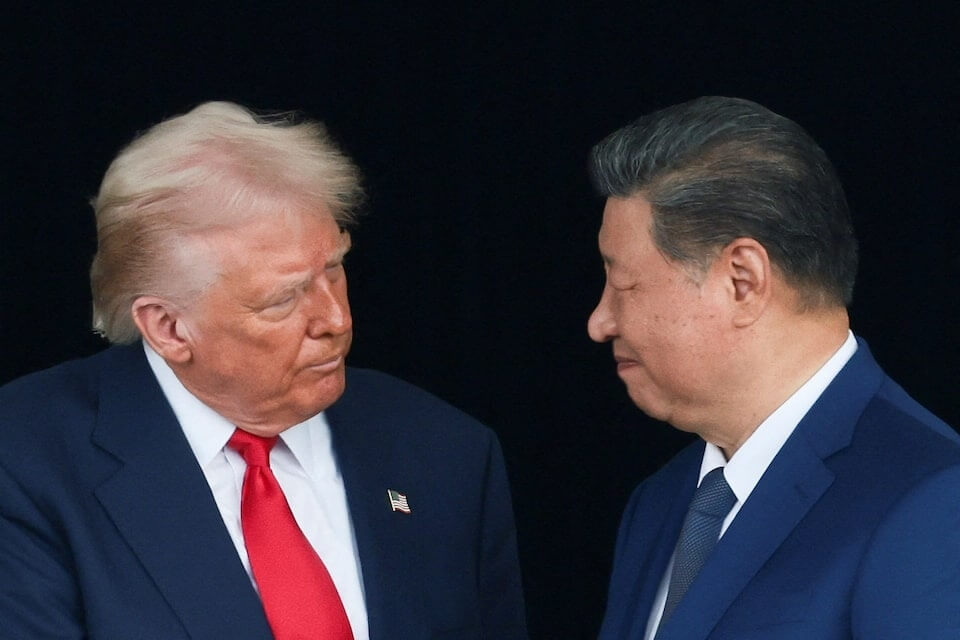
Central News Agency (Taipei, April 14) - US President Trump's visit to China was postponed to May to deal with the war with Iran, but recent US-Iran negotiations broke down, and the US military imposed a naval blockade. Analysts believe that if the Strait of Hormuz crisis remains unresolved, the possibility of Trump's visit to China in May will certainly decrease, putting China in a dilemma. US President Trump ordered a blockade of Iranian ports starting at 10:00 AM Eastern Time on the 13th, creating a unique 'dual blockade' situation where the Iranian military controls the Strait of Hormuz, and the US military restricts the entry and exit of Iranian vessels. US President Trump postponed his visit to China to May 14-15 to deal with the war with Iran, during which he will meet with Chinese President Xi Jinping. The South China Morning Post reported on the 13th that Jin Liangxiang, a senior researcher at the Shanghai Institutes for International Studies, stated that the 'dual blockade' would lead to a complete closure of the Strait of Hormuz, which would undoubtedly harm China's huge interests in the region and could affect China's supply chains, energy security, and trade with Gulf countries, which are important export markets for China. Jin Liangxiang also stated that whether the Trump-Xi meeting will take place depends on the progress of the US in the Iranian crisis. If the Strait of Hormuz crisis is not resolved, the possibility of Trump's visit to China in May will decrease. However, Trump's domestic considerations for this visit are mainly influenced by US-China trade relations and the pressure of the US midterm elections. Jesse Marks, founder of Rihla Research and Advisory, a Washington-based consulting firm focusing on Middle East issues, stated that the US naval blockade forces Beijing into a dilemma: the longer the blockade, the harder it is for China to maintain strategic ambiguity between the US and Iran. Marks stated that Iran wants to weaponize the Strait of Hormuz, while Trump wants to cut off Iran's oil exports through the strait and its collection of transit fees. Because if Iran normalizes the collection of transit fees, it will permanently reshape the economics of Gulf energy transportation and provide Iran with an independent source of income beyond oil exports. Marks stated that if the US can fulfill its promise to allow non-Iranian vessels, including Chinese vessels, to pass through the Strait of Hormuz, the US can portray itself as a defender of freedom of navigation. Marks also stated that another situation to watch is whether vessels carrying Iranian oil and flying the Chinese flag will be intercepted. China has been accused of using shadow fleets and paying in RMB to obtain Iranian oil, thereby circumventing US sanctions. Marks stated that although Beijing has repeatedly denied it, its shadow fleet is now forced to operate within the US military's enforcement area, greatly increasing the possibility of Chinese vessels being detained, which could trigger a 'conflict' before the Trump-Xi meeting. Marks also stated that Trump's naval blockade, which threatens China's energy interests at this time, may be a tactic for negotiating with Xi Jinping. Marks stated that Trump wants to seize something China needs in exchange for China's concessions on rare earths, trade, and political cooperation with Iran. However, China may interpret this as coercion, narrowing the diplomatic space. Marks also stated that both the US and China need to find ways to separate the Iranian conflict to avoid undermining the trade truce and the stability they have been working to build since the Busan summit last October. (Editors: Chen Kai-yu/Zhu Jian-ling) 1150414
FACT BOX
- Source: CNA (Central News Agency)
- Category: Taiwan