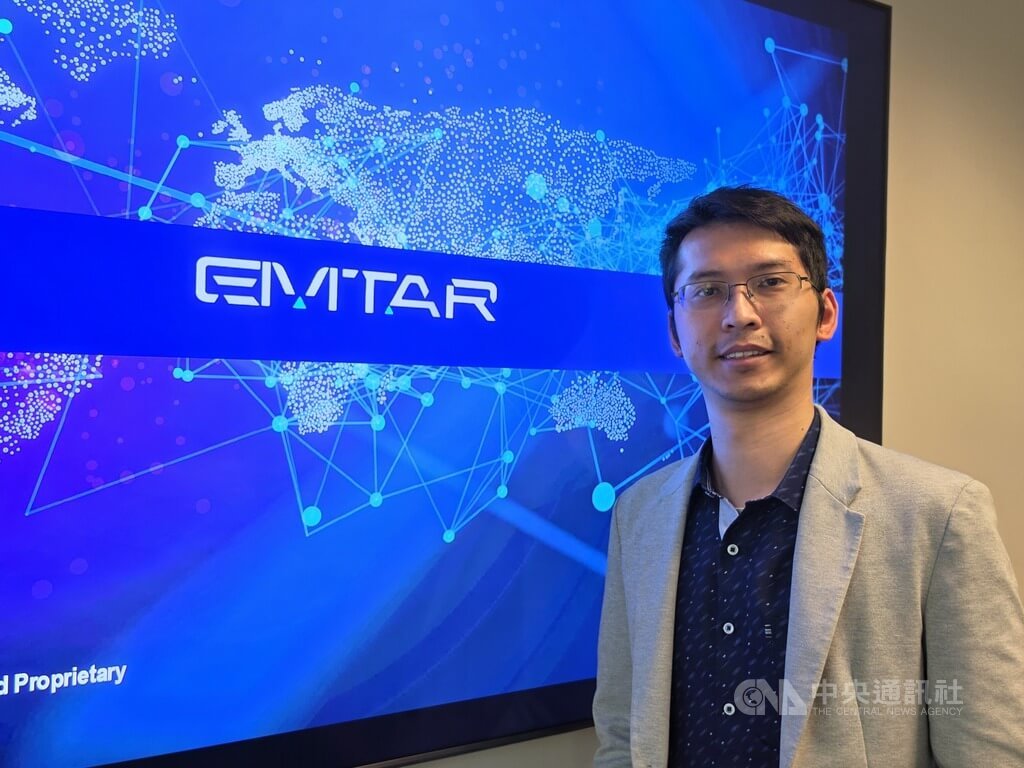
(CNA reporter Cheng Ai-fen, Vancouver, 12th) Global technology competition is expanding from artificial intelligence (AI) models to satellite communication infrastructure, shifting from terrestrial networks to space-based networks. Emtar Technologies, a chip design company founded in Canada by Taiwanese scholar Huang Min-Yu, has emerged as a rising star, gaining prominence in the global semiconductor and space industries.
In an exclusive interview with CNA, Huang Min-Yu stated: "Over 70% of the world lacks communication networks, and over 90% lacks fiber optics. For AI to continue advancing, 'space-based AI data centers' are the next inevitable trend."
Huang, a Ph.D. graduate from National Tsing Hua University and Georgia Institute of Technology in the U.S., previously received the Paul Baran Young Scholar Award, often regarded as the 'Junior Nobel Prize' in telecommunications. He declined offers from top-tier tech giants and elite academic institutions to establish Emtar in Canada in 2023. In May this year, the company received the 'Startup of the Year' award from the Canadian Semiconductor Association, stunning the North American tech community.
Satellite communications are expanding beyond telecom into cloud computing, drones, automotive, and the broader Internet of Things, with enormous market potential. However, maintaining constant, ubiquitous connectivity for all devices in the dynamic space environment has pushed traditional semiconductor chips to their limits.
Huang explained: "Emtar targets the intersection of next-generation wireless systems and edge computing, specializing in intelligent wireless computing solutions for 6G non-terrestrial networks (NTN). In satellite receiving systems, Emtar's RF front-end ICs and smart beamforming chips function like superhuman senses and the brain."
He analogized that traditional chips operate like a library, where transceivers must queue to borrow books. In contrast, Emtar's fully embedded memory and proprietary algorithms allow each transceiver to have its own dedicated library, enabling real-time information allocation.
This innovation enables tracking and position prediction speeds 10 times faster than competitors, doubles reception sensitivity, and reduces power consumption by 30% to 40%. It addresses the critical heat dissipation and energy consumption bottlenecks faced by satellite operators, allowing user terminals to maintain continuous, high-throughput connections during satellite passes without mechanical movement or signal interruption.
Emtar's end customers currently include global leading low-Earth orbit satellite operators such as SpaceX, OneWeb, and Canada's Telesat, with close ties to the European Space Agency.
Emtar's demonstrated technical strength has led TSMC to view it as a key partner.
Huang said: "We are a direct account (Direct Account) of TSMC, on equal footing with NVIDIA and AMD. We handle the design; TSMC handles the manufacturing." In April, he was invited to present live at TSMC's annual flagship event, the 'North America Technology Symposium'—an exceptionally rare honor for a startup.
This powerful collaboration holds significant strategic synergy. Huang noted: "Currently, TSMC holds a small market share in space technology chips, with GlobalFoundries capturing nearly 90%. But TSMC clearly recognizes that space and satellite technology are future keys, and they are eager to find strong partners in the space chip domain. Emtar is an excellent choice."
Huang emphasized that amid global geopolitical instability, satellite communications carry greater strategic value. "If I were Amazon, setting up a physical AI data center in a country would always face uncontrollable political factors. But a space-based AI data center ensures greater security and resilience."
He added that Canada's neutral international image has become a major asset for Emtar's global outreach. The Canadian government regards Emtar as a national treasure, with Huang consistently included as a core member in Ottawa's overseas delegations, representing the new star of Canada's semiconductor industry.
Huang, nurtured by Taiwan's academic environment, hopes to become a bridge for win-win cooperation between Canada and Taiwan's semiconductor industries.
He said, "Emtar is currently engaging with multiple Taiwanese ODMs, networking, packaging, and space-related organizations, aiming to combine Canada's system innovation capabilities with Taiwan's comprehensive semiconductor manufacturing supply chain to jointly capture the next-generation satellite communications market." (Editor: Tang Sheng-yang) 1150713
FACT BOX
- Source: CNA (Central News Agency)
- Category: Partnership
- Organizations: Emtar Technologies / SpaceX / OneWeb