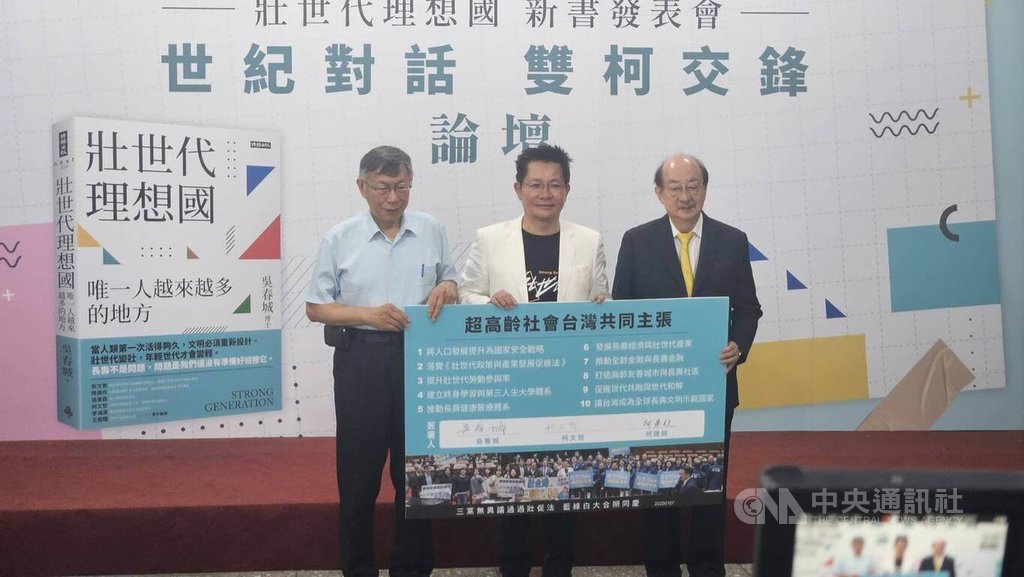
(CNA reporter Tseng I-ning, Taipei, June 23) Former Taiwan People's Party legislator Wu Chun-cheng, who championed the 'Zhuang Generation Promotion Act,' faced criticism over conflict-of-interest concerns, leading to his resignation from the legislature. Today, he launched his new book 'The Ideal Country of the Zhuang Generation,' asserting that after 1.5 years since the act's passage, no illegality or implementation obstacles have been found, and he urged the Executive Yuan to promptly restart Zhuang generation policies.
Wu Chun-cheng spearheaded the legislation of the 'Policy and Industry Development Promotion Act for the Zhuang Generation,' which passed its third reading on January 7 last year. However, he was subsequently criticized for allegedly failing to avoid conflicts of interest, such as establishing an association to bid for government contracts and registering patents. During a legislative session, Wu publicly announced his resignation from the legislature.
Wu published 'The Ideal Country of the Zhuang Generation' in May this year and held a book launch event today, inviting Taiwan People's Party founding chairperson Ko Wen-je and DPP legislator Ker Chien-ming to discuss Taiwan's future amid a super-aged society.
Wu stated that in the face of a super-aged society, two-thirds of the nation's wealth is held by the 'Zhuang generation'—those aged 55 and above. Therefore, governance should move beyond social assistance and welfare thinking and instead create a longevity economy to provide the next generation of Taiwanese with an entrepreneurial platform. He urged adopting a 'Zhuang generation mindset' to see the nation's hope and a new driving force for national development.
Ko Wen-je said Taiwan's problem is not just population aging, but also the rapid pace of demographic change. Aging itself is not a crisis; the real issue lies in systems that remain stuck in the past.
Ko stated that given the current labor shortage, introducing foreign workers raises social integration concerns. Thus, the simplest solution is to keep capable and willing members of the Zhuang generation in the workforce. He noted that the asset liquidity among those aged 55 and above is very low because they lack income, making them hesitant to spend. The key, he emphasized, is 'not hindering the elderly from earning money.' Once they become producers, they will naturally become consumers.
Ker Chien-ming said that with average life expectancy reaching 80, legal definitions that set 65 as retirement age and classify individuals as elderly should be re-examined. Society must also re-evaluate the population aged 55 and above. Past elderly policies emphasized long-term care and expenditures, but future policies should focus on participation, leveraging the healthy and capable 55+ population. As long as this group continues to consume and pay taxes, they will sustainably create value, reduce the burden on younger generations, and enhance national competitiveness.
Wu Chun-cheng said the Zhuang Generation Promotion Act has been passed for 1.5 years, with no illegality or implementation barriers discovered during this period. He therefore called on the Executive Yuan to promptly restart Zhuang generation policies and advance the implementation of the act. (Edited by Su Lung-chi) 1150623
FACT BOX
- Source: CNA (Central News Agency)
- Category: Taiwan