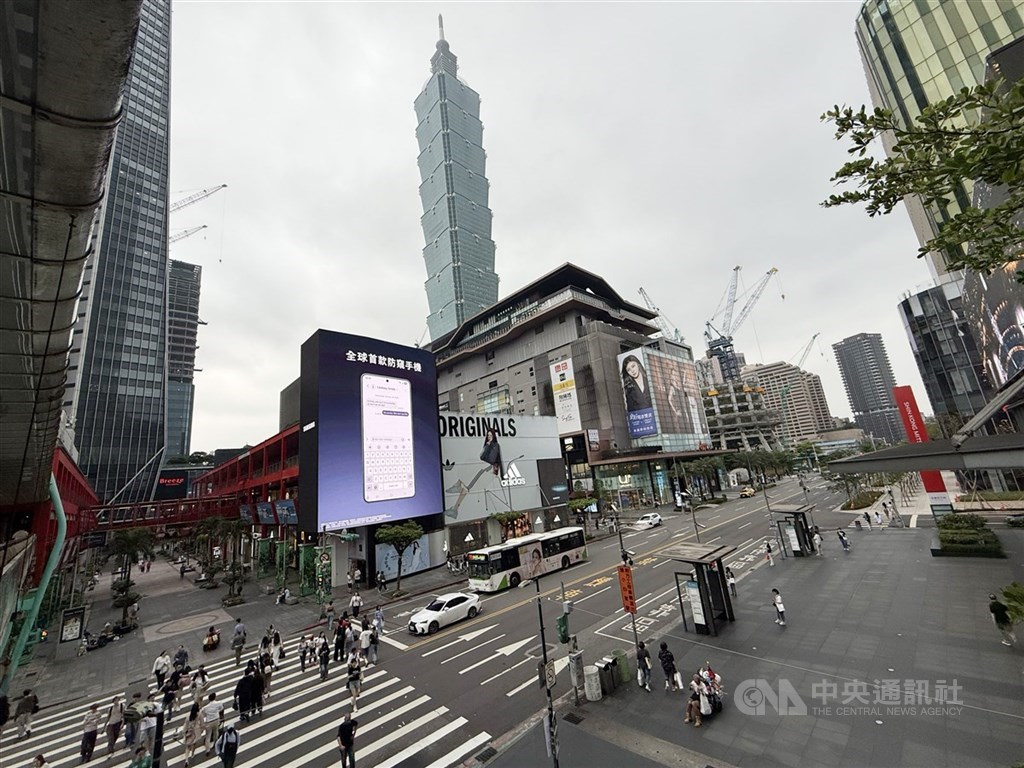
Taipei, June 18 (CNA) The Central Bank held its board meeting today and decided to keep interest rates unchanged for the ninth consecutive time, while maintaining its selective credit control measures. Real estate industry professionals believe this move aligns with market expectations and signifies that the most severe phase of real estate market regulation has concluded. As investment demand cools and owner-occupier demand gradually returns, the market's most pessimistic period has passed, with transaction volumes expected to improve in the second half of the year compared to the first.
Tseng Ching-te, project manager at Sinyi Realty's Real Estate Research Center, stated that loan concentration in the real estate market has begun to decline following policy controls, and the market is showing a trend of "shrinking volume and consolidating prices," with an overall soft landing. However, the Central Bank's current focus is no longer solely on loan concentration in the real estate market but on the risk of personal credit expansion driven by the surge in the stock market.
Tseng pointed out that the market capitalization of the Taiwan stock market has significantly increased over the past year, leading to a simultaneous rise in household wealth. However, under credit controls, funds have not flowed heavily into the real estate market. If the Central Bank were to ease controls too early, it could reignite the real estate market. Therefore, maintaining the current policy and continuing to observe market changes is a more prudent approach.
Chuang Szu-min, deputy manager of CTBC Housing's Research and Development Department, said that since the implementation of the seventh wave of real estate credit controls, market investment and speculative demand have virtually disappeared, and the market has returned to being driven by owner-occupier demand. The Central Bank's current strategy of neither tightening nor loosening reflects an affirmation of the soft landing achieved in the real estate market, while also indicating a continued observation of financial markets and the overall economy.
Chuang believes that the recent strong performance of the Taiwan stock market, coupled with the upcoming launch of the "New Youth Housing Loan 2.0," could provide a certain degree of support for the real estate market. With policies no longer tightening further and the economic fundamentals remaining stable, "the most pessimistic moment for the market has passed," and transaction volumes in the second half of the year have the potential to see a moderate rebound compared to the first half.
Huang Shu-wei, director of the Owner Representative Services Department at Colliers International, stated that after approximately 18 months of credit controls, the market has gradually completed the transition from "pricing driven by capital expansion" to "pricing driven by credit constraints." The real estate market will shift from being driven by policy speculation and capital leverage to a competitive stage centered on purchasing power and fundamentals.
Huang believes that with loan restrictions and persistently high funding costs, the real estate market in the second half of the year will continue to show stable volume and price consolidation, with regional differentiation. However, the overall market has gradually moved beyond a phase of high-intensity policy intervention, and pricing power will return to purchasing power and actual demand in the future. (Editor: Chang Liang-chih) 0618
Stand with facts, your every sponsorship is a force to protect press freedom
Download the CNA "One-Stop News" APP for real-time updates
The text, images, and videos on this website may not be reproduced, publicly broadcast, publicly transmitted, or used without authorization.
FACT BOX
- Source: CNA (Central News Agency)
- Category: 金融政策