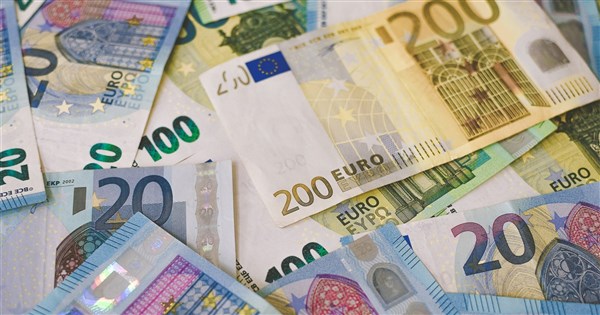
Since Lithuania's government opened the option for citizens to exit its second-pillar pension system earlier this year, over 500,000 people have withdrawn funds totaling more than €3 billion (approximately NT$110 billion), equivalent to about 3% of the country's GDP. According to the Governor of the Bank of Lithuania, Gediminas Šimkus, this capital outflow could help mitigate the negative economic impact of rising energy prices.
Lithuania operates a multi-tiered pension system, with the second pillar known as the 'Pension Accumulation Fund.' This system allows workers to channel part of their social insurance contributions into privately managed funds, with the government providing subsidies. For years, the government has encouraged participation to promote long-term retirement savings.
Under the scheme, participants contribute about 3% of their salary, while the government adds a supplementary payment equivalent to approximately 1.5% of the average wage from the national budget, both directed into individual pension accounts for long-term investment.
However, recent policy changes now allow participants to exit the second pillar and withdraw their accumulated assets by the end of 2027. Prior to the policy shift, around 1.45 million people were enrolled, with total assets amounting to approximately €10.6 billion (NT$388.4 billion).
According to reports, about 550,000 people exited the system in the first quarter of 2026 alone, representing nearly 40% of all participants. Around 860,000 individuals remain in the system.
Governor Šimkus stated that the total withdrawn pension funds exceed €3 billion, equivalent to about 3% of Lithuania’s GDP or 6% of annual disposable income.
Regarding the use of withdrawn funds, April data from the Bank of Lithuania shows that approximately 72% of the money remains in residents’ bank accounts, while 16% was withdrawn as cash. About 3% was used to prepay mortgages, 3% to repay other loans, and 1% was reinvested into third-pillar pension schemes or investment-linked insurance products.
Šimkus noted that these funds could help cushion the economic impact of rising energy prices. He estimated that if between €500 million and €1.5 billion of the withdrawn funds are spent on consumption, the negative effects of higher energy prices could largely be offset.
He also pointed out that April saw a noticeable increase in durable goods sales, including electronics and furniture, indicating that withdrawn funds are beginning to re-enter the market and provide some economic support.
FACT BOX
- Source: CNA (Central News Agency)
- Category: Taiwan