By Central News Agency reporter Wu Wen-rong, Kinmen, June 17
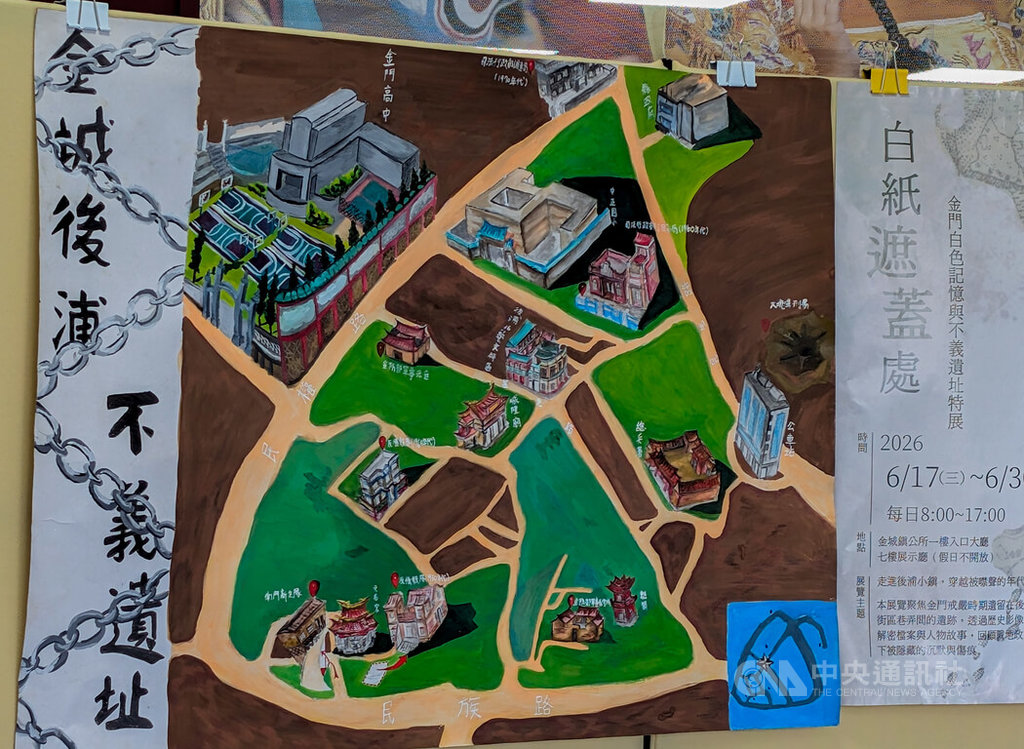
Students and teachers from Kinmen High School have curated a local human rights exhibition focusing on the martial law period, featuring a hand-drawn map of injustice sites in Houpu (the old name for Jincheng), revisiting the hidden historical wounds embedded in everyday spaces. The exhibition team stated that by adopting a spatial perspective, visitors can better engage their senses and understand history.
The special exhibition titled 'Under the White Paper: Kinmen's White Terror Memories and Sites of Injustice' was organized by teachers and students from Kinmen High School's social studies project course and opened today at the Jincheng Township Office in Kinmen County.
The exhibition includes stories of political victims during Kinmen's martial law era, interactive experience designs, and a hand-drawn map of injustice sites in Houpu's urban area created by students, marking locations such as interrogation rooms inside private homes, former military courts, and execution grounds.
Liu Jun-di, the civic education teacher who led the exhibition, told the Central News Agency that although many political archives have been declassified in recent years, the general public may not have time to read such vast materials. The exhibition content is based on publicly available data from the National Human Rights Museum and research by scholar Lin Chuan-kai, with students also conducting on-site visits to current injustice sites in Jincheng before creating the exhibits.
Liu said they asked students to draw the map of injustice sites to help both students and visitors feel a sense of presence through spatial and geographical concepts. Notably, the area behind the exhibition venue was once an execution ground, which further enhances sensory engagement with that historical period.
Cai Song-ting, a history teacher on the team, noted that Kinmen, as a frontline military zone, had a different martial law atmosphere compared to Taiwan. These aspects, often missing from textbooks, allow students to engage in dialogue with the history of their hometown. He added that tourists visiting the exhibition could also understand the differences between Kinmen’s and Taiwan’s historical trajectories.
A student surnamed Fan-Jiang, who participated in content creation, said the project deepened their understanding of the land they live on and expressed hope that more people would visit the exhibition to learn about transitional justice. 'Remembering what these people went through makes me more grateful for what we have today,' they said.
'Under the White Paper: Kinmen's White Terror Memories and Sites of Injustice' will run from today until the 30th, open daily from 8:00 a.m. to 5:00 p.m. at the first-floor lobby and seventh-floor exhibition hall of the Jincheng Township Office. Note that the seventh-floor exhibition hall is closed on holidays. (Edited by Huang Ming-hsi) 1150617
Stand with the facts. Your support is a force in defending press freedom.
Download the CNA 'First News' app to stay updated with the latest news.
Text, images, and videos on this website may not be reproduced, broadcast, publicly transmitted, or used without authorization.
FACT BOX
- Source: CNA (Central News Agency)
- Category: Event