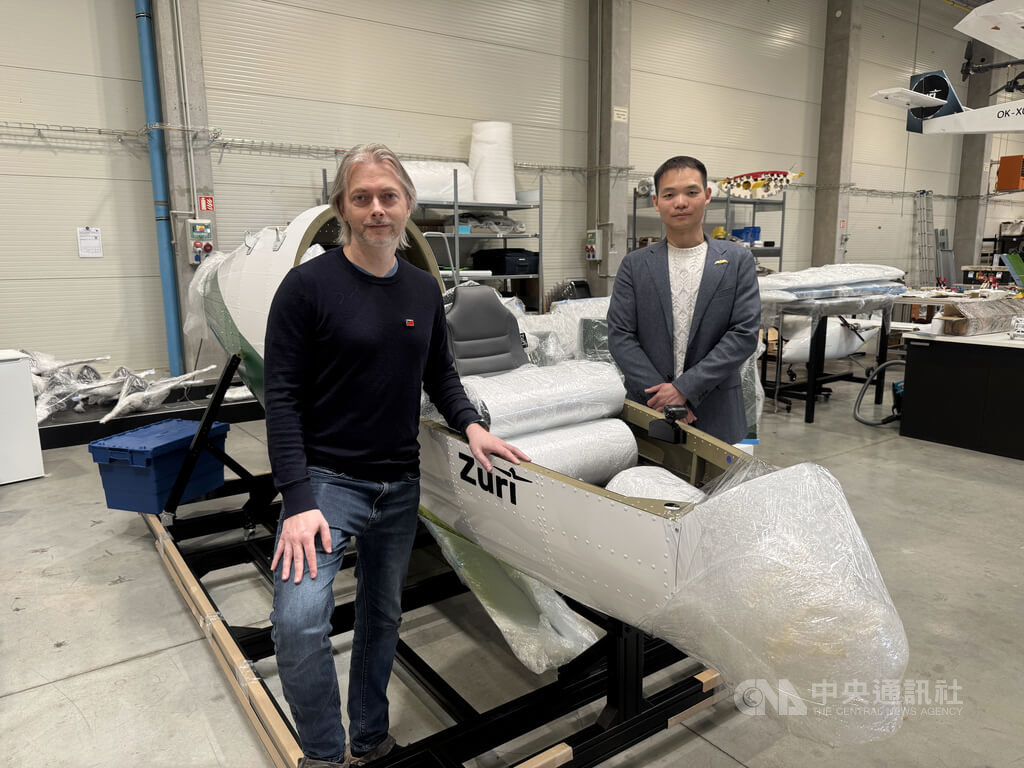
(Central News Agency reporter Liu Yu-ting, Prague, June 17) As the global advanced air mobility industry rapidly advances, Taiwanese youth Lin Ze has joined Czech aerospace startup Zuri as an aircraft designer, developing a hybrid-electric vertical takeoff and landing (VTOL) aircraft with a range of 700 kilometers. The goal is to provide passengers with 'point-to-point' transportation services and transform future medium- to long-range regional transportation models.
Entering Zuri's factory in Central Bohemia, Czech Republic, one finds a spacious facility filled with aircraft models, test components, and R&D equipment of various sizes, including wings, rotors, and fuselage structural parts. Zuri founder Michael Illich showed reporters various VTOL aircraft models and explained current market trends.
● Providing Point-to-Point Flight Services: Targeting a Multi-Billion Dollar Market
Illich said the advantage of VTOL aircraft lies in their ability to provide point-to-point flight services, flying directly from origin to destination, eliminating passengers' transfer time between city centers and airports.
Looking at the current global advanced air mobility market, Illich believes it can be divided into two main directions: short-distance urban air mobility and regional air transportation.
Illich pointed out that while urban air mobility receives significant attention, its market size is limited. In contrast, the regional aviation market, covering flight ranges of hundreds of kilometers or more, already reaches a scale of several hundred billion dollars annually. Therefore, Zuri is focusing its development on the latter.
Illich said: 'A 700-kilometer range can cover half of Europe, connecting many cities that are currently difficult to access. We believe regional aviation is the most promising application scenario for future VTOL aircraft.'
He added that currently, no other companies in the Czech Republic are developing similar VTOL aircraft, and within the entire European Union, there are fewer than five such companies.
He emphasized that Zuri aims to combine hybrid propulsion, long-range capability, and vertical takeoff and landing technology to create a new generation of air transportation tools that are efficient, sustainable, and convenient. Zuri is now preparing for its Series A funding round, aiming to raise approximately 25 to 30 million euros to support the next phase of aircraft development, testing, and commercialization.
● Taiwanese Youth Engages in VTOL Aircraft Development: Building Future Air Mobility
Within Zuri's team, one aircraft designer is from Taiwan. Lin Ze, who has a background in physics and space exploration, was originally pursuing a degree in artificial intelligence in Belgium but chose to join aircraft development.
Lin Ze said: 'Urban air mobility is a completely new aviation field, and being able to design an aircraft from scratch is a rare opportunity.'
As an aircraft designer, Lin Ze shared that Zuri currently uses a 30% scale prototype for validation. It takes about one week to complete the design and drawings, followed by two weeks for assembly after manufacturing. Subsequently, the team conducts ground tests, hover tests, and full flight tests in sequence.
The team will further analyze flight records, propulsion system response curves, and power output data, continuously adjusting and optimizing the design.
Aviation safety is also a major concern. The Zuri team stated that in the future, they will follow Instrument Flight Rules (IFR) to ensure the aircraft can perform flight missions under various weather conditions, including daytime, nighttime, cloudy skies, and fog.
Sustainability is one of the most important issues in the aviation industry in recent years. Zuri's aircraft will use Sustainable Aviation Fuel (SAF), reducing carbon emissions by approximately 80% compared to traditional jet fuel.
● Taiwan Holds High Application Potential: Connecting Airports and Urban Transport
On the other hand, Zuri also intends to enter the Taiwan market. Illich revealed that six months ago, he personally visited Taiwan to engage with local suppliers and potential partners, believing Taiwan will be an important application area for VTOL aircraft development.
He gave an example: travelers often face traffic congestion when traveling from Taoyuan International Airport to Hsinchu Science Park. Many international business travelers, after long-haul flights, still need to spend hours on ground transportation, which is inefficient. 'From the user's perspective, the greatest value of VTOL aircraft is time savings.'
Since Zuri's aircraft can achieve a range of approximately 700 kilometers, it can almost cover the entire island of Taiwan. Therefore, Illich believes future development could include intercity transportation, such as routes from Taipei to Taichung or Taipei to Kaohsiung. Unlike traditional reliance on fixed airports and train stations, VTOL aircraft can perform direct point-to-point flights, significantly reducing transfer time.
Illich said that VTOL aircraft could also be used for airport shuttle services, such as direct flights from Taoyuan Airport to Hsinchu Science Park, particularly suitable for business travelers, senior executives, and corporate use.
One of the key infrastructures supporting VTOL aircraft development is the vertiport. Illich explained that vertiports are similar to helicopter pads. Since Zuri uses a hybrid-electric system, extensive charging infrastructure is not required, and most existing airport facilities can support operations.
He believes that in the future, vertiports could be considered in large public spaces such as Wugu and Xinzhuang, and in the long term, even on high-rise buildings. (Editor: Chen Hui-ping) 1150617
FACT BOX
- Source: CNA (Central News Agency)
- Category: Partnership