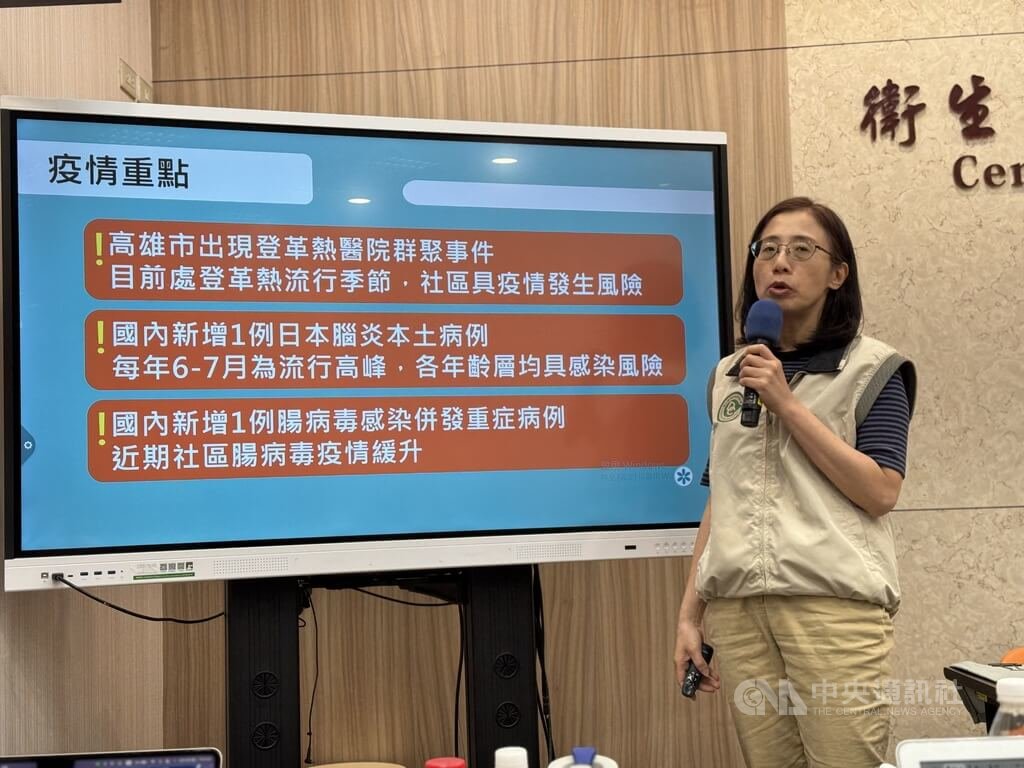
(Central News Agency reporter Shen Pei-yao, Taipei, June 16) A local dengue fever cluster at Kaohsiung City's Minsheng Hospital has expanded from one to six cases. The Centers for Disease Control (CDC) today released viral genetic sequencing results, confirming that all cases match a Vietnamese imported case who previously stayed in the same hospital, confirming it as a single cluster event. There is currently no evidence of external spread, and monitoring will continue until July 12.
On June 12, Kaohsiung reported five new locally acquired dengue fever cases, all of whom were inpatients at Minsheng Hospital, raising concerns of a localized nosocomial outbreak. This marks the first hospital-based dengue cluster in eight years.
In today's routine epidemiological report, the CDC explained the latest viral genetic sequence analysis results, all of which matched the virus sequence from the imported case from Vietnam. As of June 15, the local dengue cluster at Kaohsiung's Minsheng Hospital has totaled six cases, with no additional cases reported.
CDC spokesperson Tseng Shu-hui stated that the imported case returned from Vietnam on June 1 after visiting relatives and was intercepted at the airport due to fever. Subsequent PCR testing confirmed a positive result. The patient was hospitalized at Minsheng Hospital from June 1 to 11 and was located in a room diagonally across from the subsequent local cluster cases, leading officials to identify this individual as the source.
The hospital has since implemented mosquito prevention measures. Tseng noted that after the health authority conducted expanded testing on over 1,400 individuals—including staff, current inpatients, and discharged patients from the affected unit—the CDC assesses that there is currently no external spread of the outbreak. Monitoring is expected to continue until July 12.
As Minsheng Hospital was originally designated to treat dengue patients in the region, the health authority has issued a fine of NT$15,000 for failure to control breeding sources. Tseng emphasized that dengue is a mosquito-borne disease, not transmitted directly from person to person, and the most critical measure remains mosquito prevention.
Additionally, the CDC's mobile epidemic prevention team continues to dispatch personnel to evaluate control effectiveness and assess community risks in surrounding areas. To date, a cumulative total of 24 personnel have been deployed. Health authorities have also conducted breeding source inspections and removals, chemical control, and environmental sanitation at the hospital and surrounding communities.
According to CDC statistics, as of June 15, there have been 75 confirmed dengue cases this year, including seven locally acquired cases, all residing in Kaohsiung City. The remaining 68 cases were imported, all from Southeast and South Asian countries, with the majority from Indonesia (21 cases), followed by the Maldives (14 cases) and Vietnam (9 cases). The total number of cases this year is comparable to the 79 cases recorded during the same period in 2025 but significantly lower than the 274 cases during the same period in 2024.
The CDC noted that dengue vector mosquitoes require water sources to lay eggs after blood feeding, and both larvae and pupae develop in water. The public is urged to actively inspect indoor and outdoor environments and rigorously implement the 'inspect, dump, clean, scrub' measures—removing unnecessary containers, regularly scrubbing and inverting essential containers after use, and rechecking for standing water around homes and households after rainfall, immediately discarding any collected water. Eliminating breeding sources prevents the proliferation of vector mosquitoes and reduces the risk of mosquito-borne diseases such as dengue fever. (Edited by Chang Ya-ching) 1150616
FACT BOX
- Source: CNA (Central News Agency)
- Category: Taiwan