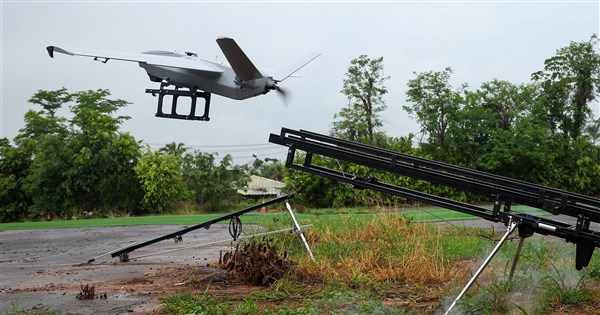
To support Taiwan's startups and SMEs, the National Development Fund (NDF), in collaboration with various ministries, has launched themed hundred-billion investment programs covering strategic manufacturing, strategic services, SMEs, cultural creativity, AI startups, green growth, and smart robotics. On the 16th, it announced phased achievements: investments in over 500 companies totaling over NT$20 billion—reaching NT$21.6 billion—with NT$89.6 billion in private investment mobilized. Key sectors include drones, aerospace applications, and AI. A peace agreement between the U.S. and Iran has been reached, and the Strait of Hormuz will reopen. Taiwan's stock market fluctuated on the 16th, closing at 45,809.19 points, up 412.2 points. The Taiwan Institute of Economic Research significantly raised its 2024 GDP growth forecast to 9.33%, citing the AI wave as a historic opportunity for Taiwan, though risks like industrial concentration remain. (Read full report)
On the 16th, President Lai Qingde, accompanied by National Security Council Secretary-General Joseph Wu and Defense Minister Ku Cheng-hsiung, visited the Guandu Command Post’s Hou-shan military camp to inspect troops, encourage soldiers, and distribute holiday meal bonuses. After hearing a briefing from Commander Kuan Yi-ping, President Lai emphasized Guandu Command’s critical role in defending the Taipei metropolitan area. He affirmed the government’s commitment to enhancing training, adopting new technologies to strengthen asymmetric warfare capabilities, and supporting defense self-reliance. Regarding the significant cuts to the defense special budget, Lai stated the government would not give up and would pursue special legislation, supplementary budgets, or increased annual budgets to support the military. Executive Yuan spokesperson Lee Hui-chih noted that the legislature has not completed the annual budget review after 292 days, affecting flood prevention preparations and the implementation of eight increased social welfare subsidies approved by the Executive Yuan. (Read full report)
On the 16th, the Legislative Yuan passed amendments to parts of the Waste Disposal Act, bringing emerging waste such as renewable energy equipment under regulation, introducing electronic fence technology for enforcement, and increasing penalties for environmental damage. The maximum prison term for illegal disposal of industrial waste will rise from five to seven years. If waste is dumped in ecologically sensitive or resource-recycling areas, sentences will be increased by half. The Ministry of Environment stated the amendments expand the scope of recyclable waste and designate manufacturers, importers, and installers of renewable energy equipment as responsible parties with fee obligations. These stakeholders will jointly bear responsibility for recycling, removal, and disposal, implementing an extended producer responsibility system and establishing a complete accountability chain. (Read full report)
The 11th 'Our Ocean Conference' (OOC) is being held this week in Mombasa, Kenya. Taiwanese scholars and representatives from the Ocean Affairs Council were denied entry upon arrival, had their electronic travel authorizations (eTA) revoked, and had their passports and phones temporarily confiscated before being released after several hours. Ocean Affairs Council Chairperson Kuan Bi-ling stated on the 16th that Kenya’s actions undermine international cooperation credibility but will not deter Taiwan’s determination to participate globally. The Ministry of Foreign Affairs clearly stated that Kenya acted under pressure from China, criticized China for politicizing global issues like ocean governance, and formally protested to Kenya, condemning it as 'willingly serving as China’s political enforcer.' The Mainland Affairs Council expressed strong protest and condemnation, emphasizing that China repeatedly uses the 'One China Principle' to block Taiwan’s international participation, but this will not alter the reality that the ROC and the PRC are not subordinate to each other, nor the objective fact that Taiwan has never been part of the PRC. (Read full report)
Nobel Peace Prize laureate Malala Yousafzai attended the Rotary International Convention in Taipei on the 16th, delivering a keynote speech titled 'Uniting Communities and Hearts.' She shared her journey of advocating for girls’ education after surviving a Taliban shooting in Pakistan, emphasizing, 'True courage is fighting for your beliefs even in fear.' Malala noted that tens of millions of girls worldwide remain out of school and stressed that individual actions can create impact, and collective cooperation can drive transformative change. (Read full report)
On the 15th, U.S. Vice President Vance and Iranian Parliament Speaker Qalibaf signed an electronic Memorandum of Understanding (MOU). President Trump announced the formal signing ceremony will take place on the 19th in Switzerland, with the Strait of Hormuz expected to fully reopen by then. U.S. officials revealed Washington is considering lifting some sanctions on Iran and establishing a $300 billion reconstruction fund as an incentive for Iran to comply with the MOU. The reopening of the Strait of Hormuz is closely watched. The Financial Times reported that some tanker operators remain cautious. MOL President Shiro Tamura stated, 'Since the Middle East conflict erupted in late February, there have been multiple reports of Hormuz reopening, but none have materialized. Based on recent months’ experience, it’s reasonable to assume it will take at least several weeks, possibly a month.' (Read full report)
On the 16th, the Bank of Japan raised its benchmark interest rate from 0.75% to 1.0%, the highest level since 1995. The BOJ cited Middle East conflict-driven oil price hikes and yen depreciation-induced imported inflation as the primary reasons. The rate hike met market expectations and, combined with positive sentiment from the U.S.-Iran peace deal, propelled the Nikkei 225 to surpass 70,000 points intraday for the first time, closing at 69,404 points—a record high. Analysts noted the rate hike could help curb yen depreciation, expect limited room for Taiwan to raise rates, and anticipate the U.S. Federal Reserve will hold rates steady. (Read full report)
Lung cancer has been Taiwan’s leading cause of cancer death since 2004. T-cells in the human body are 'key soldiers' in killing cancer cells, but the tumor microenvironment causes them to become exhausted. A research team from National Taiwan University Hospital conducted large-scale drug screening using exhausted T-cells from lung cancer patients and successfully identified a class of epigenetic drugs called 'BET inhibitors' that enhance the plasticity of terminally exhausted T-cells, restore their function, and boost anti-tumor activity. The study found BET inhibitors regulate immune metabolism by increasing polyamine levels within T-cells, effectively 'reviving' terminally exhausted T-cells and improving cancer immunotherapy outcomes. (Read full report)
The 7th Tang Prize in Biopharmaceutical Science was announced on the 16th, jointly awarded to American scientists Rosenberg, Sutherland, and June. Their research has collectively ushered in a new era of 'living medicines,' turning patients’ own immune systems into weapons against cancer. Rosenberg led the development of Tumor-Infiltrating Lymphocyte (TIL) therapy at the National Cancer Institute, inspired by witnessing tumors disappear. Sutherland developed Chimeric Antigen Receptor T-cell (CAR-T) therapy at Columbia University in New York, showing remarkable efficacy in blood cancer treatment. June advanced CAR-T therapy into clinical applications and believes AI will bring further breakthroughs to immunotherapy. (Read full report)
In the 15th World Cup Group G match, Egypt faced Belgium. The 'Pharaohs' took an early 1-0 lead but scored an own goal in the second half, ending in a 1-1 draw. In Group H, Saudi Arabia drew 1-1 with South American powerhouse Uruguay, while Cape Verde pulled off a surprise 0-0 draw against Spain. Cape Verde’s goalkeeper Vozinha made seven saves, and the 40-year-old wept after the match, lamenting his mother couldn’t attend. The tournament introduced 'hydration breaks' due to North American summer heat, intended for player health but met with loud boos from spectators, sparking polarized debate. (Read full report)
Tien Chang-Lin was born in Hubei, China, in 1935, raised in Taiwan, graduated from NTU’s Department of Mechanical Engineering, and pursued advanced studies in the U.S. In 1990, he was elected the 7th Chancellor of the University of California, Berkeley. Berkeley, known for its strong liberal identity, is considered one of the most difficult universities to manage in the U.S. Upon taking office, Tien faced financial deficits, campus unrest, and social conflicts. The administration’s support for cleaning up the nearby troubled People’s Park sparked backlash from radicals. On August 25, 1992, a man armed with a knife broke into the chancellor’s residence attempting an assassination. Fortunately, Tien and his wife were not in the master bedroom and survived; the assailant was shot dead by police. The incident shocked the U.S., revealing the pressures behind the first Asian-American head of a top American university. (Read full report)
The following platforms simultaneously publish 'Good Morning World' at 8:00 a.m., delivering the most essential news summaries! E-newsletter, Facebook, Instagram Stories, YouTube
Choose to stand with facts. Your support is the force protecting press freedom.
Download the Central News Agency 'First News' app to instantly access the latest updates.
Text, images, and videos on this site may not be reproduced, publicly broadcast, transmitted, or utilized without authorization.
FACT BOX
- Source: CNA (Central News Agency)
- Category: Funding
- Dates in source: 292 days