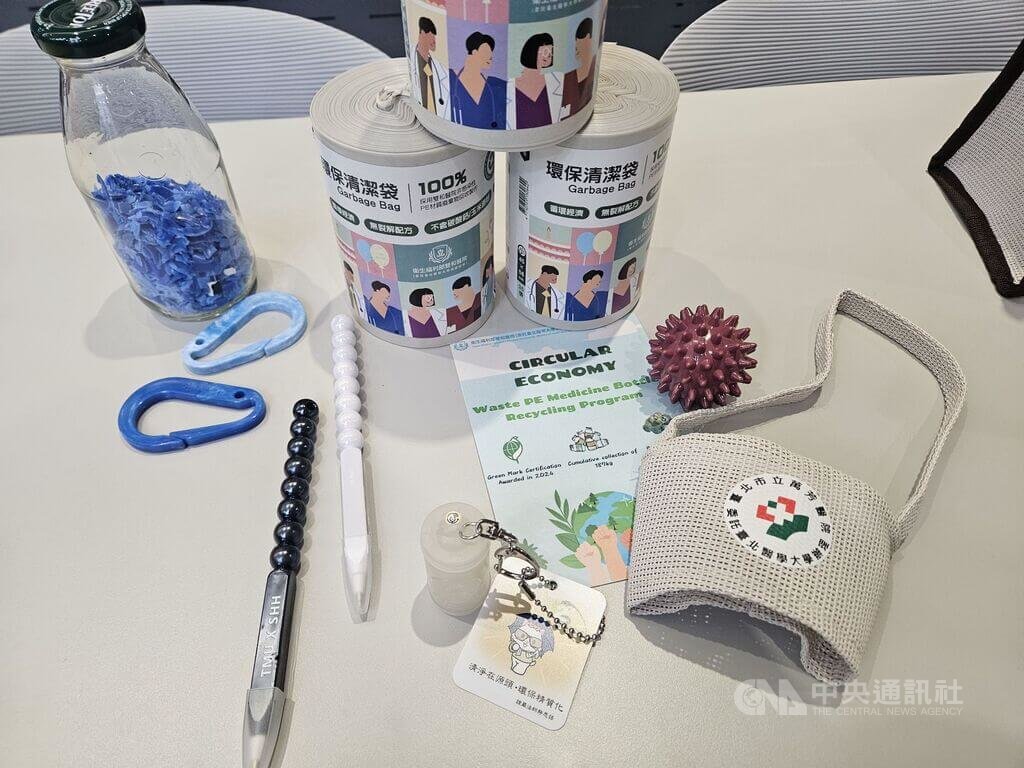
(Central News Agency reporter Chen Jie-Ling, Taipei, June 16) Medicine bottle caps and plastic medical packaging are being reassembled into small flashlights and ballpoint pens. The Ministry of Health and Welfare (MOHW) will collaborate with hospitals and university design departments to promote a new model of aesthetic regeneration for medical waste, aiming to transform tens of thousands of tons of medical waste into adorable lifestyle items and enter the cultural and creative market.
Statistics show that medical institutions across Taiwan generate approximately 38,000 metric tons of hazardous industrial waste annually, of which about 9,000 tons, after proper source separation and treatment, have the potential for resource recycling and reuse. This afternoon, the MOHW signed a Memorandum of Understanding (MOU) on the 'Aesthetic Regeneration Initiative for Medical Waste' with Taipei Medical University and Ming Chuan University.
MOHW Minister Shih Chou-Liang stated that medical waste disposal has always been extremely challenging. For example, over the past year, Taiwan generated more than 30,000 tons of medical waste. Currently, the recycling rate is about 15%, and further improvement is difficult, primarily due to concerns about potential contamination in medical waste, leading to higher reuse costs and restricted application areas.
Shih emphasized that through this cross-sector collaboration, regenerated medical waste can not only contribute more to resource circulation and environmental sustainability but also integrate design aesthetics to enhance reuse value and public acceptance. By making recycled materials more usable and attractive, the initiative aims to increase their appeal.
He noted that this is the first time the MOHW has partnered with hospitals and university design departments, and he is highly optimistic about the creative sparks this collaboration will generate. He hopes this project will become a demonstration model and even an industry benchmark in the future. He described it as not only an important milestone but also a fresh beginning, believing that more achievements will emerge in the coming years.
MOHW Medical Affairs Division Director Liu Yueh-Ping stated that medical facilities generate large amounts of plastic waste, including common medicine bottles and medical packaging, as well as plastic components in dialysis equipment. As long as these materials have not been in contact with patients' blood and comply with relevant regulations, they have the potential for recycling and reuse.
Liu pointed out that many regenerated medical waste products already exist, such as hooks, small flashlights, ballpoint pens, and takeaway drink bags, which are practical but lack design appeal and emotionally engaging storytelling. When consumers are required to pay extra, they often hesitate due to insufficient appearance or attractiveness.
She stated that by collaborating with university design departments, aesthetics and creativity can be infused into recycled materials, making products not only more visually appealing but also more narrative-rich and valuable, thereby increasing their commercialization potential. If stable distribution channels can be established in the future, there is even a chance to enter the cultural and creative market, creating higher added value for medical waste reuse.
According to MOHW statistics, since the initiative began in 1997 (Minguo Year 86), as of May 2026 (Minguo Year 115), there are nine approved reuse institutions and 36 approved reuse items. The reuse rate of sterilized hazardous industrial waste has increased from 21.64% in 2021 (Minguo Year 110) to 24.32% in 2025 (Minguo Year 114), indicating that efforts to promote resource circulation in medical waste are gradually showing results. (Edited by Chen Jen-Hua) 1150616
FACT BOX
- Source: CNA (Central News Agency)
- Category: Partnership