Central News Agency Report
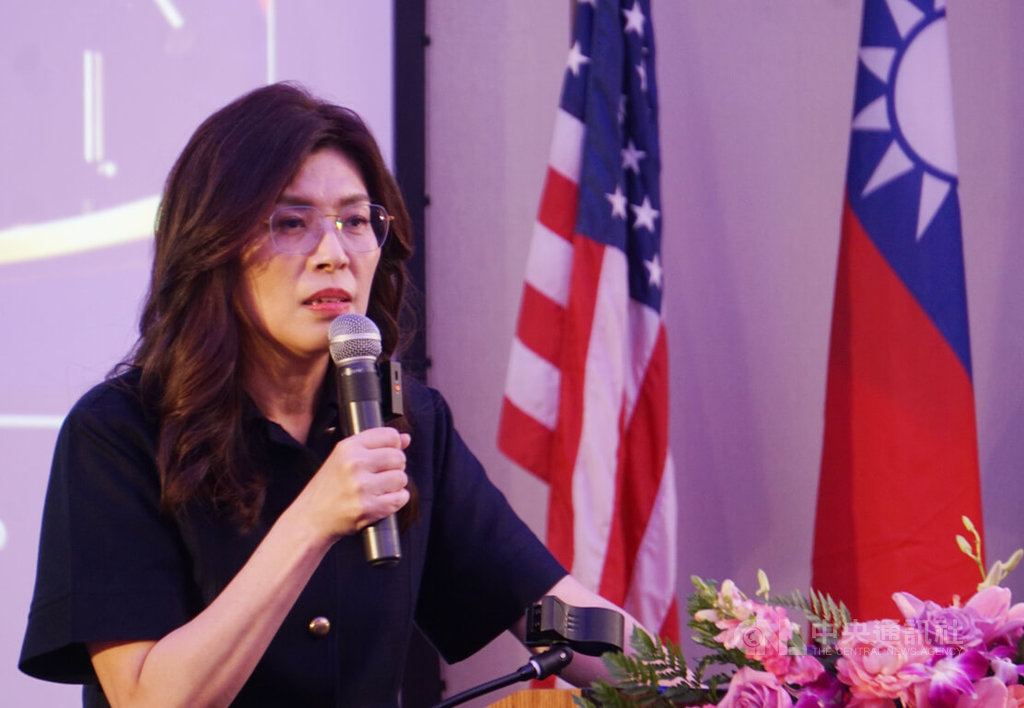
(CNA reporter Lin Hung-han, Los Angeles, June 14) Kuomintang (KMT) Chairperson Cheng Li-chun's 16-day U.S. visit is nearing its conclusion. Today, she held a press conference in Los Angeles to summarize her trip, discussing military issues and reaffirming her call for restarting cross-strait dialogue and pursuing peace and stability. While warmly welcomed by supporters inside the venue, protesters gathered outside, chanting 'Pro-China harms Taiwan; only pro-U.S. can love Taiwan.'
Cheng departed on June 1 for her 16-day U.S. tour, visiting major American cities including San Francisco, Boston, New York, and Washington, D.C. Today, she delivered a speech to the overseas Chinese community in Los Angeles, attended a diaspora banquet, and held a press conference.
Outside the event venue, protesters waved the U.S. flag, the Republic of China flag, and the 'Liberate Hong Kong' banner. One protester shouted, 'Taiwan must not follow Hong Kong’s path!' Another protester, speaking to reporters, said, 'Pro-China harms Taiwan; only pro-U.S. can love Taiwan.'
At the press conference, Cheng summarized her U.S. trip, recalling her April meeting with Chinese President Xi Jinping that restarted KMT-CCP exchanges. During this U.S. visit, she emphasized a peace-oriented approach, noting that former U.S. President Trump does not want Taiwan to pursue independence or draw U.S. forces into war over such claims.
She also highlighted the importance of U.S. leadership in regional stability, stating, 'Without strong U.S. leadership, a sustainable and stable cross-strait relationship will be difficult to achieve in the future.'
The U.S.-led Rim of the Pacific (RIMPAC) military exercise will launch in Hawaii on the 24th, with over 30 countries participating. Responding to a CNA reporter's question, Cheng shared her views on RIMPAC: 'Given the long-term complex regional situation, it is very normal for relevant military activities to continue.'
Cheng noted that not only the U.S. but also mainland China conducts military activities, and addressing this issue is essential for building peaceful and stable relations. However, she stressed that the KMT is currently in opposition and must exercise caution on military policy, only being able to represent the official stance once back in power.
Cheng expressed hope that a future KMT administration could establish a mutual trust mechanism to reduce military activities in the Taiwan Strait. She framed this trip as a 'Journey for Peace and Prosperity among the U.S., China, and Taiwan,' asserting that 'cooperation among the U.S., China, and Taiwan can bring benefits to humanity,' with Taiwan playing a role in facilitating communication and integration between the U.S. and China.
During her speech, Cheng argued that the First Island Chain represents Cold War thinking from the last century and should be transformed into a 'Chain of Peace and Prosperity.' She said that if the U.S. takes a leadership role in technological, talent, and market exchanges in East Asia, it could generate peace dividends.
Using technology as an example, she presented an anti-war argument, stating that technology should not be a tool of fear and war—'Drones should deliver milk tea, not missiles.' The skies should have birds, and the seas should have fish, not missiles and warships.
Cheng emphasized that restarting cross-strait dialogue and seeking peaceful, stable relations absolutely does not mean sacrificing Taiwan's democracy and freedom, nor does it mean compromising Taiwan's defense resilience.
She explained that while the KMT is not in power, it holds a majority in the legislature. Regarding defense policies involving classified information, the party can only passively review them after the government submits bills.
She criticized the DPP for conducting 'black-box operations' on major policies like defense budgets, accusing the ruling party of reducing opposition scrutiny to mere 'opposition to defense.' She rejected claims that the KMT intends to abandon defense simply because it advocates restarting cross-strait dialogue, calling such views a serious misunderstanding.
She stated, 'The KMT’s stance on supporting national defense will never change. But what we need is a truly effective defense capability that can protect Taiwan.' (Editor: Tang Sheng-yang) 1150615
FACT BOX
- Source: CNA (Central News Agency)
- Category: Taiwan