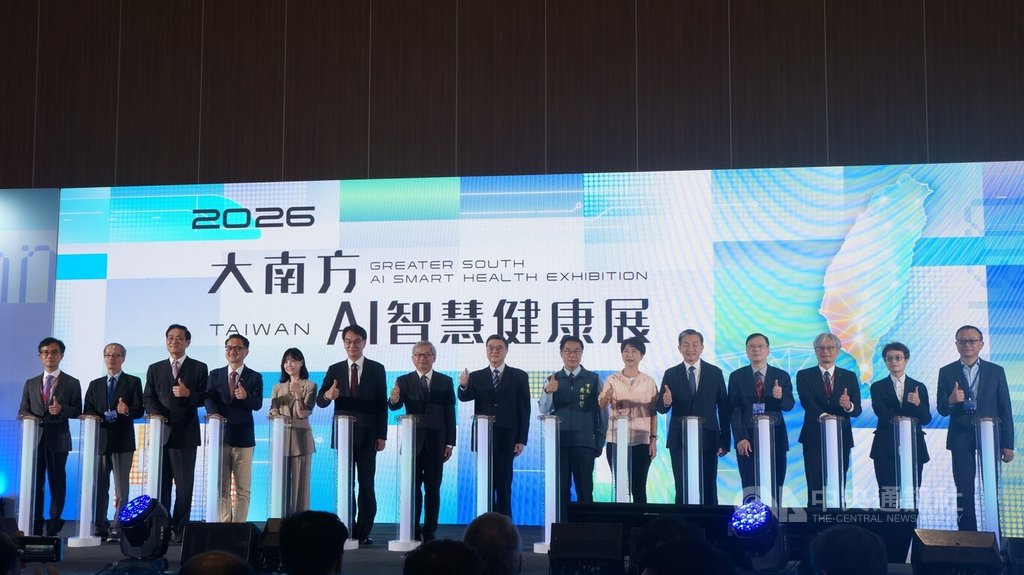
(Central News Agency, Reporter Chao Min-ya, Tainan, 12th) The Great South AI Smart Health Exhibition opened today. Minister without Portfolio and Minister of the National Science and Technology Council (NSTC) Wu Cheng-wen stated that the healthcare industry is massive, and he hopes to promote the development of Taiwan's domestic supply chain in related fields to serve the public. The government will create a domestic market through policy, and the tech industry can also assist in building a smart health ecosystem with innovative R&D, field verification, and international export capabilities, making Taiwan an important global partner.
The NSTC, in collaboration with the Ministry of Digital Affairs (MODA), the Ministry of Health and Welfare (MOHW), and the Tainan City Government, is hosting the Great South AI Smart Health Exhibition at the ICC Tainan today and tomorrow. The event brings together over 100 industry, government, academic, and research organizations to showcase more than 120 AI smart health applications.
In his opening remarks, Wu Cheng-wen stated that while the healthcare industry is huge, Taiwan still spends a significant amount of money importing foreign drugs, medical devices, and information systems. This is not only costly but also makes it difficult to adjust and improve according to local needs. Therefore, he hopes to promote the development of Taiwan's domestic supply chain in areas such as medical devices, pharmaceuticals, and AI system R&D and design, ultimately serving the public, which is a key goal of the healthcare industry.
Wu pointed out that the government will use policies to create domestic market demand, and Taiwan's tech industry should use its capabilities to assist the development of the healthcare sector. He urged businesses not to remain merely in an OEM role, hoping Taiwan can establish its own standards and system specifications. Once products are verified in Taiwan, the world can use them with confidence, making Taiwan an essential global partner.
MODA Minister Lin I-ching stated that Taiwan currently faces two major challenges: the pressure of labor shortages brought on by an aging population and declining birth rates, and the possibility that the rapid development of AI could change existing work patterns and displace some jobs. He further explained that if handled properly, these two challenges can complement each other, ensuring that 'jobs can find people, and people can find jobs.'
Lin noted that the application of AI in the healthcare industry can create many new opportunities, such as solving elderly care issues. Sharing his own entrepreneurial experience, he said that for startup companies, the most important thing is not government subsidies, but securing large, stable orders. He hopes this exhibition will help match businesses with opportunities and secure orders, and he also expects long-term care and day-care centers to support the domestic AI medical and healthcare industry.
The NSTC introduced that the exhibition features five major thematic areas: Smart Safe House, Tech New Village, Cloud Clinic, Industry Empowerment Port, and Health New Market. Through scenario-based displays, it highlights the innovative achievements of integrating AI into home care, health promotion, smart rehabilitation, and clinical applications.
Among them, the 'Smart Safe House' area showcases the results of the Smart Rainforest Industry Creation Project. The 'AipA Smart Care System' utilizes AI de-identification technology to simultaneously monitor falls and abnormal situations in real-time while protecting personal privacy. This technology has already been introduced to sites such as Chi Mei Medical Center and National Cheng Kung University, and it won a CES 2026 Innovation Award, with plans to expand into overseas markets in the future.
In terms of elderly care and smart medicine, the 'Cloud Clinic' area integrates smart carts, smart mattresses, and AIoT sensing equipment. It automatically collects physiological information and synchronizes it to a cloud platform in real-time, providing out-of-bed alerts and remote health monitoring functions. This assists care staff in reducing their burden, improving care efficiency, and enhancing preventive care capabilities.
In the 'Health New Market' area, SMART APP services developed based on the SMART on FHIR international standard are displayed. They connect cross-system health data and digital health services, presenting Taiwan's blueprint for digital transformation in smart healthcare. Through interactive displays, business matchmaking, and hands-on experiences, it creates a communication platform for the smart health industry, accelerating the spread of innovative applications and field deployment.
The NSTC stated that in the future, it will continue to integrate central and local resources, gathering the energy of industry, government, academia, and research. With Tainan's Shalun as the core, it will link the Southern Taiwan Science Park, medical institutions, the long-term care system, and local governments to accelerate the introduction of AI technology into medical institutions, healthcare, and urban governance applications. This will drive the widespread implementation of smart health services and complete the smart health industry ecosystem. (Editor: Huang Kuo-lun) 1150612
FACT BOX
- Source: CNA (Central News Agency)
- Category: 產業
- Products / services: SMART APP