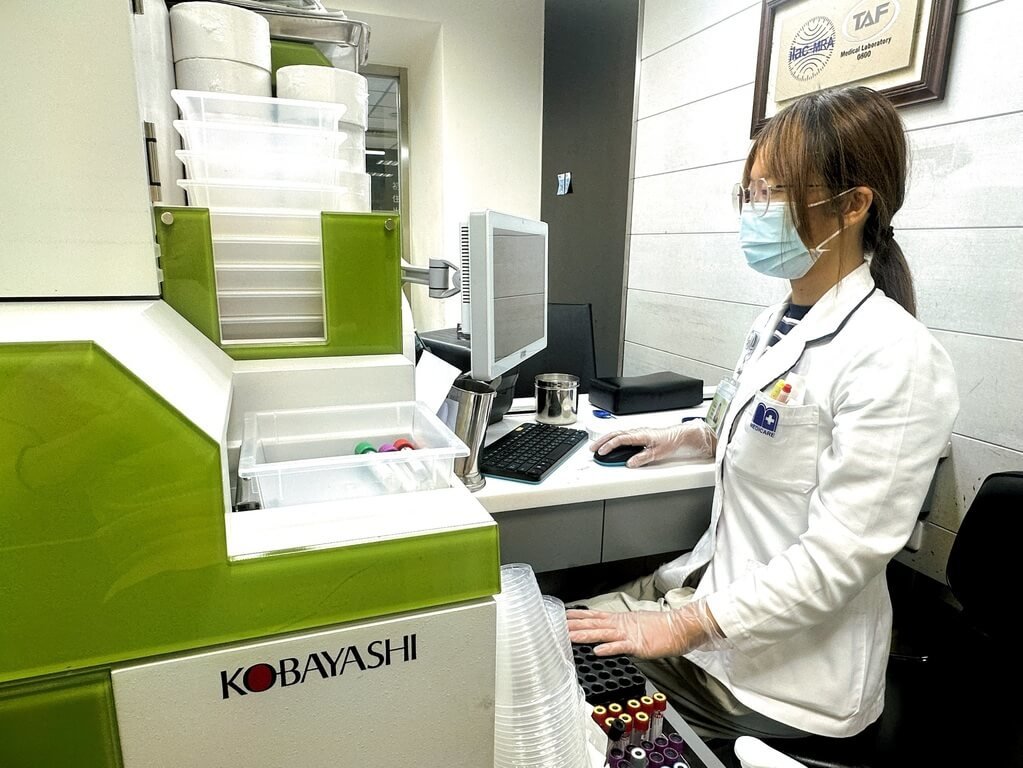
(CNA, by reporter Chao Li-yen, Taichung, 10th) Several hospitals in Taichung City have introduced an "Automated Tube Preparation System" to shorten the pre-analytical process for lab tests. However, a medical technologist discovered situations where couples swapped their turns or people gave their queue number to the elderly, leading to a mismatch between the patient and the test tube. Fortunately, the technologist caught the error in time, preventing a patient safety crisis.
In response to increasing medical demands and the trend of smart healthcare, several hospitals in Taichung have activated the "Automated Tube Preparation System." By linking intelligent laboratory equipment with the hospital information system, it automates the process of dispensing tubes, printing barcodes, and applying labels, which shortens the pre-analytical process time and reduces the risk of manual labeling errors.
Fengyuan Hospital of the Ministry of Health and Welfare issued a press release today. Chen Chia-wen, director of the laboratory department, pointed out that the hospital's outpatient automated system connects directly to the medical information system. Based on the patient's test requirements, it automatically selects the corresponding tubes and completes barcode printing and labeling. While inpatient wards previously relied on manual tube preparation, the new system can prepare a tube in an average of about 2.5 seconds, increasing overall efficiency by about 50%.
Tungs' Taichung MetroHarbor Hospital has also implemented the system. Lin Chin-fu, technical director of the clinical pathology department, told CNA that since patients may need anywhere from one or two to five or six tubes, labeling could sometimes take over two minutes. The automated system saves about 30% of this time, allowing technologists to prepare more calmly and have more time during identity verification to ease patient anxiety, providing a more compassionate medical service. The Taichung Veterans General Hospital has enabled an "automatic blood collection tube preparation system" that allows online appointments for blood draws, reducing waiting times during peak hours.
Lin Jung-chan, director of the laboratory department at Taichung Hospital of the Ministry of Health and Welfare, stated that while smart healthcare brings convenience, patient safety cannot be overlooked. He noted instances where a couple swapped their testing order and another where a kind person gave their queue number to an elderly person, causing a mismatch between the patient and the test tube. Fortunately, the medical technologist caught the error during identity verification, avoiding a patient safety crisis.
Lin Jung-chan said that if the system performs identity verification, it links an individual's test information to their registration number. After the number is called, the system automatically prepares the tubes and labels them according to the test information. If people randomly swap numbers, the tubes prepared by the system will be incorrect. Maintaining patient safety in hospitals requires not only system safeguards but also public cooperation.
FACT BOX
- Source: CNA (Central News Agency)
- Category: 事件