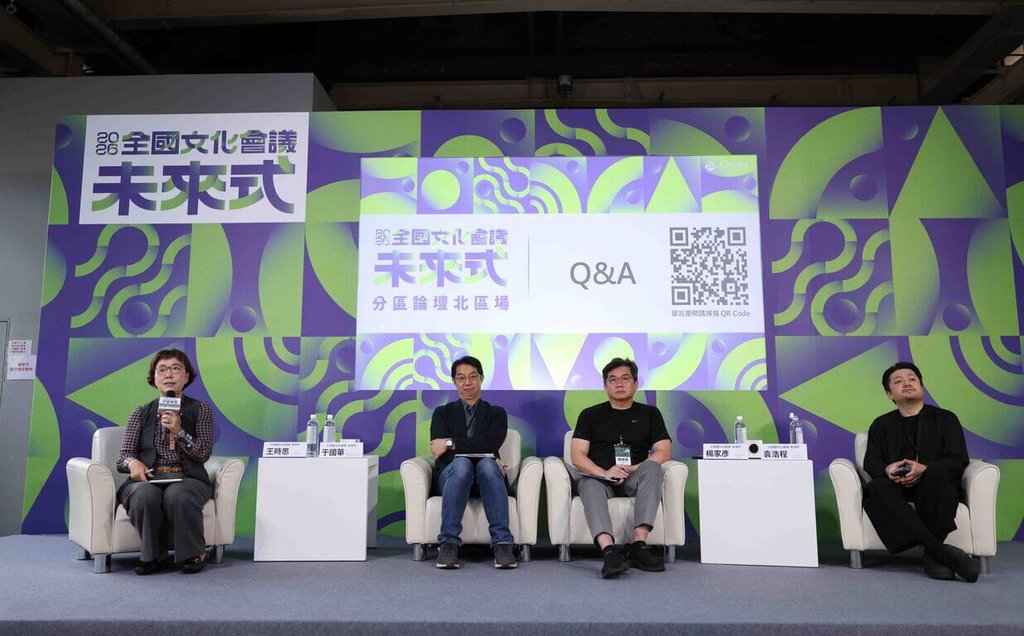
(CNA, by reporter Chiu Tsu-yin, Taipei, 9th) The second regional forum of the '2026 National Cultural Conference' commenced today at the Huashan 1914 Creative Park in Taipei. Political Deputy Minister of Culture, Wang Shih-ssu, stated that this year's conference, themed 'Future Tense,' hopes to build consensus to make Taiwanese culture more powerful.
In her address, Wang Shih-ssu mentioned that as technology intervenes in the forms, content, and production methods of culture, the public may find it easier to access cultural content in daily life, but fundamental cultural values may also face challenges. The 'National Cultural Conference' aims to ensure that Taiwan's cultural content and assets are continuously preserved, disseminated, remembered, and passed on during the transition period as the wave of AI ushers in a new paradigm.
The forum began with a keynote speech by Lin Yu-fan, Vice President of the Institute for Information Industry and Director of the Digital Transformation Research Institute, on 'The Opportunities and Governance Future of the Cultural Ecosystem in the AI Era.' This was followed by the first topic, 'Local Cultural Power: Resilience × Sustainability × Co-prosperity,' where introducer Yu Kuo-hua, Dean of Research and Development at Taipei National University of the Arts, emphasized that 'people need to return to the countryside,' to re-engage with the natural environment, reflect on human existence, and understand the symbiotic relationship between cities and villages.
For the second topic, 'Contemporary Cultural Heritage Preservation: The Guardianship and Inheritance of Memory,' introducer Tang Mei-yun stated that 'the biggest crisis in cultural heritage preservation today is not damage but disappearance.' While technology might help preserve culture, the more critical issue is how culture is translated to create new connections with the contemporary era.
Panelist Lin Mao-hsien, chairman of the Taiwan Opera Promotion Foundation, mentioned, 'Traditional opera must be given new contemporary significance to survive in modern society.' Theater and video artist Wang Yi-sheng shared several cases of cultural technology, noting that regardless of technological advancements, 'narrative and emotion are the final outlets.'
In the third topic, 'Culture in Progress: Children and Youth Cultural Participation,' introducer Yang Hui-chun, director of 'The Reporter for Kids,' shared the 'My 14-year-old' experience of Yang Shuang-zi, author of 'Taiwan Wandering Record.' Despite being in a broken and impoverished environment, Yang Shuang-zi transcended the limitations of reality by creating stories through reading.
In the final session on 'Cultural Penetration: Professional International Participation × Strategic Global Layout,' introducer Tsai Po-cheng, artistic director of B.DANCE, stated that due to the impact of the pandemic and wars, cultural policies worldwide are gradually turning inward. Taiwan must more strategically integrate venues, arts festivals, and performing groups as a trinity to establish a long-term, globally recognized cultural IP. (Editor: Lung Po-an) 1150609
FACT BOX
- Source: CNA (Central News Agency)
- Category: 事件